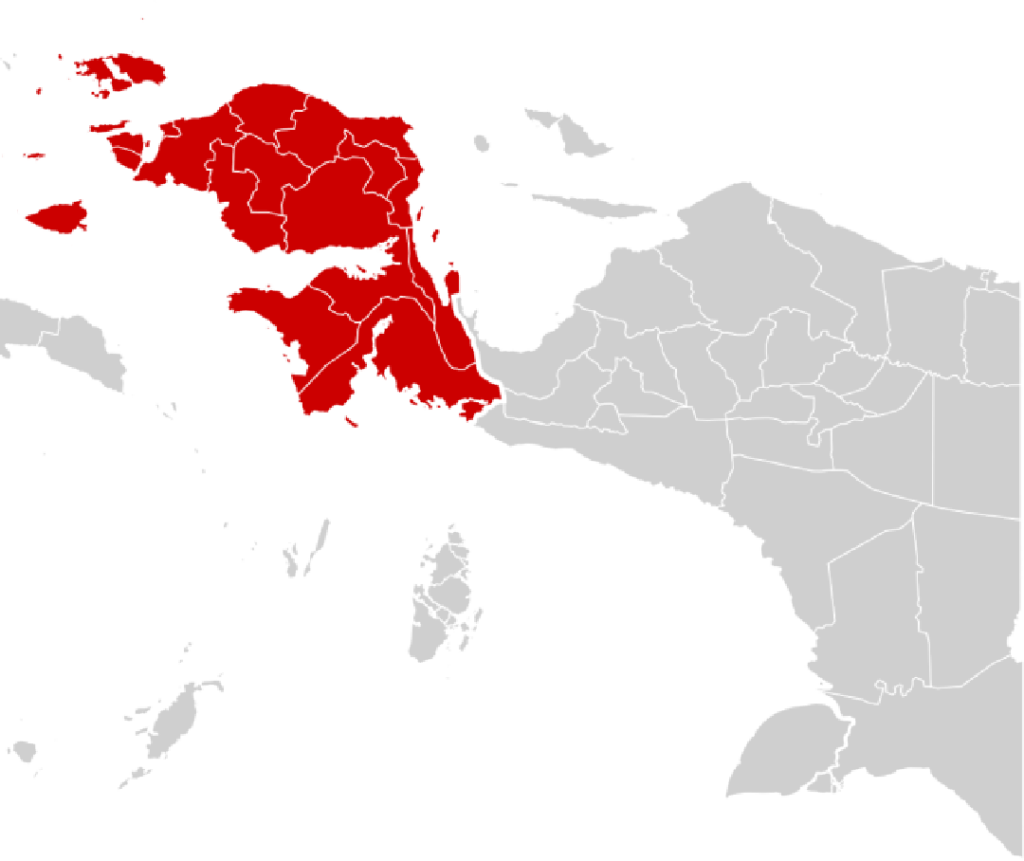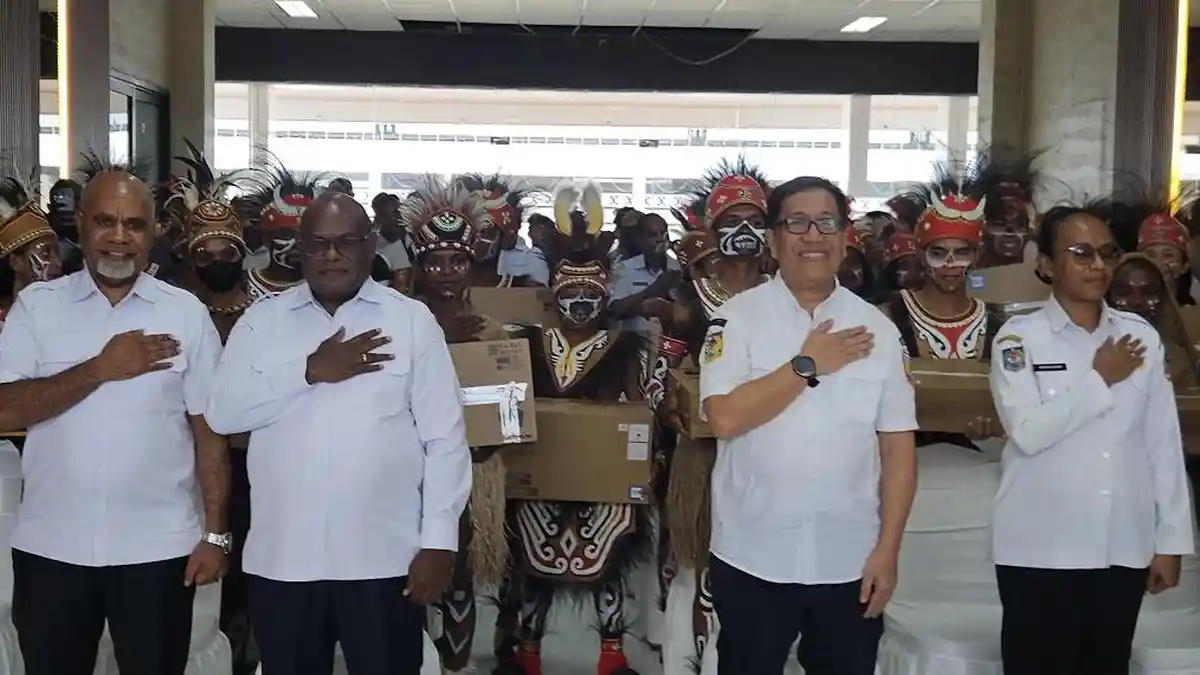
In mid 2026, a series of modest yet meaningful ceremonies took place across several regencies in Papua Tengah Province. From Nabire on the coast to the mountainous districts of Puncak, Puncak Jaya, Intan Jaya, Paniai, Dogiai, Deiyai, and Mimika, dozens of students returned home carrying laptops provided directly by the provincial government.
Governor Meki Nawipa spearheaded the initiative, consistently emphasizing that enhancing human resources forms the cornerstone of Papua’s long-term development. While infrastructure and economic growth often dominate development discussions, this program placed students at the center of policy attention, highlighting education and digital access as strategic priorities.
For many students in Papua Tengah, receiving a laptop was not simply about owning a device. It marked their first personal encounter with digital learning tools and opened doors to knowledge that previously felt distant.
Education Gaps in Remote Papua
Papua Tengah faces structural challenges that differ sharply from Indonesia’s western regions. Educational inequality has been a persistent issue, fueled by vast distances, poor road infrastructure, expensive transportation, and inconsistent electricity supply. In isolated regions like Puncak and Intan Jaya, schools frequently struggle with inadequate learning materials.
Shared textbooks, spotty internet access, and a lack of digital equipment are still commonplace. As Indonesia’s digital economy gains momentum, these existing inequalities threaten to further isolate Papua’s youth from their counterparts in other areas.
The provincial government sees education as the key to overcoming these hurdles in the long run. Officials are working to ensure that geography doesn’t hinder young Papuans from participating in the digital age, even going so far as to provide laptops directly to students.
Governor Meki Nawipa’s Focus on Human Development
Governor Meki Nawipa has consistently emphasized that Papua’s future hinges on the capabilities of its people, not just its natural wealth.
He made it clear during laptop distribution events that supporting education requires more than just good intentions; it demands tangible resources.
Local reports indicate that the governor personally supervised the laptop handouts across multiple regencies, underscoring the program’s significance. His involvement signaled that the provincial leadership views investing in education as a key concern.
Nawipa stressed that the laptops were intended to cultivate learning discipline and responsibility. Students were cautioned to use the technology judiciously, to build their knowledge and skills, and not to become sidetracked from their studies.
Reaching Students in Across Province
The laptop distribution initiative spanned a considerable area, demonstrating the government’s commitment to reaching students no matter where they lived.
In Puncak Regency, the government provided 25 of laptops to students who often face lengthy commutes to school.
Teachers warmly welcomed the initiative, viewing digital tools as a means to extend learning beyond the confines of the classroom.
Local officials in Puncak Jaya emphasized the distribution of laptops in conjunction with broader educational support programs, such as scholarships for higher education, especially in health-related fields.
In Intan Jaya, 15 students received laptops during cultural and educational events, symbolizing a balance between tradition and modern learning.
In Paniai, Dogiai, and Deiyai, a total of 75 laptops were distributed to students, many of whom had never previously used a computer. Teachers in these districts noted increased student enthusiasm and curiosity following the distribution.
In Mimika, 25 students returned home with laptops and messages of encouragement from provincial leaders, emphasizing responsibility and perseverance.
Meanwhile, Nabire, as the provincial capital, 25 students received laptops from governor. Nabire played a coordinating role in ensuring that distribution across districts remained consistent and transparent.
Digital Literacy as a Path to Equality
The government’s laptop initiative goes beyond simply handing out computers. It’s a concerted effort to cultivate digital literacy, a skill set that’s becoming vital for both academic achievement and finding a job.
Having laptops opens up a world of possibilities for students. They can delve into digital textbooks, watch educational videos, use writing tools, and learn how to conduct basic research. These are all essential skills for anyone hoping to go to college or thrive in today’s job market.
Teachers have noticed a change, too. Students seem more engaged once they have laptops, posing new questions and showing a heightened interest in subjects like science, language, and technology.
Local education officials are convinced that even a little bit of digital exposure can have a big impact on a student’s self-assurance and future goals.
Supporting Teachers and Schools
The laptop program isn’t just for the students; it also provides support to teachers and schools.
Educators have the opportunity to integrate digital resources into their lesson plans, thereby moving towards blended learning paradigms that merge conventional instruction with digital materials.
In regions characterized by restricted internet access, laptops can still serve as valuable offline learning instruments, enabling the storage of educational resources for repeated student access.
School administrators have underscored the critical role of continuous training and support in ensuring the program’s efficacy. Consequently, numerous districts have initiated informal training programs designed to equip both students and educators with fundamental computer proficiency.
Infrastructure and Connectivity Obstacles
Notwithstanding its beneficial effects, the laptop initiative is not without its constraints. Specifically, the availability of electricity and internet connectivity is often unreliable across numerous districts. The complete realization of digital learning’s potential remains unattainable without dependable infrastructural support.
Provincial authorities recognized the hurdles and stressed that the distribution of laptops needed to be coupled with wider investments in energy, telecommunications, and educational facilities.
The government sees this program as a starting point, not the end of the road. Input from students and teachers will inform future policy tweaks.
Parents’ and Community Reactions
Parents in the eight regencies were generally pleased with the program. For many families, economic limitations made it difficult to purchase laptops, making the government’s assistance particularly valuable.
Community leaders lauded the initiative for its focus on education, rather than just physical infrastructure. They observed that equipping children with knowledge generates enduring advantages that reach far beyond individual families.
Youth organizations voiced their approval of the program, seeing it as a clear indication that Papua Tengah’s government has faith in its young people to help mold the province’s destiny.
Preparing Papua’s Youth for the Digital Economy
Indonesia’s economy is increasingly fueled by technology, digital services, and knowledge-based industries. For Papua Tengah, equipping its youth for this new landscape is vital to lessening long-term disparities.
The provincial government aims to give students in remote areas a fighting chance at careers in education, healthcare, administration, and entrepreneurship by introducing digital tools early on.
Officials are convinced that digital access will help students cultivate problem-solving abilities, creativity, and adaptability, all essential qualities for future employment.
Education as a Foundation for Peace and Progress
Education is often seen as a bedrock, a force that helps hold society together, beyond just the financial aspects. Young people who have a good education tend to be more active, engaged citizens, and they contribute to their communities in a positive way.
Governor Nawipa has made it clear that putting money into education is really an investment in a peaceful, dignified, and self-sufficient future. The government’s goal is to help build a generation that can guide Papua toward development that includes everyone and lasts.
A Blueprint for What’s Next
Though the current program is small, giving out dozens of laptops instead of thousands, it’s a template for what could come.
Provincial leaders have said that if the money is there, similar programs could be expanded, potentially reaching more students and making digital learning a bigger part of the education system.
The initial phase’s success hinges on diligent oversight, ongoing assistance, and active community participation.
Conclusion
The Papua Tengah Provincial Government’s distribution of free laptops to students in Nabire, Mimika, Puncak, Puncak Jaya, Intan Jaya, Paniai, Dogiai, and Deiyai signals a clear policy commitment.
Governor Meki Nawipa has made education and digital access central to the region’s development. Though hurdles persist, this initiative powerfully demonstrates that Papua’s young people deserve equal chances to learn, thrive, and succeed in a digital landscape.
For the students who trekked home with laptops, these devices symbolize more than just technology. They embody trust, hope, and the conviction that Papua’s future begins with educated individuals.