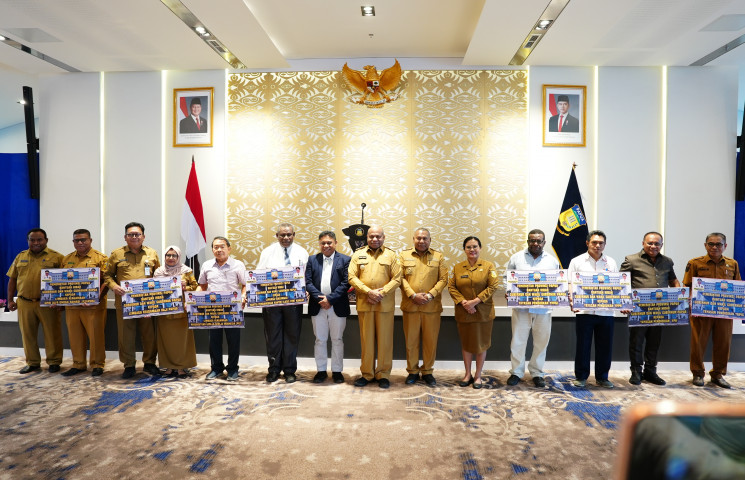
The provincial hall in Jayapura felt more like a community gathering than a government ceremony on a warm afternoon on February 25, 2026. Pastors from the mountains and imams from the coast sat next to each other. Nuns in plain white habits talked to school principals who had traveled by boat and motorcycle for days. Some people had traditional woven noken bags slung over their shoulders. Some people had folders with proposals and handwritten notes in them. They all came for the same thing.
On that day, Governor Mathius Fakhiri officially gave out Rp575 billion in provincial grants to religious groups and pioneer schools all over Papua. It was one of the biggest recent social assistance payments made by the Papua Provincial Government. But for the people in the room, the number itself wasn’t the most important thing. What mattered was what the money meant: recognition, partnership, and a promise that communities working quietly at the grassroots level wouldn’t be forgotten.
Governor Fakhiri didn’t give a speech full of technical terms when he stepped up. Instead, he talked about trust and responsibility. He said that in many parts of Papua, religious institutions and pioneer schools are the most important parts of daily life. People go to these places not only to pray or study but also to get advice, settle disagreements, mourn losses, and celebrate important events.
He said, “This help isn’t just a line item in the budget.” “It’s our way of saying thank you for helping to shape character, strengthen faith, and teach our kids.”
People clapped for his words, but they also looked relieved. For a lot of the leaders who were there, keeping their organizations going has been a constant battle.
Where Faith and Education Meet Real Life Every Day
Papua is a beautiful and complicated place. Communities are often separated by mountains, forests, and rivers that make it hard and expensive to get around. This is true from the busy streets of Jayapura to the quiet valleys of the highlands. In a lot of places, churches, mosques, and small schools are the most stable parts of people’s lives.
Papua’s religious groups do more than just hold services. They often run unlicensed schools, help people get food during hard times, and act as peacemakers when there is social tension. People in villages where government offices are far away often turn to faith leaders for advice first.
Pioneer schools are just as important. People in the area call these schools “sekolah perintis.” They were built in places where there isn’t much or any formal education infrastructure. A lot of them work out of simple wooden buildings with tin roofs. Some started with only a few volunteer teachers and students sitting on woven mats instead of desks.
Even though they don’t have a lot of money, these schools have helped students get into college and find jobs. In places where opportunity can seem far away, they have become symbols of hope.
The Rp575 billion grant is meant to make both of these pillars stronger.
Nine Religious Institutions and Dozens of Schools
Official reports from provincial sources and national media say that the grant was given to nine major religious groups in Papua, covering a wide range of faiths. The money will be used to help with building repairs, community programs, running costs, and outreach programs.
Support for pioneer schools includes things like better infrastructure, bigger classrooms, teaching materials, and sometimes even bonuses for teachers. The provincial government made it clear that the process of allocating funds followed administrative rules and was based on proposals and evaluations sent in by the institutions themselves.
There is a more human story behind the formal procedures.
A church leader in a highland area said that their building had been leaking for years. When it rained heavily, people who were worshiping would move benches to keep the water from dripping on them. They will be able to fix the roof and make the place safer for gatherings thanks to the grant.
A pioneer school principal in a coastal village said that her students often share textbooks because there aren’t enough for everyone. She wants to buy books, make the classroom brighter, and get basic computer equipment with the new money.
She said softly, “These kids want to learn.” “They just need the tools.”
Building Social Cohesion in a Diverse Province
There are hundreds of ethnic groups and many different religions in Papua. It takes a lot of work to keep peace and cooperation among such a wide range of people. The provincial government shows that social cohesion is important by giving money to religious groups of all kinds.
Governor Fakhiri has said many times how important it is for the government and community-based organizations to work together. He said that development isn’t just about building roads and bridges and other physical structures. It is also about making society stronger.
Religious groups often run youth programs, counseling services, and charity programs that work with government programs. Pioneer schools get the next generation ready to be active members of society. The provincial government is strengthening networks that already exist at the grassroots level by putting money into these institutions.
A Personal Commitment
People who have watched Governor Mathius Fakhiri lead know that he often talks about policy choices in personal terms. He talks about how he met people in remote villages and listened to their worries. He remembered going to places where children had to walk a long way to get to makeshift classrooms during the ceremony.
He talked about parents who told him that their biggest wish was for their kids to get a good education without having to leave their home country. He talked about religious leaders who keep working even when they don’t get much help.
He said, “These institutions have been there for the people when times were tough.” “It’s our turn to stand with them now.”
A lot of people in the audience could relate to the phrase.
Accountability and Long-Term Impact
The provincial government stressed accountability as well as the strong emotional tone of the ceremony. Grants should be used by institutions in a clear way and in line with approved proposals. There are ways to keep an eye on things to make sure that the help leads to real improvements.
Social development experts say that grants of this size can have effects that are bigger than the grant itself. Better facilities bring in more people. Schools with better resources improve the quality of education. When community institutions are stronger, people are less likely to get into social conflict.
In Papua, where geography can make progress slow, strengthening existing community structures can be a smart move.
Hope in Small Details
After the ceremony, pictures of religious leaders holding symbolic checks and schoolchildren posing with new equipment spread across the internet. These pictures may look ceremonial, but for the people in them, they are the start of real change.
A teacher in a remote area said that she plans to use some of the money to make a small library area in her classroom. She said, “Even ten new books can change how kids see the world.”
A member of the mosque committee said that the grant would let them hold literacy programs for the community in the evenings. He said, “We want our mosque to be a place to learn as well as pray.”
These little things show how policy choices affect everyday life.
Looking Forward
Papua’s problems with development are complicated and have been around for a long time. There is no one grant that can fix everything. But projects like this show a strategic way of thinking that values working together and leading in the community.
The provincial government knows that development isn’t just about how many kilometers of asphalt or megawatts of electricity there are. By giving Rp575 billion to faith-based and educational institutions, they are showing this. It is measured by stronger trust, better places to learn, and stronger ties between people in the community.
This project helps international observers understand Papua by showing how local government can work with cultural realities. Here, faith and education are not just ideas. They are a part of everyday life and the group’s identity.
After the ceremony in Jayapura was over, the recipients made small groups outside the hall. Some people talked about making plans to travel back to faraway districts. Some people gave each other their contact information and started thinking about working together. There was laughter, but there was also a sense of duty.
Soon, the grants would be used to buy building materials, books, desks, and programs for the community. But they also sent an unspoken message: Papua’s future depends on communities that support faith and learning.
And for a lot of the people who went to that meeting in February, it wasn’t just about money. It was about being seen, heard, and helped in their ongoing work to teach and guide the next generation.