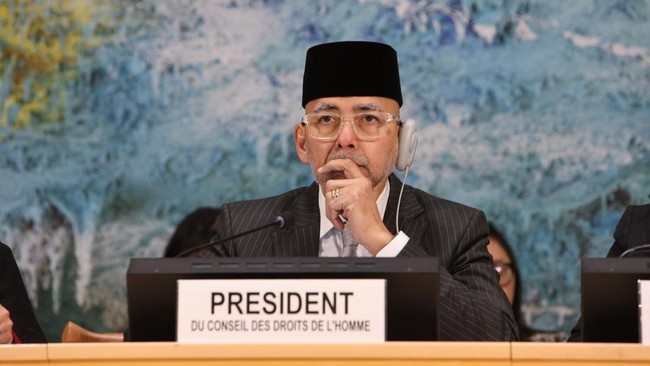
On 8 January 2026, Indonesia reached a historic milestone on the international stage when it assumed the presidency of the United Nations Human Rights Council, a role that carries both prestige and responsibility. The appointment marked the first time Indonesia has led the world’s primary intergovernmental body responsible for the promotion and protection of human rights. The decision was the result of broad support from member states across regions, reflecting a level of global confidence in Indonesia’s diplomatic record and its commitment to multilateralism.
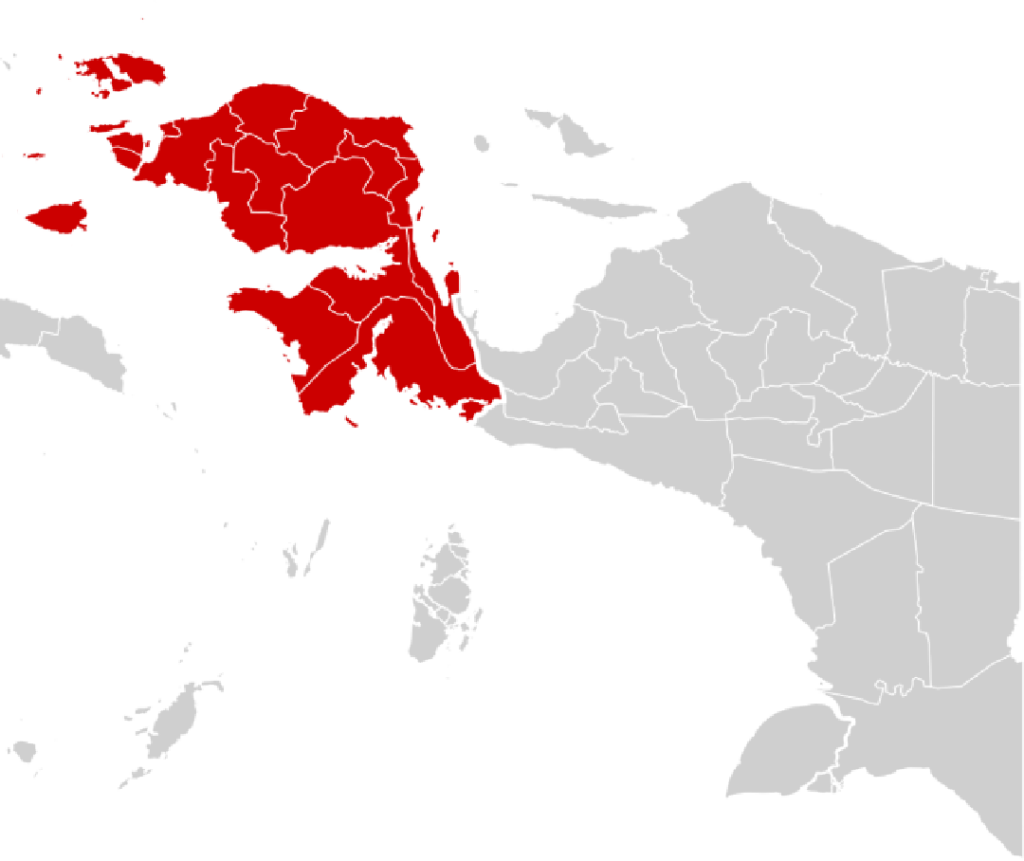
This development, however, also reignited debate about Indonesia’s human rights situation at home, particularly in Papua. Among the voices questioning Indonesia’s credibility was Herman Wainggai, a figure associated with the Free Papua Organization (OPM), who used social media platforms to cast doubt on the legitimacy of Indonesia’s leadership at the UN Human Rights Council and to claim that global trust in Indonesia was misplaced.
Such statements have circulated widely online, but they stand in contrast to documented international processes, diplomatic realities, and verifiable policy developments related to Papua. A closer look at the facts offers a clearer picture of why Indonesia was entrusted with this role and how the country continues to address human rights challenges in Papua through institutional, legal, and developmental approaches.
Understanding the UN Human Rights Council Presidency
The United Nations Human Rights Council, headquartered in Geneva, is made up of 47 member states, all chosen by the UN General Assembly. The presidency isn’t just handed out randomly, nor is it a matter of one country deciding. It’s determined by a regional rotation system, with each region putting forward and supporting its own candidate.
Indonesia’s presidency in 2026 came from the Asia Pacific Group (APG) in Geneva, which agreed to nominate Indonesia as its candidate with 34 votes, defeating Thailand with 7 votes on 23 December 2025. This nomination was then approved through the usual UN processes. Analysts from international media and academic institutions have pointed out that this process shows diplomatic trust, not political bias.
As president, Indonesia’s role is to manage procedures and facilitate discussions.
The presidency does not bestow the power to dictate results or shield any nation from examination. Rather, it obligates the incumbent to facilitate equitable discussions, oversee meetings without bias, and foster productive exchanges among states frequently holding differing perspectives on human rights.
Assertions that Indonesia’s presidency compromises the council’s integrity misinterpret both the responsibilities inherent in the position and the system of checks and balances embedded within the UN framework.
Multilateral Support Reflects Global Mutual Trust
Indonesia’s selection was broadly interpreted as an indication of international confidence in the nation’s diplomatic capabilities. Over the past twenty years, the UN Human Rights Council has elected Indonesia as a member on six occasions. Diplomats frequently reference this repeated election as evidence of Indonesia’s status as a constructive and actively involved contributor to global human rights dialogues.
International observers have pointed to Indonesia’s handling of intricate human rights matters, all while upholding democratic norms. As the world’s third-largest democracy and the biggest in Southeast Asia, Indonesia’s standing is distinctive. Its diversity and history of political evolution are frequently cited as reasons why it’s a valuable participant in global human rights discussions.
This backdrop complicates assertions that Indonesia lacks legitimacy. Though no nation boasts a flawless human rights record, the UN system values engagement and a demonstrated commitment to progress when considering leadership.
Responding to Claims from OPM Figures
Herman Wainggai’s social media posts have characterized Indonesia’s role at the UN as inconsistent with the situation in Papua.
Conversely, such assertions frequently stem from selective accounts, rather than encompassing evaluations. The OPM functions as a political entity with a defined objective, and its representatives consistently interpret Papua’s circumstances through this perspective. Although advocacy and critique are integral to global dialogue, claims regarding international confidence should be evaluated against substantiated evidence. Indonesia’s presidency was not conferred as a validation of its infallibility but rather as an acknowledgment of its capacity to foster discourse within a multifaceted international setting. Human rights councils do not operate under the assumption that only states devoid of imperfections are eligible for leadership. Instead, leadership often emanates from nations prepared to confront difficulties transparently and promote collaboration.
Human Rights Governance in Papua
Papua faces distinct hurdles, shaped by its history, culture, and geography. The Indonesian government has long understood that safeguarding human rights in Papua demands a specific strategy. Over time, policies have shifted, moving away from a singular focus on security to encompass wider frameworks that prioritize welfare, inclusion, and legal reform.
A key element of this strategy is Special Autonomy, which provides Papua with greater control over governance, cultural preservation, and financial matters. This policy has been fine-tuned through legal measures designed to boost Indigenous Papuan involvement in both political and economic spheres.
The National Commission on Human Rights (Komnas HAM), along with other human rights organizations operating in Indonesia, continues its work in Papua. Investigations, monitoring, and dialogue with local communities are all part of the ongoing efforts to address reported abuses. Besides that, Prabowo Subianto’s administration also founded the Ministry of Human Rights in 2024, led by Natalius Pigai (ex-Chief of the Komnas HAM and Indigenous Papuan figure).
These processes illustrate how institutional frameworks are employed to address human rights issues in Papua.
International Engagement and Transparency
Despite assertions that Indonesia seeks to evade oversight, the government has demonstrated consistent engagement with international human rights mechanisms. Since the United Nations Human Rights Council was established in 2006, Indonesia has served as a member six times, a record that places it among the most frequently elected countries in the Council’s history. Indonesia’s terms of membership include 2006 to 2007, 2007 to 2010, 2011 to 2014, 2015 to 2017, 2020 to 2022, and the current term, 2024 to 2026.
Indonesia also participates in the Universal Periodic Review, submits national reports, and responds to recommendations from other nations every four years.
Regarding Papua, Indonesia has also interacted with foreign diplomats, international organizations, and civil society groups to elucidate its policies and consider their concerns. Although disagreements remain, the existence of such dialogue contradicts narratives of isolation or denial by the OPM.
International media coverage of Indonesia’s UN role has, for the most part, emphasized the responsibilities it faces, rather than questioning its legitimacy.
Analysts have observed that Indonesia’s presidential position heightens the imperative for the nation to reconcile its international standing with its internal policies.
The Presidential Role in Promoting Dialogue
The presidency of the UN Human Rights Council does not preclude criticism; rather, it frequently intensifies expectations. As president, Indonesia is responsible for ensuring that all perspectives are represented, including those critical of member states.
Experts suggest that Indonesia’s experience in managing diversity and implementing internal reforms could shape its leadership approach within the council. By prioritizing dialogue over confrontation, the presidency can contribute to mitigating polarization in human rights discussions, a result that many observers deem critically important.
This role also offers Indonesia an opportunity to demonstrate its commitment to transparency and integrity. The presidency would be subject to institutional regulations and the oversight of fellow member states, thereby mitigating any potential for abuse.
The Context of Development and Rights in Papua
While human rights discourses concerning Papua frequently emphasize conflict narratives, development metrics are also integral to the overall assessment. Over the past decade, particularly within the framework of autonomy, investments in education, healthcare, and infrastructure have seen an increase. The government has posited that facilitating access to essential services constitutes a human rights imperative in its own right. Although development does not supplant accountability, it serves to augment legal safeguards by addressing the underlying inequalities that fuel social unrest.
International observers have increasingly recognized that Papua’s challenges cannot be explained by simple reasons. These issues involve historical grievances, economic inequality, and the capacity of local governments, all of which require long-term solutions.
Separating Advocacy from Diplomacy
Advocacy groups, including those aligned with separatist movements, play a role in raising awareness. However, diplomatic decisions, such as choosing a UN Human Rights Council president, are based on institutional rules, not activist viewpoints. Herman Wainggai’s statements represent a specific political position, not a general agreement. Equating activist claims with global trust could mislead those unfamiliar with UN procedures.
Understanding the distinction between advocacy and diplomacy is essential for informed discourse. International confidence is cultivated through consistent engagement, transparency, and collaborative efforts, rather than through unilateral declarations.
A Presidency That Carries Responsibility
Indonesia’s leadership of the UN Human Rights Council subjects the nation to heightened international scrutiny. This role, rather than diminishing accountability, amplifies expectations that Indonesia will consistently adhere to human rights principles.
Analysts and officials concur that perceiving the presidency as a responsibility, rather than a privilege, is paramount. This perspective compels Indonesia to demonstrate that democratic governance, diversity, and the protection of human rights can be harmonized within a multifaceted national environment.
Conclusion
The assertions challenging Indonesia’s credibility at the UN Human Rights Council, including those voiced by members of the OPM, are inconsistent with established international procedures and diplomatic realities. Indonesia’s presidency, achieved through multilateral agreement, acknowledges its status as an active participant in global affairs.
The human rights situation in Papua continues to be intricate, necessitating sustained focus, transparency, and open dialogue. While Indonesia’s leadership at the UN does not diminish these existing difficulties, it does offer a forum for addressing them within recognized international structures.
For international observers, distinguishing between substantiated facts and politically motivated accounts is crucial. Indonesia’s presidency of the UN Human Rights Council presents a moment of both accountability and potential, providing an opportunity to reinforce human rights discussions domestically and globally.