
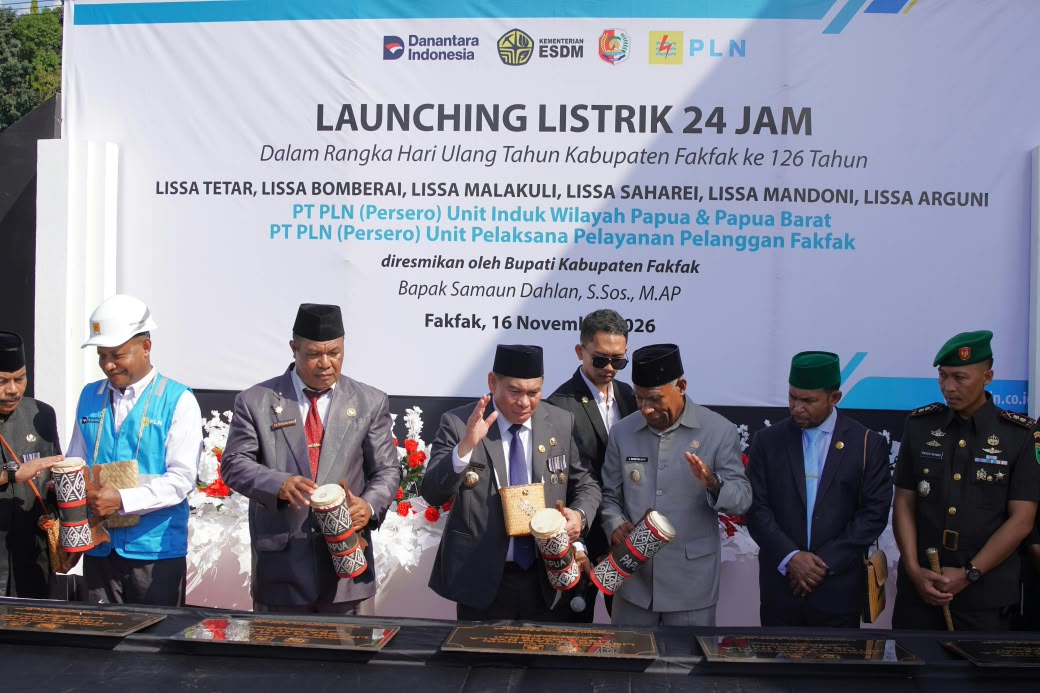
For 1,391 electricity customers across 18 villages in Fakfak Regency, Papua Barat (West Papua), the end of scheduled power availability represents a major shift in everyday life. Communities that previously received electricity for only 12 hours a day can now access power around the clock, following an expansion program implemented by state-owned electricity company PT PLN (Persero).
The service improvement was formally launched on November 16, 2026, at the Ma’ruf Amin Green Open Space in Fakfak. Local government representatives and PLN officials marked the occasion by striking traditional tifa drums, a symbolic ceremony signalling the start of 24-hour electricity service across the 18 villages.
The expansion covers six village electricity systems, known locally as Listrik Desa or Lisdes. It involved strengthening existing diesel power plants, improving generation capacity, upgrading equipment, and introducing Battery Energy Storage System (BESS) technology to support electricity supply reliability.
The achievement is particularly significant for communities where geographical conditions have made infrastructure development difficult. PLN personnel had to travel along steep and challenging roads, while some power generation equipment was transported by sea.
For residents, the additional hours of electricity mean more flexibility in household activities, children’s study schedules, community administration, and small business operations. The improvement also creates better conditions for health facilities and other essential services that depend on reliable power.
The program reflects Indonesia’s continuing efforts to expand electricity access beyond major towns and strengthen infrastructure in remote parts of Papua.
A New Chapter for 18 Villages in Fakfak
Before the latest expansion, residents in the six service areas generally received electricity for approximately 12 hours a day, with supply concentrated mainly during the evening and night.
Although this arrangement provided basic lighting and supported some household needs, the limited operating hours created practical restrictions. Activities requiring electricity had to be planned around the availability of power.
Children studying after school, for example, could face difficulties when they needed to use electronic devices or other electrical equipment outside scheduled supply hours. Small businesses also had limited flexibility to operate equipment during the day, while public facilities needed to adjust certain activities to available electricity.
The extension to 24-hour service alters the daily pattern for electricity usage. Residents can now use electricity throughout the day, allowing households and community institutions to organize their activities with greater flexibility.
The launch ceremony on November 16 brought together representatives of the Fakfak Regency Government and PLN to mark the operational improvement. The symbolic striking of the tifa drums gave the event a distinctly local character, connecting a modern infrastructure milestone with a traditional cultural expression of the community.
According to reporting by Papua Inside, the launch took place at the Ma’ruf Amin Green Open Space in Fakfak and marked the availability of round-the-clock electricity for 1,391 customers across the 18 villages.
The expansion is not simply a matter of extending operating schedules. It required technical adjustments to generation systems and supporting infrastructure to ensure that electricity could be supplied for longer periods.
Six Village Electricity Systems Support the Expansion
PLN implemented the improvement through six village electricity systems: Arguni, Tetar, Saharei, Mandoni, Malakuli, and Bomberay.
Each system serves a different group of villages, reflecting the dispersed settlement patterns and geographical conditions of Fakfak Regency.
The six systems cover the following communities: Arguni System (Kampung Arguni); Tetar System (Kampung Tetar); Saharei System (Kampung Saharei and Kampung Weri); Mandoni System (Kampung Mandoni and Kampung Kiminakra); Malakuli System (Kampung Malakuli); and Bomberay System (Kampung Bumi Muroh Indah, Mekar Sari, Wono Rejo, Onim Jaya, Onim Sari, Pinang Agung, Mbima Jaya, Warisa Mulya, Wasa Mulya, Wonodadi, and Wanmar).
The Bomberay system serves the largest number of villages among the six networks, covering 11 communities. Together, the systems extend the benefits of 24-hour electricity to residents across different parts of the regency.
The arrangements also demonstrate that there is no single technical solution suitable for every location. Some communities depend on isolated local generation systems, while others can be connected to a wider electricity network.
PLN therefore adapted its operational approach according to the characteristics of each system.
Strengthening Power Plants and Introducing Battery Storage
One of the main technical components of the expansion was the improvement of existing diesel power plants, known as Pembangkit Listrik Tenaga Diesel (PLTD).
The systems serving Arguni, Saharei, Mandoni, Malakuli, and Bomberay receive electricity directly from local diesel power plants whose reliability has been strengthened.
The Tetar system uses a different arrangement. It is connected to the wider Fakfak electricity network, allowing it to receive supply through the existing grid.
Alongside these improvements, PLN increased generation capacity and introduced Battery Energy Storage System (BESS) technology.
BESS is designed to store electrical energy and make it available when required by the system. Battery storage can help keep electricity supply stable and reliable in small or isolated electricity networks.
Its use in Fakfak forms part of the technical effort to maintain a more stable supply as operating hours increase.
The combination of strengthened diesel generation, improved equipment, and battery storage reflects the importance of selecting technology according to local operating conditions.
For remote communities, electricity systems must be designed not only to provide sufficient generation capacity but also to remain manageable and reliable despite transportation and maintenance challenges.
The technical improvements are therefore an important part of making 24-hour service sustainable rather than simply extending the time electricity is switched on.
Challenging Terrain Tests PLN’s Field Operations
The expansion required considerable work in areas where geography presents obstacles to infrastructure development.
According to PLN General Manager for Papua and Papua Barat, Roberth Rumsaur, field personnel faced difficult terrain while carrying out the improvements.
Workers had to travel along steep and challenging hillside roads. In some locations, power generation machinery also had to be transported by sea.
These conditions added complexity to the work, particularly when equipment needed to be moved to isolated locations and installed within the required operational schedule.
Roberth said the effort was worthwhile when residents could finally enjoy electricity throughout the day.
“The difficult struggle of navigating challenging terrain is immediately repaid when we see the smiles of people who can finally enjoy 24-hour electricity to support their productivity, worship, and daily routines,” he said.
His remarks highlighted the practical challenges behind infrastructure development in remote areas. The availability of electricity depends not only on power generation facilities but also on transportation, equipment delivery, technical personnel, and continuing maintenance.
For PLN, expanding service in Fakfak required coordination between operational teams and attention to the specific needs of each village electricity system.
The experience also illustrates a broader issue facing infrastructure development in Papua: geographical accessibility can significantly influence the time, cost, and technical requirements of public service expansion.
Local Government Welcomes the Improvement
The expansion received support from the Fakfak Regency Government.
Fakfak Regent Samaun Dahlan said access to electricity throughout the day was expected to improve residents’ quality of life and support several areas of community activity.
“The availability of electricity for 24 hours is expected to improve people’s quality of life, support education and healthcare services, stimulate the economy, and open up business opportunities in the region,” Samaun said.
He described the achievement as an example of how strong cooperation could deliver development benefits directly to communities.
The local government’s response reflects the importance of cooperation between PLN and regional administrations in expanding basic infrastructure.
Electricity services require coordination beyond the electricity company itself. Local authorities can support planning, facilitate communication with communities, and help identify infrastructure priorities.
In remote areas, such cooperation can also help address practical issues related to land, transportation, and local development requirements.
The Fakfak expansion demonstrates how national infrastructure providers and local administrations can work together to improve essential services in communities that face geographical challenges.
What 24-Hour Electricity Means for Education
One of the most immediate potential benefits of reliable electricity is its contribution to education.
For students, access to electricity throughout the day can provide greater flexibility for studying, completing assignments, and using digital learning resources.
Households with access to lighting and electricity-powered devices can organize learning activities without being restricted to a limited evening supply schedule.
Schools and other educational facilities may also benefit from more flexible use of computers, communication equipment, and other electrical infrastructure, subject to the capacity of their individual facilities.
In communities where electricity availability has previously been limited, longer operating hours can help create conditions for wider use of digital technology.
However, electricity alone does not guarantee better educational outcomes. Improvements also depend on teachers, learning materials, internet access, school facilities, and the ability of students to use technology effectively.
The expansion nevertheless provides an important foundation. Reliable power can help educational institutions and families make greater use of resources that depend on electricity.
Supporting Healthcare and Community Services
Healthcare is another area where the availability of electricity throughout the day can make a practical difference.
Health facilities rely on electricity for lighting, communication equipment, medical devices, and the operation of certain essential services. More consistent access to power can provide greater flexibility for healthcare workers and support the continuity of daily operations.
For remote communities, reliable electricity can also contribute to improved communication between health facilities and other institutions.
The precise benefits will depend on the equipment available at each facility and the reliability of the local electricity system. Nevertheless, extending supply hours provides a stronger foundation for public services that require electricity.
Community administration can also benefit. Village offices and other public institutions can organize activities more flexibly, while residents may discover it easier to access services that depend on electronic equipment.
The expansion therefore has implications beyond household lighting. It can support the broader operation of community institutions and public facilities.
New Opportunities for Local Economic Activity
Access to electricity throughout the day can also help create more favorable conditions for local economic activity.
Small businesses often rely on electricity for refrigeration, lighting, food preparation, communications, and other productive activities. Longer operating hours can provide entrepreneurs greater flexibility in managing their businesses.
For example, shops can use refrigeration equipment for longer periods, food businesses can organize preparation and storage more effectively, and home-based enterprises can consider activities that require electrical equipment.
The availability of electricity can also support communication and access to digital services, which are increasingly relevant to business administration and marketing.
For agricultural and fisheries communities, electricity may support certain processing and storage activities, depending on local infrastructure and the availability of suitable equipment.
These opportunities do not automatically translate into increased income. Businesses still require capital, market access, skills, transportation, and customers. Reliable electricity is one enabling factor among several.
However, by removing the restriction of limited daily supply hours, the expansion allows residents more flexibility to consider productive uses of electricity.
Over time, the interaction between reliable power, local entrepreneurship, and improved transportation could contribute to stronger economic activity in the 18 villages.
PLN Calls on Residents to Protect Electricity Infrastructure
While celebrating the expansion, PLN also emphasized the importance of protecting the facilities that make the service possible.
Roberth Rumsaur encouraged residents to help maintain electricity infrastructure so that the benefits of round-the-clock supply could continue over the long term.
This request reflects the importance of community participation in maintaining public infrastructure.
Electricity systems require regular maintenance, safe operating conditions, and responsible use. Damage to equipment, unsafe electrical connections, and other preventable problems can affect service reliability and create risks for residents.
Community awareness can therefore contribute to the sustainability of the improvement.
PLN’s message also emphasizes the necessity for residents to report problems through the company’s available service channels and follow safety guidance when using electricity.
As the six systems continue operating for longer hours, ongoing monitoring and maintenance will remain essential.
Part of a Wider Effort to Expand Electricity Access in Papua
The Fakfak expansion forms part of PLN’s broader effort to improve electricity access across Papua.
The region’s geographical conditions make electrification a complex undertaking. Settlements can be separated by mountains, forests, rivers, and coastal waters, creating different technical requirements for electricity distribution.
Some locations can be connected to larger networks, while others require independent village systems or locally operated power plants.
This means that electrification programs must consider local conditions rather than rely on a single infrastructure model.
The Fakfak project demonstrates how local generation, grid connections, and battery storage can be combined to support service improvements across different communities.
It also highlights the importance of continued coordination between PLN, regional governments, and residents.
For Indonesia’s wider development agenda, expanding reliable electricity access is closely connected to efforts to improve public services and strengthen economic opportunities in remote areas.
The 18 villages in Fakfak provide an example of how infrastructure improvements can have a direct impact on everyday life, particularly when technical planning is combined with local engagement.
Conclusion
The extension of 24-hour electricity services to 1,391 customers across 18 villages marks an important development for communities in Fakfak Regency. Through six village electricity systems, PLN has improved access by strengthening local diesel power plants, increasing generation capacity, and introducing battery storage technology.
The work was made possible despite difficult geographical conditions, including steep hillside roads and the need to transport machinery by sea. The support of the Fakfak Regency Government and the involvement of local communities have also been important in bringing the improvement into operation.
For residents, the highest value of this achievement will be measured in everyday activities: children studying with greater flexibility, health facilities operating with more reliable power, village administrations carrying out their work, and small businesses exploring new opportunities.
The next priority is to maintain the reliability of the six systems through regular maintenance, responsible electricity use, and continued cooperation between PLN and local communities.
Reliable power is not an end in itself. It is infrastructure that can help education, healthcare, and economic activity develop. If the new service is sustained and complemented by improvements in other public facilities, the benefits of 24-hour electricity could extend well beyond the immediate convenience of brighter homes.
For Fakfak, the expansion represents a practical step towards more inclusive infrastructure development, giving communities in 18 villages greater opportunities to participate in the region’s social and economic progress.
Read Also‘
PLN Inspires 120 Female Students Through Energy Education in Jayapura
PLN Brings Electricity to 128 Remote Papua Villages

