
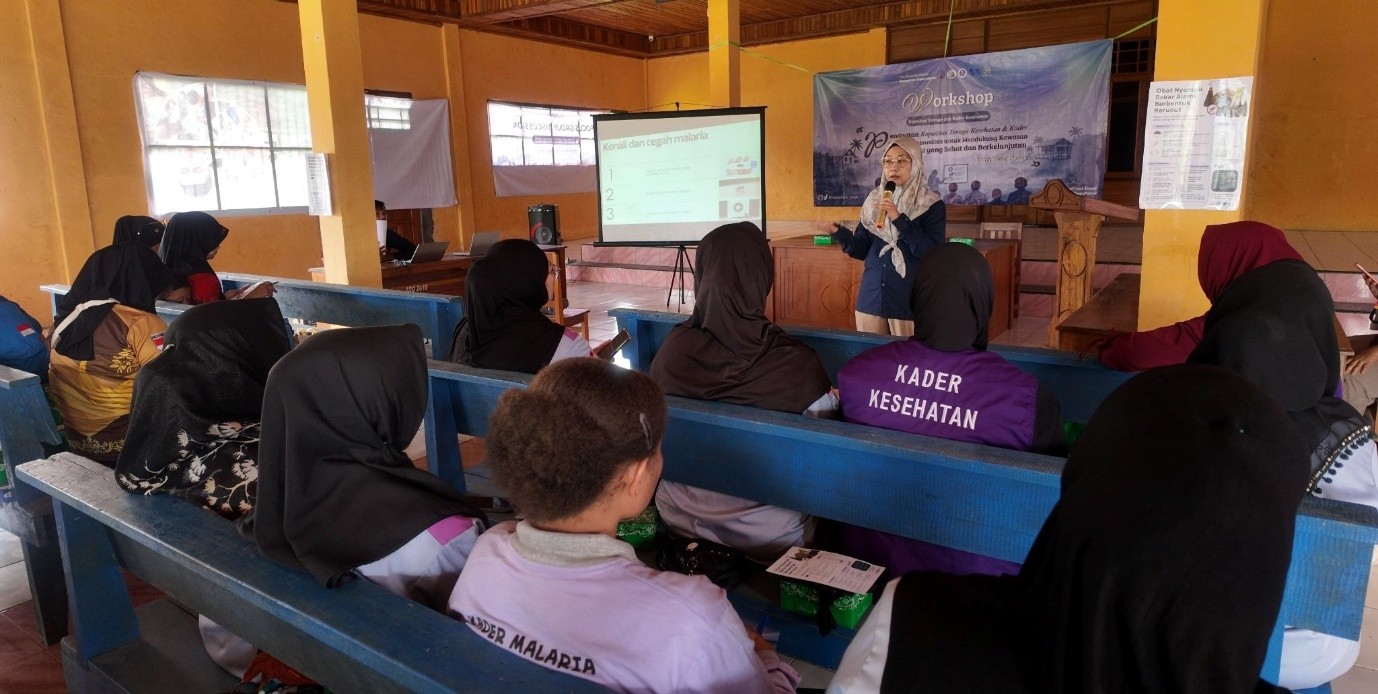
In a practical effort to strengthen malaria prevention in Papua, a team from the Bandung Institute of Technology (ITB) has introduced an innovative way to turn agricultural waste into a useful community resource. Through its Patriot Expedition Programme, Team 12 trained malaria cadres and health workers in Yapsi District, Jayapura Regency, to make a natural mosquito repellent using charcoal produced from discarded cocoa husks. The initiative, held in Ongan Jaya Village on November 4, 2026, brought together public health education, local agricultural potential, and community participation in a single activity.
The training reflects a growing emphasis on solutions that connect health awareness with resources already available in rural communities. Rather than treating cocoa husks as agricultural waste with little practical value, the ITB team introduced participants to the possibility of processing them into one of the ingredients for a spatial bio-repellent. The approach also sought to strengthen the capacity of local malaria cadres, who can play an important role in sharing preventive health information with residents.
The initiative is not presented as a replacement for established malaria prevention measures or as a clinically proven mosquito-control product. Instead, it offers a practical introduction to local resource utilization while encouraging communities to understand the importance of safe and evidence-based prevention.
ITB Brings Community-Based Malaria Education to Yapsi
The activity was organized by Team 12 of the ITB Patriot Expedition, which has been working to identify and develop opportunities for community empowerment in Papua.
The workshop took place on Wednesday, November 4, 2026, in Kampung Ongan Jaya, within Yapsi District. It involved local malaria cadres and health workers, with the programme designed to expand their knowledge and practical skills in using natural materials available in their surroundings.
According to ITB, the training was intended to strengthen community-based malaria prevention, particularly in the transmigration area. The organizers recognized that health education cannot rely exclusively on formal health personnel. Local cadres and community members also need practical knowledge so they can help communicate preventive practices and encourage wider participation.
The programme began with opening remarks from representatives of Ongan Jaya Village, the Yapsi Community Health Centre, known locally as UPTD Puskesmas Yapsi, and the head of ITB’s Team 12.
The representative of the Yapsi Community Health Centre, who was also responsible for the malaria programme, welcomed the initiative. The representative said that neither the malaria programme staff nor the local cadres had previously received similar training focused on producing mosquito repellent from natural materials.
“I sincerely appreciate this because, during my time as the person responsible for the malaria programme here and throughout my time in Papua, neither I nor the malaria cadres have ever received training in making mosquito repellent from natural materials,” the representative said.
The response highlighted the practical value of introducing new approaches to community health education. For local cadres, the workshop offered an opportunity to learn a skill that could be discussed and demonstrated within their own communities.
Why Local Resources Matter in Malaria Prevention
One of the central messages of the training was that local natural resources can be explored as potential materials for community-based solutions.
Yapsi District and the wider Lereh area have agricultural resources, including cocoa. Cocoa processing generates husks that are often discarded in fields. The ITB team identified this material as a potential source of charcoal for the production of a natural mosquito repellent.
The idea connects two issues that are relevant to rural development. The first is the need to strengthen public awareness and participation in malaria prevention. The second is the challenge of making productive use of agricultural by-products.
Agricultural waste is not automatically a useful product. It requires appropriate processing, knowledge, and attention to safety. However, the ITB initiative demonstrated how a material that might otherwise be left unused could be considered for a new application.
The workshop also introduced participants to another local resource: male breadfruit flowers, which are found in Yapsi District. The team explained that these flowers have potential as one of the ingredients in a spatial bio-repellent, although their possible application may not be widely known among local residents.
The presentation encouraged participants to look more closely at the natural resources around them and consider how scientific knowledge could help identify appropriate uses. Importantly, the team emphasized that any such development must take account of safety and available scientific evidence.
Understanding Different Types of Mosquito Repellents
Before moving into the practical session, the participants received an explanation of different types of mosquito repellents and how they should be used.
Team 12 leader Yangie Dwi Marga Pinanga, a pharmacist with academic qualifications in pharmaceutical science, explained the distinction between topical and spatial repellents.
Topical repellents are applied to the skin to help prevent mosquito bites. Spatial repellents, by contrast, are intended for use in the surrounding environment. Understanding this distinction is important because the two products are not interchangeable.
The training also introduced several natural materials with potential repellent properties based on scientific studies. Participants were given an explanation of the principles of appropriate and safe use, rather than simply being shown how to combine ingredients.
Yangie emphasized that topical repellents must be used according to their instructions and should not be applied carelessly. The cone-shaped bio-repellent introduced during the workshop was designed for environmental use, not for direct application to the skin.
The team also advised that the cone-shaped product should be used in a well-ventilated area.
Another important point was that the biorepellent should not replace other established malaria prevention measures. These include sleeping under mosquito nets, eliminating mosquito breeding sites, seeking early medical examination when symptoms occur, and following treatment instructions from health professionals.
This distinction gives the programme a broader public health significance. Community innovation can complement established prevention strategies, but it should not encourage residents to abandon measures recommended by health authorities.
From Cocoa Husk Waste to a Cone-Shaped Bio-Repellent
Following the educational session, participants moved to the practical workshop.
The ITB team had prepared a module titled Mosquito Repellents in Malaria Vector Control, which provided guidance on the materials and production stages. Participants were divided into several groups and provided with the necessary ingredients and equipment.
The bio-repellent formulation introduced during the activity combined charcoal, lemongrass stem powder, local natural materials, and tapioca flour as a binding agent.
The choice of cocoa husk charcoal was an important adjustment during the programme’s preparation. The team had initially planned to use charcoal made from coconut fiber. However, after considering the availability of local materials and the potential to utilize agricultural waste from one of Lereh’s important commodities, the team decided to use cocoa husk charcoal instead.
The change made the workshop more closely connected to the agricultural conditions of the area. It also demonstrated how a programme developed elsewhere can be adapted to local circumstances rather than applied without modification.
The concept itself drew on an earlier community service initiative developed by Dr. apt. Annisa, a lecturer at ITB’s School of Pharmacy. Her previous work had introduced the use of biorepellents for preventing mosquito bites in the Pangkajene Islands.
Although Annisa was not directly involved in the Yapsi workshop, her earlier initiative provided part of the conceptual foundation for the programme. Team 12 adapted the idea to the natural resources available in Yapsi, particularly cocoa husk charcoal and male breadfruit flowers.
During the practical session, participants followed a series of production steps. They weighed the ingredients, mixed the materials, added water gradually, and shaped the resulting mixture into cones.
The process required participants to pay attention to the proportions and consistency of the mixture. With guidance from the ITB team, every group successfully practiced making the bio-repellent independently.
The organizers considered it a significant achievement that all groups were able to finish the practical process. It indicated that participants had moved beyond listening to an explanation and had gained direct experience with the production method.
Malaria Cadres Welcome the Opportunity to Learn
The workshop was also an opportunity for local health workers and malaria cadres to discuss the resources available in their surroundings and how those materials might be used responsibly.
ITB reported that participants actively discussed the availability of natural ingredients and the potential for developing them into useful products. Their involvement reflected the importance of making community training interactive, particularly when the objective is to build skills that can be applied after the programme ends.
One malaria cadre expressed satisfaction at discovering a new possible use for cocoa husks, which are commonly discarded in agricultural fields.
“I am thrilled. Today I learned that cocoa husks, which we usually throw away in the fields, can be used as material for a bio-repellent,” the cadre said.
The comment captured the practical message of the initiative. A familiar agricultural by-product could be reconsidered as a resource, provided it was processed appropriately and used with an understanding of its intended purpose.
For communities involved in cocoa cultivation, this kind of knowledge can encourage a more constructive approach to agricultural waste. It may also stimulate further discussion about how local commodities can support activities beyond their primary agricultural use.
However, the workshop did not establish that the resulting product had achieved a measured reduction in mosquito bites or malaria transmission. Further testing would be needed to determine its effectiveness, safety, consistency, and suitability for wider use.
Strengthening Local Capacity Through the Patriot Expedition
The workshop was part of ITB’s wider contribution through the Patriot Expedition Programme, which seeks to connect academic knowledge and technology with community needs.
For Team 12, the Yapsi activity was built around the principle that community health programmes should involve more than formal health workers. Local cadres and residents need opportunities to understand preventive measures and develop practical skills that can be shared with others.
Yangie Dwi Marga Pinanga said that strengthening community capacity was an important part of malaria prevention, especially in transmigration areas.
“In efforts to improve the capacity of human resources in health in Yapsi District, we see that these efforts should not focus only on health workers but also need to involve cadres and the community,” he said.
He added that the bio-repellent workshop was introduced to encourage health cadres to become more creative and independent in using local natural resources as alternative materials to support malaria prevention.
The statement reflects a broader approach to community empowerment. Academic institutions can contribute by providing scientific knowledge, while local residents bring an understanding of their environment, agricultural practices, and community needs.
When these forms of knowledge are combined, training programmes can become more relevant to the conditions in which people live.
For Yapsi, the immediate achievement was the practical experience gained by local participants. The longer-term opportunity lies in whether the cadres can share the knowledge with other residents and whether further research can establish the safety and effectiveness of the product.
Connecting Public Health, Agriculture, and Sustainable Development
The use of cocoa husks for bio-repellent production also illustrates the potential relationship between public health and sustainable agricultural practices.
Cocoa is one of the agricultural commodities found in the Lereh area. Its processing produces organic by-products that may have alternative uses. Exploring these materials can help communities consider ways to reduce waste and create additional value from local resources.
The initiative is consistent with several broader sustainable development priorities identified by ITB, including optimal health and well-being, quality education, responsible consumption and production, and partnerships for development.
These connections are important because public health challenges are rarely isolated from other aspects of community life. Access to information, local skills, environmental conditions, and the availability of resources can all influence how communities respond to health risks.
The Yapsi workshop brought these elements together through a relatively simple activity: teaching local cadres how to process cocoa husk charcoal into one component of a mosquito-repellent product.
Nevertheless, moving from a successful training exercise to a reliable community product will require additional work. Scientific evaluation should establish whether the formulation has sufficient repellent effectiveness, how long its effect lasts, and whether repeated use produces any unwanted effects. Guidance on production quality and safe handling would also be necessary before wider distribution could be considered.
These steps are essential to ensure that enthusiasm for local innovation is matched by evidence and responsible use.
Conclusion
The training conducted by ITB’s Team 12 in Ongan Jaya Village demonstrates how academic institutions can help communities explore practical responses to local challenges. By introducing malaria cadres to the use of cocoa husk charcoal in bio-repellent production, the Patriot Expedition programme connected health education with agricultural resource management and community empowerment.
Its most immediate contribution was the knowledge and practical experience gained by local participants. Every group successfully practiced making the cone-shaped product, while the discussion encouraged residents to reconsider agricultural waste as a potential resource. Just as importantly, the training reinforced that natural repellents must be used carefully and cannot replace mosquito nets, environmental management, early medical examination, or treatment under professional guidance.
The next stage should focus on strengthening the knowledge-sharing role of malaria cadres and conducting further tests to assess the product’s effectiveness and safety. If supported by scientific evaluation and continued cooperation between universities, health workers, and local communities, the initiative could provide a useful model for exploring locally adapted health solutions in other parts of Papua.
For Yapsi, the lesson extends beyond cocoa husks. Sustainable development can begin by recognizing the value of resources already available in the community, equipping residents with relevant knowledge, and ensuring that innovation is guided by scientific evidence. That combination of local participation, education, and responsible resource use offers a constructive contribution to stronger community health in Papua.
Read Also
Undip Trains 30 Papua Health Cadres to Prevent Malaria
Indonesia Targets Malaria Elimination, Papua is Key

