
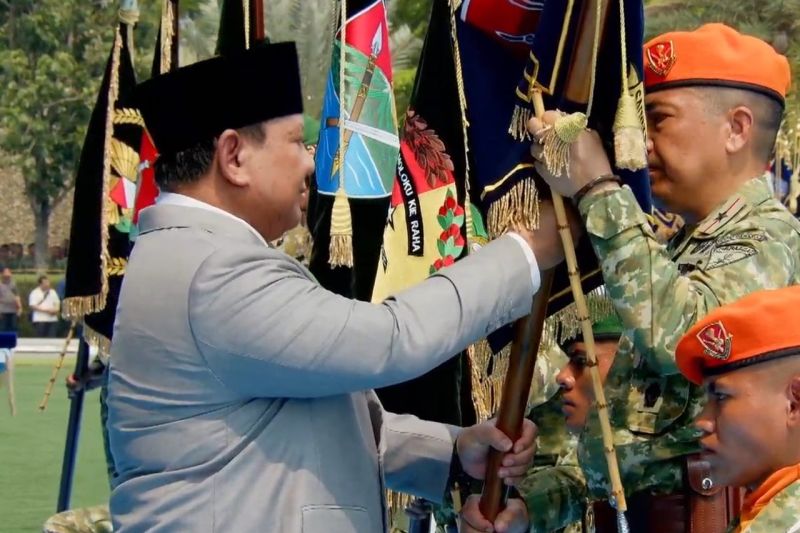
The establishment of Regional Military Command (Kodam) XXIX/Mambruk marks a new chapter in Indonesia’s effort to strengthen security, territorial coordination, and development in Papua Tengah (Central Papua), following President Prabowo Subianto’s inauguration of six new military commands on October 5, 2026.
The new command, headquartered in Nabire, is responsible for the military territorial structure covering all eight districts of Papua Tengah. It is led by Major General TNI Aminton Manurung, formerly Assistant for Operations to the Army Chief of Staff.
The inauguration took place as Indonesia celebrated the 81st anniversary of the Indonesian Armed Forces, or TNI. At the national ceremony at the TNI Headquarters in Cilangkap, Jakarta, President Prabowo formally inaugurated 204 new TNI units, including six new Army Regional Military Commands, or Kodam.
For Papua Tengah, the decision has significance beyond military organization. Provincial and military officials have described the new command as an opportunity to strengthen territorial coordination while maintaining a close relationship between soldiers and the communities they serve.
At a ceremony in Nabire, Brigadier General TNI Vivin Alvianto, commander of Korem 173/Praja Vira Braja, described the establishment of Kodam XXIX/Mambruk as an important moment for strengthening the defense structure in Papua Tengah.
The development comes as the government continues to place greater emphasis on combining security with territorial development and community engagement in Papua.
October 5: From National Inauguration to Papua Tengah
The chronology began in Jakarta on Monday, October 5, when President Prabowo presided over the 81st TNI anniversary ceremony at the Prima Field at TNI Headquarters in Cilangkap.
During the ceremony, the president formally announced the establishment of 204 new TNI units.
The restructuring included six new Kodam, 30 Territorial Development Infantry Brigades, 150 Territorial Development Infantry Battalions, and three Combat Support Battalions. The Navy and Air Force also received additional formations under the broader restructuring program.
The six new Army commands are Kodam XXV/Mahmud Riayat Syah in the Riau Islands, Kodam XXVI/Mataram in Yogyakarta, Kodam XXVII/Sobe Sonbai in East Nusa Tenggara, Kodam XXVIII/Moloku Kie Raha in North Maluku, Kodam XXIX/Mambruk in Papua Tengah, and Kodam XXX/Rinambora in West Nusa Tenggara, according to reports on the presidential inauguration.
President Prabowo then symbolically inaugurated the new commands by handing over command staffs and unit flags to the respective commanders.
For Papua Tengah, that ceremony formally placed Major General Aminton Manurung at the head of the newly established Kodam XXIX/Mambruk.
The announcement was subsequently confirmed in Nabire by Brigadier General Vivin Alvianto during local celebrations marking the TNI anniversary.
“In the commemoration of the 81st TNI anniversary, TNI Headquarters has established Kodam XXIX in Papua Tengah under the name Kodam Mambruk,” Vivin said, as quoted by ANTARA.
Why the name Mambruk?
The name chosen for the new command carries a distinctly Papuan identity.
Mambruk is a bird native to Papua, known for its distinctive crown-like feathers on its head. Local military officials explained that the name was selected as the identity of the new Kodam based in Papua Tengah.
Lieutenant Colonel Arh Dwi Palwanto, commander of Kodim 1705/Nabire, explained that the mambruk is a large bird resembling a pigeon or dove but distinguished by its prominent crest.
The choice is notable because it connects the formal structure of a national military institution with a symbol associated with Papua’s natural environment.
For the military, the name therefore represents more than an organizational designation. It provides the new command with a local identity as it begins operating across a province with diverse ethnic, religious, cultural, and customary traditions.
Eight Districts Under One Command
Kodam XXIX/Mambruk will oversee the defence structure across all eight districts of Papua Tengah.
The province consists of Nabire, Mimika, Paniai, Puncak, Puncak Jaya, Dogiyai, Deiyai, and Intan Jaya.
Before the creation of the new Kodam, the regional military structure was centered around Korem 173/Praja Vira Braja.
The establishment of Kodam Mambruk alters the previous organizational structure by creating a higher regional army command that is specifically responsible for Papua Tengah.
Vivin said the restructuring would involve personnel, facilities, and territorial units so that defense responsibilities and community service could be managed more effectively across the province.
The significance is particularly relevant given the geographical scale of Papua Tengah.
The eight districts encompass communities separated by mountainous terrain, forests, and long distances. A dedicated regional command can provide a more direct organizational framework for coordinating military units and territorial activities within the province.
Six Territorial Development Battalions
The establishment of Kodam XXIX/Mambruk is being accompanied by another major organizational change: the expansion of Territorial Development Battalions.
Two such battalions are already available in Papua Tengah. Battalion 804 is based in Nabire, while Battalion 820 is based in Timika.
The plan is to add six more battalions so that each of the province’s eight districts will eventually have one Territorial Development Battalion.
The deployment is being organized geographically.
From the Nabire area, additional units are expected to support Dogiyai, Deiyai, and Paniai.
From Timika, additional units are planned for Puncak, Puncak Jaya, and Intan Jaya.
Vivin said the arrangement would eventually produce eight Territorial Development Battalions across the province, corresponding with the eight districts.
Reports indicate that three of the additional battalions were scheduled to arrive around October 9, 2026, with the remaining units intended for the other designated districts.
The program is significant because these units are designed not only around conventional defense responsibilities but also around territorial engagement and support for communities.
Security and Development Under One Framework
The concept of territorial development is central to understanding the government’s broader objective.
In Papua Tengah, the additional battalions are expected to support the military’s territorial responsibilities while also contributing to community-oriented activities within their respective areas.
That can include support for public infrastructure, assistance during emergencies, engagement with local communities, and participation in programs that require a presence in remote areas.
The approach fits into a broader Indonesian policy of strengthening territorial institutions while maintaining closer interaction between the TNI and communities.
The military leadership in Papua Tengah has repeatedly emphasized that the effectiveness of security depends not only on organizational strength but also on public trust and communication.
Vivin stressed that the new Kodam must be accompanied by stronger communication and kemanunggalan TNI dengan rakyat, or the close relationship between the military and the people.
“Togetherness, communication, and the unity between the TNI and the people constitute a vital force in safeguarding the unity and integrity of the Unitary State of the Republic of Indonesia,” Vivin said.
In English, he said that togetherness, communication, and the close relationship between the TNI and the people were important strengths in maintaining national unity and the integrity of the Republic of Indonesia.
Infrastructure Begins with Existing Facilities
The creation of a new Kodam does not mean that a completely new military complex is immediately available.
Instead, Papua Tengah is beginning the organizational transition by making use of facilities that already exist.
Vivin explained that the existing Korem 173/PVB headquarters would temporarily be used as the headquarters of Kodam XXIX/Mambruk.
Korem 173/PVB would then move into the facility previously used by Kodim 1705/Nabire.
The Kodim, meanwhile, would temporarily use the Nabire branch of the Indonesian National Youth Committee, or KNPI, whose facilities were made available by the Nabire local government.
The arrangement demonstrates how the organizational transition is being carried out gradually.
Rather than waiting for all permanent infrastructure to be completed before the new command begins operating, existing public and military facilities are being used to establish the initial structure.
Vivin expressed appreciation for the support from the Nabire government and said further assistance from the provincial and district administrations would be important as permanent facilities are developed.
Local Government Welcomes the New Command
The establishment of Kodam Mambruk has also received support from the Papua Tengah provincial government.
Governor Meki Nawipa expressed appreciation for the TNI’s service and contribution to communities in Papua Tengah.
“I just want to express my sincere gratitude for all the service and dedication of the TNI to the people throughout Indonesia, particularly in Papua Tengah,” Nawipa said.
The governor linked the work being carried out today with the interests of future generations.
He stated that the current efforts would ultimately benefit future generations, including children and grandchildren.
Nawipa also expressed hope that the TNI would continue to build, protect, and serve the people within the framework of the Republic of Indonesia.
His remarks underline an important element of the new command’s role: the relationship between defense institutions and civilian government.
The provincial administration will be important not only in supporting security coordination but also in providing land, buildings, and other facilities needed to establish the new military structure.
A Command Shaped by Papua’s Geography
For international observers, the creation of Kodam XXIX/Mambruk should also be understood in the context of Papua Tengah’s geography.
The province combines major urban and economic centers such as Nabire and Timika with mountainous districts where access can be significantly more difficult.
A regional command based in the province can provide a dedicated organizational structure closer to the communities it serves.
This may improve coordination between units, provincial authorities, and district governments, particularly when dealing with emergencies, infrastructure challenges, and territorial security.
The addition of battalions in individual districts also creates a more distributed military presence.
That presence is intended to support the government’s wider territorial responsibilities rather than relying exclusively on a central headquarters.
The Development Dimension
The government’s description of the new structure places considerable emphasis on the development role of territorial units.
The name itself, Territorial Development Battalions, reflects this emphasis.
The idea is that security and development can reinforce one another when military personnel maintain close contact with local communities.
In remote parts of Papua Tengah, military personnel may sometimes be among the government representatives with the ability to reach communities in difficult terrain.
Their involvement in infrastructure assistance, disaster response, community programs, and other forms of public service can therefore complement the work of civilian institutions.
The model does not replace the responsibility of civilian government agencies. Rather, it provides another institutional capacity that can support government programs when required.
That distinction will be important as Kodam Mambruk develops its role.
A Broader National Military Restructuring
Kodam XXIX/Mambruk is part of a much larger restructuring of Indonesia’s armed forces.
The six new Kodam were inaugurated alongside 30 Territorial Development Infantry Brigades and 150 Territorial Development Infantry Battalions.
The restructuring also included additional combat support units, Marine units, and Air Force formations.
The scale of the reform demonstrates that Papua Tengah’s new command is not an isolated policy decision.
Instead, it forms part of a nationwide effort by the Indonesian government and TNI to adjust its organizational structure to changing defense, territorial, and operational requirements.
For Papua Tengah, however, the impact is particularly local.
A new Kodam means that decisions concerning the province’s territorial military structure can be coordinated through an institution specifically responsible for the region.
The First Test Begins Now
The inauguration is only the beginning.
The immediate challenge will be completing the organizational transition, establishing permanent facilities, deploying personnel, and ensuring that the six additional Territorial Development Battalions can operate effectively.
The government will also need to maintain coordination with the governor, eight district administrations, and community leaders.
As the new structure develops, Vivin has already called for systematic support from the governor and district heads.
The success of Kodam XXIX/Mambruk will therefore depend not simply on the number of soldiers or facilities it possesses.
It will also depend on how effectively it communicates with local communities and how well its territorial responsibilities complement civilian development programs.
The emphasis on communication and kemanunggalan with the people provides an important indication of the intended direction.
Conclusion
The establishment of Kodam XXIX/Mambruk represents a significant institutional development for Papua Tengah.
Formally inaugurated by President Prabowo Subianto on October 5, 2026, the new Kodam places the province’s eight districts under a dedicated Army regional command led by Major General TNI Aminton Manurung.
Its creation is being accompanied by the planned addition of six Territorial Development Battalions, complementing the existing units in Nabire and Timika. Once the expansion is completed, each of Papua Tengah’s eight districts is expected to have one such battalion.
The significance of the new structure extends beyond defense organization. The government’s stated objective is to strengthen territorial coordination while maintaining communication and a close relationship between the TNI and the people.
For Papua Tengah, that combination will be important.
Security provides the foundation for communities to live and work with confidence, while development requires institutions capable of reaching people across a vast and challenging geographical area.
The temporary use of existing facilities, support from the Nabire government, and the planned deployment of additional battalions show that the new command is entering an initial phase of gradual development.
The longer-term test will be whether Kodam XXIX/Mambruk can translate its new organizational capacity into effective service, stronger coordination, and meaningful support for communities across Papua Tengah.
Governor Meki Nawipa’s message captures the broader expectation. The work undertaken today, he said, should ultimately be felt by future generations.
If that principle guides the development of Kodam Mambruk, its legacy may be measured not only through stronger defense coordination but also through the ability of the TNI and civilian government to work together in building a safer, more connected, and more resilient Papua Tengah.
Read Also
Public Enthusiasm Welcomes Kodam Mandala Trikora as Partner for Security and Development in Papua Selatan
TNI’s Commitment to Stability and Peace in Papua
TNI Expands Community Service Across Papua Tengah

