
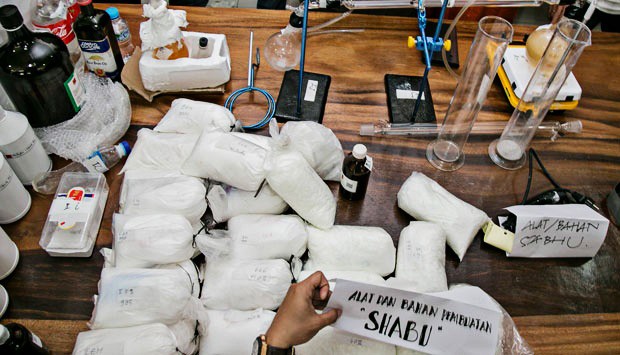
The scale of the challenge is becoming harder to ignore. Drug trafficking in Papua has continued to draw the attention of Indonesian law enforcement agencies, with police recording 237 narcotics cases involving 265 suspects through September 2026.
The figures, released by the Papua Regional Police, come as officers across the province and neighbouring Papua regions have stepped up arrests, airport inspections, border monitoring and the destruction of illegal cannabis plantations. In Mimika, police have also linked the circulation of narcotics and illegal alcohol to wider criminality, while operations in the highlands have uncovered large cannabis cultivation sites.
The response is increasingly taking place on several fronts at once. Police are pursuing dealers and couriers in urban areas, airport security officers are intercepting shipments in passenger luggage, joint TNI and Polri teams are searching remote plantations, and authorities are asking residents to report suspicious activity.
For Papua, the issue is not simply about the number of arrests. It is also about preventing narcotics from becoming embedded in communities already dealing with difficult geography, limited access to some areas and other social pressures.
Papua Records 237 Narcotics Cases
A Sharp Focus on the 2026 Data
The latest figures were presented by Papua Police Narcotics Investigation Director Kombes Pol. Dr. Alfian spoke during an RRI Jayapura programme on October 1.
According to Alfian, police across Papua had handled 237 narcotics cases involving 265 suspects through September 2026. The police also reported seized evidence with an estimated value of about Rp162.17 million, which they said represented drugs that could potentially have reached approximately 14,375 people.
The numbers provide a snapshot of the enforcement workload facing the police.
But they do not necessarily mean that every increase in reported cases represents an increase in drug consumption. Higher case numbers can also reflect stronger policing, improved intelligence and more successful investigations.
That distinction is important when assessing the situation.
Alfian nevertheless described narcotics as a serious threat, particularly because of their potential impact on young people.
“Narcotics are a very serious threat to the next generation,” Alfian said.
The police response has therefore combined enforcement with prevention.
Young People Seen as Particularly Vulnerable
According to Alfian, prevention should begin before young people become involved in drug use.
He specifically identified children in grades five and six of elementary school, followed by junior and senior high school students, as groups requiring attention and education. He said adolescence is a period when young people are developing their identities and can become vulnerable to harmful influences.
The message places families and schools alongside law enforcement in the prevention effort.
Parents are encouraged to pay attention to behavioural changes and seek professional assistance if they suspect drug abuse. Police have also emphasised the importance of public education rather than relying exclusively on arrests.
This approach matters because a criminal justice response addresses the supply side of the problem, while prevention and rehabilitation address some of the factors that allow drug use to continue.
Alfian also noted that drug users can, depending on the circumstances and assessment, be treated as victims of abuse who may require rehabilitation under Indonesian law. At the same time, police continue to pursue those involved in narcotics crimes and illicit distribution.
Mimika Shows the Link Between Drugs and Crime
Police Point to Multiple Factors
The connection between narcotics and criminality has become particularly visible in Mimika, Papua Tengah.
In June, Mimika Police Chief AKBP Billyandha Hildiario Budiman said illegal alcohol distribution and narcotics were among the major factors associated with high crime levels in the regency during the first half of 2026.
He was careful to discuss illegal alcohol as a significant factor while also pointing to economic pressures as another contributor.
“There is certainly a correlation between increasing crime and the circulation of alcohol,” Billyandha told reporters in Mimika on June 15.
During the first six months of 2026, Mimika Police seized more than two tonnes of illegal alcohol, including locally produced drinks and commercial products. Police also reported destroying narcotics, including nearly one kilogram of methamphetamine, pills and marijuana, with the total seized narcotics valued at approximately Rp2.7 billion.
Billyandha said the scale of the seizures indicated that Timika had become a target for drug distribution networks.
The situation illustrates the need to view narcotics enforcement as a multifaceted issue rather than a standalone policing concern. Drug markets can intersect with theft, violence and other forms of criminal activity, while alcohol abuse and economic pressures may create additional risks.
However, the relationship is not automatic.
Some drug users do not commit another crime, and some crimes in Papua are not linked to narcotics. The available local evidence instead suggests that drugs form part of a wider combination of factors affecting public security.
From Airports to Remote Highlands
Sentani Intercepts Nearly One Kilogram of Marijuana
The geography of Papua makes transportation a central part of the narcotics problem.
Mountains, forests, and limited road networks separate large parts of the region. Air travel therefore plays an important role in connecting remote districts.
This makes airports crucial locations for law enforcement activities.
On August 5, aviation security personnel at Sentani International Airport intercepted approximately 940 grammes of dried marijuana allegedly concealed in a passenger’s luggage. The passenger was travelling to Dekai in Yahukimo. Airport security officers detected suspicious contents during baggage inspection and coordinated with police and narcotics investigators.
The incident illustrates the importance of routine security screening.
The seizure did not require a large-scale military operation. It began with ordinary airport checks, followed by a police investigation.
Authorities then examined the suspected origin and intended destination of the marijuana and whether other individuals were involved.
That investigative phase is crucial.
Stopping a courier prevents one shipment from reaching its destination, but identifying the supplier and other members of the network offers the possibility of disrupting the wider distribution chain.
A PNG Citizen Arrested in Jayapura
A similar concern emerged in Jayapura in June.
On June 25, Jayapura police arrested a Papua New Guinea citizen identified by the initials JH, who was allegedly carrying approximately 1.6 kilograms of dried marijuana in the Base G Kiri area.
According to police, the marijuana was allegedly intended for distribution. Investigators had monitored the suspect’s activities after receiving information about a foreign national allegedly transporting narcotics in Jayapura.
The case illustrates the cross-border dimension of Papua’s narcotics challenge.
Indonesia shares a long land border with Papua New Guinea, extending for roughly 824 kilometres. Much of the frontier consists of forests, mountains, rivers and traditional routes connecting communities.
Those conditions create legitimate social and economic connections, but they can also complicate law enforcement.
For Indonesian authorities, border security therefore has to serve two purposes at the same time: facilitating legitimate movement while preventing illegal goods from crossing into Indonesia.
The Fight Moves into the Highlands
1,347 Cannabis Plants Found in Pegunungan Bintang
In 2026, the most significant cannabis-related operation occurred far from an airport or city centre.
On September 7, a joint TNI and Polri operation discovered 1,347 cannabis plants at two cultivation sites in Kampung Siminbuk, Serambakon District, Pegunungan Bintang Regency, Papua Pegunungan.
The first site contained 345 plants, while a second location contained another 1,002.
The operation began with aerial surveillance. A drone operated by a TNI intelligence task force reportedly detected indications of cultivation in the remote mountainous area. Ground personnel subsequently conducted reconnaissance before entering and securing the sites.
The operation involved personnel from several security elements, including the RI-PNG border security task force, TNI intelligence units, airborne security elements, the local military command, Pegunungan Bintang Police and other related units.
The use of aerial surveillance was particularly important.
In mountainous Papua, the terrain’s inaccessibility by road or foot allows for the concealment of cannabis plantations. Drone technology can provide authorities with an initial view of areas that would otherwise require considerable time and manpower to inspect.
The discovery subsequently moved into the criminal justice process, with the seized plants handed to the Pegunungan Bintang Police Narcotics Unit for further processing and destruction.
Alleged Links to Armed Networks
Authorities Continue to Investigate
The discovery of cannabis plantations has also brought the narcotics issue into the wider security debate in Papua.
Indonesian security authorities alleged that the Siminbuk cultivation was connected to the TPNPB OPM’s Kodap XXV Bintang Timur. That attribution is an allegation by security authorities and remains subject to the appropriate investigative and legal process.
Similar concerns have appeared in earlier reports concerning cannabis cultivation in Pegunungan Bintang.
West Papua Voice previously reported that security personnel had uncovered hidden marijuana cultivation in remote highland areas, raising questions about whether proceeds from illicit crops could support wider criminal or armed networks.
Such claims require careful handling.
The discovery of an illegal plantation establishes that unlawful cultivation occurred. It does not, by itself, establish who financed or controlled the operation.
That is why investigators need to establish the chain of responsibility through evidence, including information about land use, financing, cultivation, transportation and distribution.
From a security perspective, however, authorities have reason to investigate whether illegal drug profits are being diverted into other criminal activities.
A Supply Chain That Crosses Different Terrains
Taken together, the cases reveal several different layers of Papua’s narcotics problem.
At one end are remote cultivation sites in mountainous areas. From there, drugs can move through informal transport routes into more populated areas.
Airports provide another potential channel.
Urban centres such as Jayapura and Timika provide consumer markets and logistical connections.
The border with Papua New Guinea adds another layer because narcotics can potentially move across an international boundary.
The police therefore face a problem that cannot be solved by focusing on a single location.
Alfian said areas from Jayapura to Merauke remain under attention, particularly because of the potential movement of marijuana. Police, TNI, BNN and other agencies are coordinating their efforts.
The approach increasingly combines intelligence gathering, community information, surveillance, airport inspections, border security and criminal investigation.
That combination is important because trafficking networks adapt when one route becomes difficult to use.
Prevention Beyond Arrests
Police Turn to Communities and Schools
The enforcement figures tell only part of the story.
Police leaders have increasingly emphasised that prevention must take place inside communities.
Alfian said public participation was essential because residents often know what is happening around them before authorities do.
“The success of Polri, BNN and law enforcement will not be possible without cooperation or community participation,” he said.
He urged residents to report information about marijuana, suspected dealers and other narcotics activity.
This community-based approach can be particularly useful in Papua, where authorities cannot maintain a permanent presence in every village or remote area.
Local knowledge can help identify unusual movements, suspected cultivation and distribution activity.
At the same time, prevention campaigns need to avoid treating communities merely as sources of intelligence. Families, schools, religious organisations and local leaders also have a role in reducing demand and helping people affected by drug abuse access appropriate assistance.
Mimika Uses Sport as Prevention
Mimika Police have adopted another preventive approach.
Billyandha said the police and local government were organising positive community activities, including badminton and mini-soccer competitions, followed by a planned 10-kilometre Timika Run.
The idea is straightforward: create constructive activities and stronger community engagement, particularly for young people, while maintaining police visibility outside conventional enforcement operations.
Such programmes cannot replace policing.
But they can complement it.
A successful prevention strategy needs to address both supply and demand. Arresting dealers removes drugs from circulation, while education, family involvement, rehabilitation and youth activities can help reduce vulnerability to drug use.
Why the Issue Matters to Papua’s Development
Papua’s broader development agenda also connects to narcotics enforcement.
Papua is investing in education, infrastructure, healthcare, connectivity and economic opportunities. Those investments are intended to improve living standards and expand opportunities for young people.
Drug abuse can undermine those objectives by creating additional pressures on families, schools, healthcare services and public security.
This is especially relevant in remote areas.
In areas with limited economic opportunities, illegal activities can sometimes become appealing due to their potential for immediate income. West Papua Voice’s earlier reporting on remote cannabis cultivation highlighted the importance of combining law enforcement with economic development and community resilience.
That does not mean poverty automatically causes drug trafficking.
Rather, economic vulnerability can create conditions that criminal networks may exploit.
The long-term response therefore needs to include legitimate employment, agricultural development, education and accessible public services alongside police operations.
A More Integrated Security Response
The pattern emerging across Papua in 2026 suggests a more integrated law enforcement model.
In Sentani, airport security detected a suspected shipment.
In Jayapura, police surveillance led to the arrest of a suspected courier.
In Pegunungan Bintang, aerial surveillance helped identify remote cannabis fields.
In Mimika, police combined narcotics enforcement with efforts to reduce other forms of crime and strengthen community engagement.
At the provincial level, police are coordinating with TNI, BNN and other agencies.
This is significant because narcotics trafficking does not respect administrative boundaries.
A shipment that begins in one district can move through another before reaching its final destination. A cultivation site can be hidden in a remote area while its products are distributed hundreds of kilometres away.
An effective response therefore requires information sharing and coordination across jurisdictions.
The Road Ahead
The 237 cases recorded through September demonstrate that enforcement agencies are actively uncovering narcotics offences. Yet the figure also shows why the challenge is unlikely to disappear through arrests alone.
Police will need to maintain pressure on trafficking networks while improving prevention.
The role of communities will remain important. So will cooperation between Indonesia’s law enforcement institutions and, where appropriate, counterparts across the Indonesia-Papua New Guinea border.
Technology is likely to become increasingly important as well.
The discovery of 1,347 cannabis plants following aerial surveillance demonstrates how drones and other intelligence tools can help authorities operate in terrain where conventional patrols face limitations.
However, technology is just one aspect of the overall solution.
Investigators still need evidence. Prosecutors need legally usable cases. Communities need confidence in reporting. Young people need credible alternatives to drug use and involvement in criminal networks.
That is where enforcement meets prevention.
Conclusion
Papua’s narcotics problem is becoming an increasingly important public security and social issue, but the available evidence points to a complex picture rather than a single cause of rising crime.
Through September 2026, Papua Police recorded 237 narcotics cases involving 265 suspects, while authorities reported seizures of marijuana, methamphetamine and other illegal substances.
In Mimika, police identified illegal alcohol and narcotics as important factors associated with criminality, while also pointing to economic pressures. More than two tonnes of illegal alcohol were seized during the first half of the year, alongside narcotics valued at approximately Rp2.7 billion.
Meanwhile, enforcement operations have stretched from Sentani airport, where 940 grammes of marijuana were intercepted, to Jayapura, where police arrested a PNG citizen allegedly carrying 1.6 kilograms of marijuana.
The most striking operation came in Pegunungan Bintang, where joint TNI and Polri personnel discovered 1,347 cannabis plants in two remote cultivation areas following aerial surveillance. Authorities have alleged a connection to an OPM-affiliated network, although that allegation remains a matter for investigation and legal verification.
The response is consequently evolving.
Police are not relying solely on arrests. They are strengthening surveillance, working with TNI and BNN, monitoring transportation routes, involving communities and increasing public education. In Mimika, authorities are also using sports and community activities as part of a wider preventive strategy.
The ultimate measure of success for Papua will be more than just the quantity of drugs seized.
It will be whether communities become less vulnerable to narcotics, whether young people have stronger alternatives, whether trafficking networks lose access to local markets and whether criminality associated with substance abuse can be reduced.
The challenge is substantial, particularly across Papua’s vast and difficult terrain.
But the expanding cooperation between law enforcement agencies, local governments and communities provides a foundation for a sustained response.
The task ahead is to ensure that enforcement remains professional and evidence-based while prevention, rehabilitation and economic opportunity develop alongside it.
That combination is likely to matter most in protecting Papua’s younger generation and ensuring that the province’s wider development gains are not undermined by the illegal narcotics economy.
Read Also
1 Kg Cannabis Seized in Biak as Papua Drug Risk Grows
Sentani Airport Stops Marijuana Smuggling Attempt
Indonesian Police Arrest PNG Citizen in Jayapura Related Drug Smuggling

