
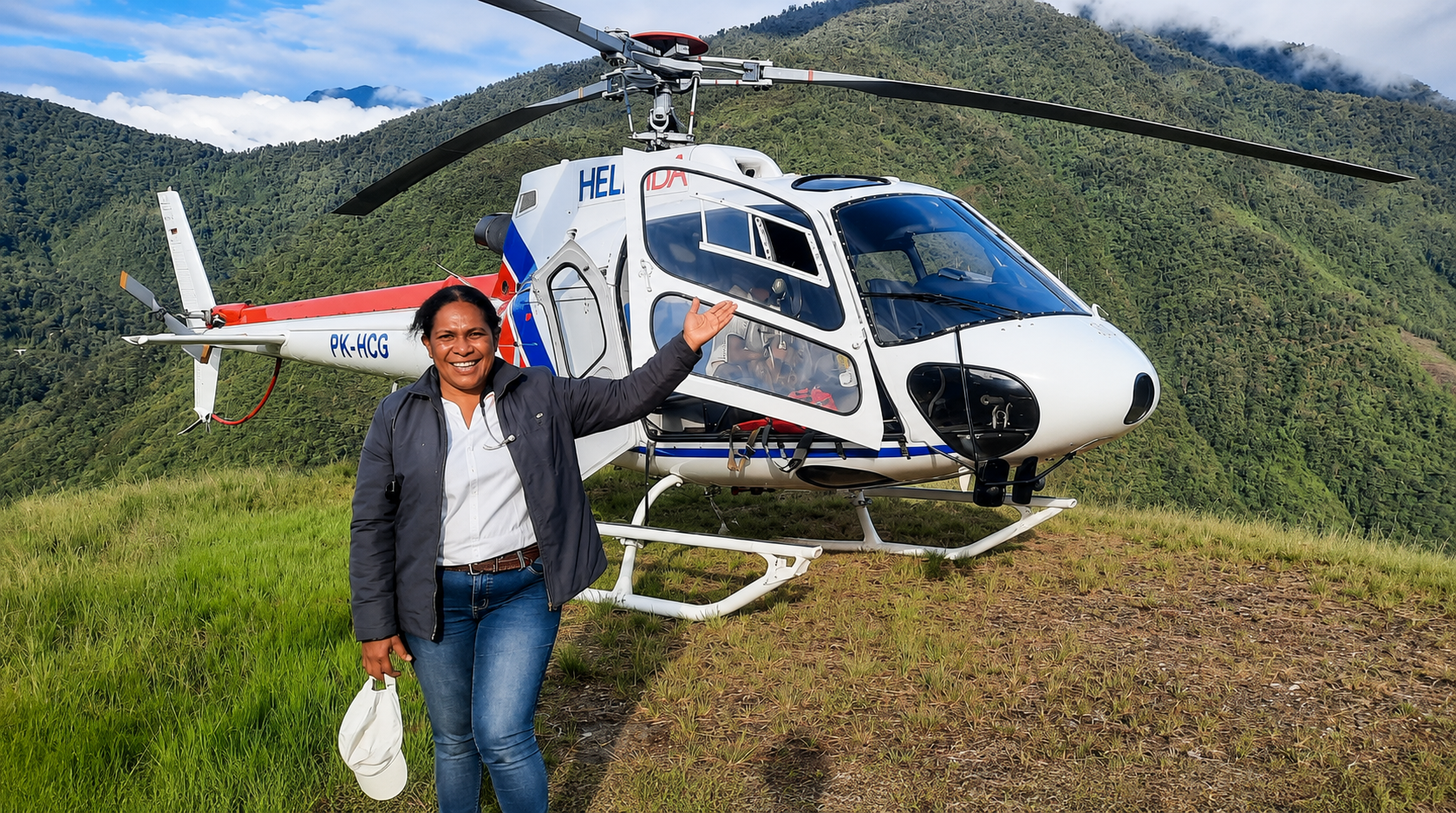
In Papua, where mountains, forests, and limited road networks can turn a medical emergency into a race against time, air ambulances in Papua are becoming an increasingly important part of the government’s strategy to reach communities far from hospitals. The Ministry of Health says six helicopters are being prepared to support emergency medical services in isolated areas, while the minister has confirmed that air ambulance operations are already being used in Papua.
The initiative reflects a practical challenge facing healthcare delivery across Indonesia’s easternmost region. A patient suffering a serious injury or medical emergency may live in an area where a journey to the nearest hospital takes hours or where conventional road transportation is simply unavailable. In such circumstances, the difference between receiving treatment immediately and waiting for transportation can be decisive.
Health Minister Budi Gunadi Sadikin said the air ambulance system is intended primarily for emergency cases in remote areas far from hospitals. The service is being developed through coordination between the Ministry of Health, the National Search and Rescue Agency, the Indonesian National Police, and the Indonesian military.
The policy places Papua within a broader national effort to improve emergency medical access in frontier, underdeveloped, and geographically isolated areas.
Papua’s Geography Makes Emergency Care Difficult
Healthcare access in Papua has long been closely connected to geography.
The region contains extensive mountainous areas, dense forests, rivers, and settlements separated by considerable distances. In many locations, infrastructure development has improved connectivity, but transportation remains difficult, particularly for communities located away from major urban centers.
For ordinary healthcare, these conditions create challenges. For emergency medicine, the problem becomes more acute.
A patient with severe trauma, complications during childbirth, a serious infection, or another life-threatening condition may require treatment that is unavailable at a small local health facility. The patient must therefore be transported to a hospital capable of providing more advanced care.
When roads are limited or travel times are extremely long, aviation can provide an alternative.
This is where the government’s air ambulance program becomes significant.
Rather than viewing healthcare access solely through the construction of hospitals, the policy recognizes that medical infrastructure is useful only when patients can reach it in time. Air transportation can therefore function as a bridge between remote communities and higher-level medical facilities.
Six Helicopters for Emergency Response
According to Health Minister Budi Gunadi Sadikin, six helicopters are being used to support the air ambulance system. The aircraft can operate on a return basis, carrying medical personnel to isolated locations and transporting patients back to hospitals for further treatment.
The minister explained that the helicopters can bring doctors to locations where patients are difficult to reach by conventional transportation. Once the patient is stabilized or prepared for evacuation, the aircraft can transport the patient to a hospital where more advanced treatment, including surgery, can be provided.
The arrangement is designed specifically for emergencies rather than routine transportation.
The Ministry of Health has emphasized that not every location requires an air ambulance. Instead, priority is given to areas that are remote, have emergency medical needs, and are located far from hospitals.
That distinction is important because helicopter operations are expensive and require careful coordination. Their value is greatest when they are deployed to cases in which conventional transportation could result in dangerous delays.
Papua Already Has Experience with Air Ambulances
The government’s announcement is not the beginning of air ambulance operations in Papua.
Budi said the service has already been implemented in Papua and has been used frequently. The next stage is to organize and expand the system so that it can be deployed more effectively in other remote locations where the need is greatest.
This experience provides an important foundation.
For communities living in isolated parts of Papua, an air ambulance is more than an aircraft. It represents a different model of healthcare access, one in which distance does not necessarily determine whether a patient can reach specialized medical treatment.
The system also demonstrates why emergency healthcare in Papua requires cooperation between multiple institutions.
A helicopter cannot operate as an independent healthcare facility. Medical personnel must determine whether evacuation is necessary. Pilots and aviation teams must assess operational conditions. Search and rescue agencies can provide support, while security institutions can assist with transportation and emergency operations where required.
The Ministry of Health’s cooperation with Basarnas, the National Police, and TNI is therefore central to the model described by the minister.
From Geographic Isolation to Faster Medical Access
The larger significance of the program lies in the way it approaches geographic inequality.
For decades, development in remote Papua has been closely associated with roads, bridges, telecommunications, and public facilities. These remain essential. However, infrastructure cannot always eliminate geographical barriers completely, especially in mountainous or sparsely populated areas.
Air transportation can complement those investments.
A helicopter can reach a location in a fraction of the time required for a long overland journey. For emergency medicine, that difference can affect the patient’s prospects for recovery.
The Ministry of Health’s explanation illustrates this point. Budi referred to cases in remote areas where patients with serious injuries needed rapid medical attention. He also described the danger of prolonged transportation, including the risk that injuries could become infected or develop additional complications.
Although his example was from Nusa Tenggara Timur, the principle is directly relevant to Papua’s remote communities.
A broken bone, severe trauma, or other emergency does not become less serious simply because the patient lives far from a hospital. The challenge is therefore to bring the medical system closer to the patient, either physically through mobile medical teams or by reducing transportation time.
Air ambulances provide one mechanism for doing so.
A Broader Strategy for Remote Healthcare
The helicopter program is also part of a broader shift in how Indonesia is approaching healthcare delivery in geographically challenging regions.
The government has increasingly recognized that medical services in remote communities cannot depend exclusively on permanent hospitals located in major population centers.
The Ministry of Health is also developing mobile or field hospitals for emergency situations. Budi cited the construction of two mobile hospitals in Nusa Tenggara Timur that can conduct surgical procedures in the field.
Together, mobile hospitals and air ambulances point toward a more flexible healthcare model.
Instead of relying on a single fixed location, medical services can be distributed through a combination of local health facilities, mobile teams, emergency transportation, and referral hospitals.
For Papua, this model could be particularly relevant.
Healthcare As Part of Regional Development
Improving healthcare access also has consequences beyond medicine.
A functioning healthcare system is an important component of economic development. Families are less vulnerable when serious illness can be treated quickly. Workers have greater access to medical services, while children and mothers can benefit from better emergency care.
For remote communities, reliable access to healthcare can also strengthen confidence in public services.
This matters in Papua, where development policy increasingly focuses on reducing disparities between urban centers and communities in geographically isolated districts.
Healthcare, therefore, should not be viewed simply as a social program. It is also part of human capital development.
A healthy population is better positioned to participate in education, agriculture, small business, public services, and other economic activities.
The air ambulance program can contribute to that objective by addressing one of the most difficult barriers to healthcare access: distance.
The Challenge Is Making the System Sustainable
Despite its potential, air ambulance services are not a substitute for basic healthcare infrastructure.
Helicopters can transport doctors and patients quickly, but they cannot replace community health centers, trained healthcare workers, medicine supplies, maternal care, preventive health programs, or functioning referral hospitals.
The most effective approach will therefore be to integrate aviation with existing healthcare infrastructure.
A remote patient may need to be identified by a local health worker, stabilized before evacuation, transported by helicopter, and then treated at a hospital equipped for advanced care. Each stage needs to function properly.
There are also practical considerations involving weather, landing facilities, aviation safety, fuel, maintenance, medical equipment, and coordination.
These factors mean that expanding the service will require more than simply adding aircraft.
The government will need reliable operational procedures and clear criteria for determining which emergencies receive priority.
That is particularly important in Papua, where weather and terrain can change rapidly.
Building Public Confidence Through Equal Healthcare Access
The government’s emphasis on remote healthcare also carries a broader message about public service.
Papua’s geographical diversity means that equal access does not always mean providing exactly the same infrastructure everywhere. In some locations, a conventional hospital may be the appropriate solution. In others, mobile clinics or air transportation may be more effective.
The six-helicopter program represents this principle in practice.
It seeks to adapt healthcare delivery to the realities of the communities being served.
The policy also fits into a wider national commitment to improving services in frontier, disadvantaged, and outermost areas. The Health Ministry has specifically identified these areas as priorities for emergency air ambulance services.
For international observers, the development is significant because Papua’s healthcare challenges are inseparable from its geography. Expanding access requires a combination of infrastructure investment, technology, logistics, and institutional cooperation.
Papua’s Next Step: Connecting Healthcare to Development
The long-term success of the program will depend on how effectively air ambulances are integrated into Papua’s broader healthcare network.
If the system operates reliably, remote communities could gain faster access to emergency treatment without having to overcome the full burden of Papua’s difficult terrain.
That would complement investments in roads, telecommunications, electricity, education, and other public services.
The policy also creates an opportunity to strengthen cooperation between national institutions and local governments. Local health authorities can identify areas with the greatest need, while national agencies can provide aviation and emergency-response capacity.
Over time, data from actual emergency operations could help authorities determine where additional aircraft, landing facilities, or medical personnel are required.
Such an evidence-based approach would make the program more efficient and help ensure that resources reach communities where they can have the greatest impact.
Conclusion
The preparation of six helicopters for air ambulance services marks an important step in Indonesia’s effort to narrow the healthcare access gap in remote areas. The Ministry of Health has confirmed that the service is already being used in Papua, particularly where patients face long distances to hospitals and require urgent treatment.
For Papua, the significance goes beyond the helicopters themselves. The program reflects an understanding that improving healthcare in a geographically challenging region requires solutions adapted to local realities. Roads and hospitals remain fundamental, but when distance becomes a medical emergency, aviation can provide a critical link.
The next challenge is sustainability. The government will need to ensure that air ambulance operations are properly integrated with local health facilities, referral hospitals, trained medical teams, and emergency response agencies. If that coordination is maintained, the program can become an important part of a wider strategy to ensure that geography does not determine who receives timely medical care.
For communities in Papua’s most isolated areas, the real measure of success will be simple: when a medical emergency occurs, help arrives before it is too late.
That is ultimately what an air ambulance is meant to achieve, turning the region’s difficult geography from an obstacle into a challenge that public services can increasingly overcome.

