
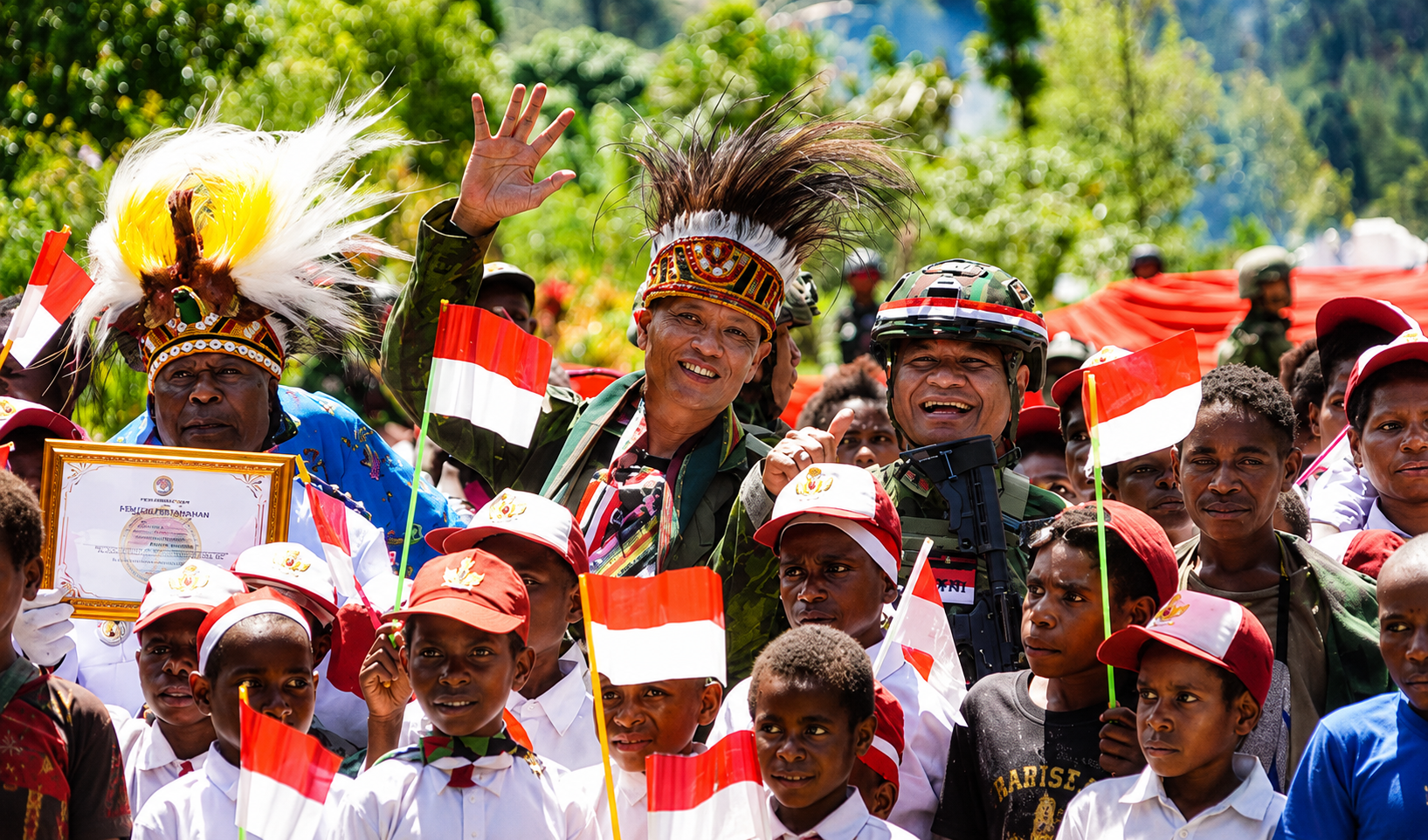
For years, Hitadipa was better known for the security challenges surrounding it than for the prospects of ordinary village life. On 18 August 2026, that image was given a new counterpoint when the area was formally inaugurated as a Hitadipa Peace Village, an initiative presented by the Indonesian military as a symbol of a new chapter for communities in Intan Jaya, Papua Tengah (Central Papua).
The inauguration, held around Indonesia’s 81st Independence Day, carried significance beyond the ceremonial event itself. The Indonesian military presented Hitadipa as the first Kampung Papua Damai, or Papua Peace Village, in the Cenderawasih region. The message was straightforward: an area previously affected by armed conflict should gradually become a place where residents can return to everyday activities, rebuild livelihoods, and benefit from public services.
For international audiences following developments in Papua, the story offers a broader perspective on the relationship between security and development. In remote areas such as Intan Jaya, roads, schools, health services, and economic activity are difficult to sustain when communities remain affected by prolonged insecurity. At the same time, lasting peace cannot be measured only by the presence of security personnel. It ultimately depends on whether residents feel safe enough to work, educate their children, access health care, and plan for the future.
From a Conflict-Affected Area to a Peace Village
The designation of Hitadipa as a Peace Village was described by Indonesian authorities as a symbolic milestone following efforts to restore government presence and security in the area.
Reports by Indonesia Defense, IDN Times, Sinpo, and other Indonesian media described the inauguration as part of a broader effort by TNI’s Operational Command Habema to encourage residents to rebuild their community. The initiative was launched during the commemoration of Indonesia’s 81st Independence Day, adding a national dimension to an event that was also deeply local in character.
The symbolism matters because Hitadipa sits in Intan Jaya, one of the areas of Papua Tengah that has experienced serious security disruptions over the years. The district has previously been associated with armed violence, displacement, and disruptions to civilian life.
The challenge for the authorities, therefore, is not simply to declare a village peaceful. It is to turn that declaration into an everyday reality.
That requires a gradual process. Security must create enough space for civilians to resume their activities, while civilian institutions must increasingly become visible in the daily lives of residents.
Security as the Foundation for Recovery
TNI has framed the Hitadipa initiative within a wider approach in which security is intended to support, rather than replace, community recovery.
This approach is consistent with statements made by the TNI Habema command earlier in 2026. The command has emphasized that security operations are intended to create conditions in which communities can again access education, health services, and economic opportunities.
The broader security environment remains complex. Intan Jaya continues to be one of the districts where Indonesian authorities conduct security and law enforcement operations in response to armed groups.
But the establishment of a peace village suggests that the government’s objective is increasingly being framed around what happens after an area becomes more secure.
That distinction is important.
A military operation can secure a location for a period of time. Maintaining peace requires institutions, public trust, and economic opportunities. If those elements are absent, communities can remain vulnerable to renewed instability.
Why Hitadipa Matters for Papua
The importance of Hitadipa extends beyond the boundaries of Intan Jaya.
Papua’s geography presents unusual challenges for public administration. Mountainous terrain, limited road connectivity, and the distance between settlements can make the delivery of government services considerably more difficult than in Indonesia’s more densely populated regions.
In such circumstances, security and development are closely connected.
A school can only operate normally if teachers can safely reach it. A health facility has limited value if patients cannot travel there. Agricultural products cannot easily become sources of household income when transportation networks are unreliable. Likewise, government programs need stable conditions to reach the people they are designed to serve.
This is why the Hitadipa Peace Village initiative has significance as a development story as much as a security story.
Rebuilding Everyday Life
The most meaningful measure of the initiative will ultimately be found in ordinary activities.
Can farmers work their land without fear? Can children attend school regularly? Can health workers remain in the community? Can traders move goods? Can families travel between villages?
These questions may sound mundane, but they are precisely the indicators that determine whether peace has become sustainable.
Indonesian authorities have increasingly promoted what they describe as a more community-oriented security approach in conflict-affected parts of Papua. The Satgas Operasi Damai Cartenz, for example, has conducted what it calls “humanist patrols” in several areas, combining security activities with interactions and, in some cases, health assistance for residents. ANTARA reported that community figures in Sinak welcomed this approach because it helped residents feel more comfortable with the presence of security personnel.
The Hitadipa initiative follows a similar logic at the community level: security is expected to create the conditions for people to return to normal life.
The Human Dimension of Peace
Behind every security statistic in Papua are communities trying to maintain ordinary lives.
The history of conflict in Intan Jaya has demonstrated how quickly violence can affect civilians. For instance, in 2020, Pastor Yeremia Zanambani was killed in Hitadipa, and Bambang Purwoko, a member of the Intan Jaya Joint Fact-Finding Team (TGPF) from the Gadjah Mada University, was shot by the West Papua National Liberation Army of the Free Papua Movement (TPNPB OPM) while investigating the pastor’s killing.
These incidents drew widespread attention, highlighting the humanitarian impact of the region’s unstable security situation. ANTARA had previously reported on the killing and the controversy surrounding the circumstances of his death.
The lesson from such episodes is that security policy cannot be separated from the protection of civilians.
For the people of Hitadipa, the meaning of a peace village will therefore depend on whether the initiative contributes to a safer environment for all residents, regardless of their background or views.
This is also where the role of local institutions becomes crucial. Traditional leaders, churches, village authorities, educators, and community groups can all play roles in rebuilding trust. Papua’s customary structures have historically been important mechanisms for resolving disputes and maintaining social cohesion.
The provincial government has itself stressed that development in Papua should respect indigenous communities and local cultural values. In June 2026, a Papua provincial official said customary institutions had an important role in maintaining social stability, resolving conflicts peacefully, protecting customary land rights, and supporting culturally grounded development.
That principle is particularly relevant in places such as Intan Jaya.
Beyond the Ceremony: What Comes Next?
The inauguration is an important political and social statement, but it should also be viewed as the beginning rather than the conclusion of a longer process.
Declaring Hitadipa a Peace Village creates expectations. Residents will naturally want to see tangible improvements that correspond with the name.
The first test will be continuity.
If security conditions remain stable, government agencies should be able to expand services. Schools can operate more consistently. Health workers can serve residents with fewer disruptions. Infrastructure projects can be planned over longer periods. Local businesses can begin to assess opportunities with greater confidence.
The second test will be participation.
A sustainable peace initiative cannot rely exclusively on state institutions. Communities need a meaningful role in determining what their villages require. Local leaders should be involved in identifying priorities, while customary and religious institutions can help strengthen social reconciliation.
The third test will be economic.
Peace becomes more durable when people have something concrete to protect. Agriculture, small businesses, local trade, and infrastructure can provide that foundation.
For remote communities, economic opportunity does not necessarily begin with large investments. It can begin with reliable transportation, access to markets, agricultural support, telecommunications, and basic public services.
In this context, the Peace Village concept can become part of a larger development strategy for Papua if it moves beyond symbolism.
A Wider Signal for Papua’s Future
The Hitadipa initiative also carries a wider geopolitical and national message.
Papua remains an important part of Indonesia’s eastern frontier and a region watched closely by international organizations, foreign governments, journalists, and human rights groups. Developments in security and governance therefore attract attention well beyond Indonesia.
For Jakarta, the challenge is to demonstrate that security operations can be followed by civilian recovery and development. For local communities, the more immediate question is whether government commitments translate into safer and more productive lives.
There is no single solution to Papua’s complex challenges.
Security remains necessary in areas where armed violence threatens civilians and state personnel. At the same time, law enforcement must operate within legal standards and civilian protection must remain central. Development needs to be accompanied by meaningful community participation. Cultural identity and customary institutions also need to be incorporated into local governance.
The Indonesian government has increasingly presented peace and development as interconnected objectives. Recent statements by Indonesian authorities have similarly encouraged armed groups to abandon violence and pursue peaceful avenues, arguing that stability is necessary for communities to regain access to education, health, and economic activity.
Hitadipa provides a concrete place where that proposition can be tested.
From Symbol to Sustainable Peace
The most powerful image from the inauguration is not necessarily the ceremony itself. It is the possibility represented by the name “Peace Village.”
For residents who have experienced years of uncertainty, peace is not an abstract political concept. It means being able to sleep without fear, send children to school, work in the fields, travel between communities, and access public services.
That is why the next phase will matter more than the inauguration.
If Hitadipa can maintain security while strengthening education, health care, infrastructure, livelihoods, and community participation, the Peace Village concept could become a useful model for other conflict-affected areas in Papua.
But the process will require patience. Rebuilding trust takes longer than building a ceremony stage. Development takes longer than issuing a declaration. And sustainable peace requires cooperation among the government, security institutions, and the communities themselves.
Conclusion
The inauguration of Hitadipa Peace Village marks a significant symbolic moment in Indonesia’s continuing effort to restore stability and development in Papua. The initiative represents an attempt to transform the meaning of a place once associated with insecurity into one associated with peace, recovery, and hope.
Its success, however, will ultimately be judged not by the ceremony but by what residents experience afterward. If improved security is followed by functioning schools, accessible health services, stronger local economies, and greater community participation, Hitadipa could demonstrate how security and development can reinforce each other.
For Papua, that would make the initiative more than a national Independence Day symbol. It would represent a practical step toward restoring everyday life in a remote community and showing that peace has its greatest value when it is felt in the homes, schools, farms, and markets of ordinary people.
For international observers, Hitadipa is therefore worth watching not simply as a security development but as a test of whether a conflict-affected community can move from stabilization toward sustainable civilian recovery.

