
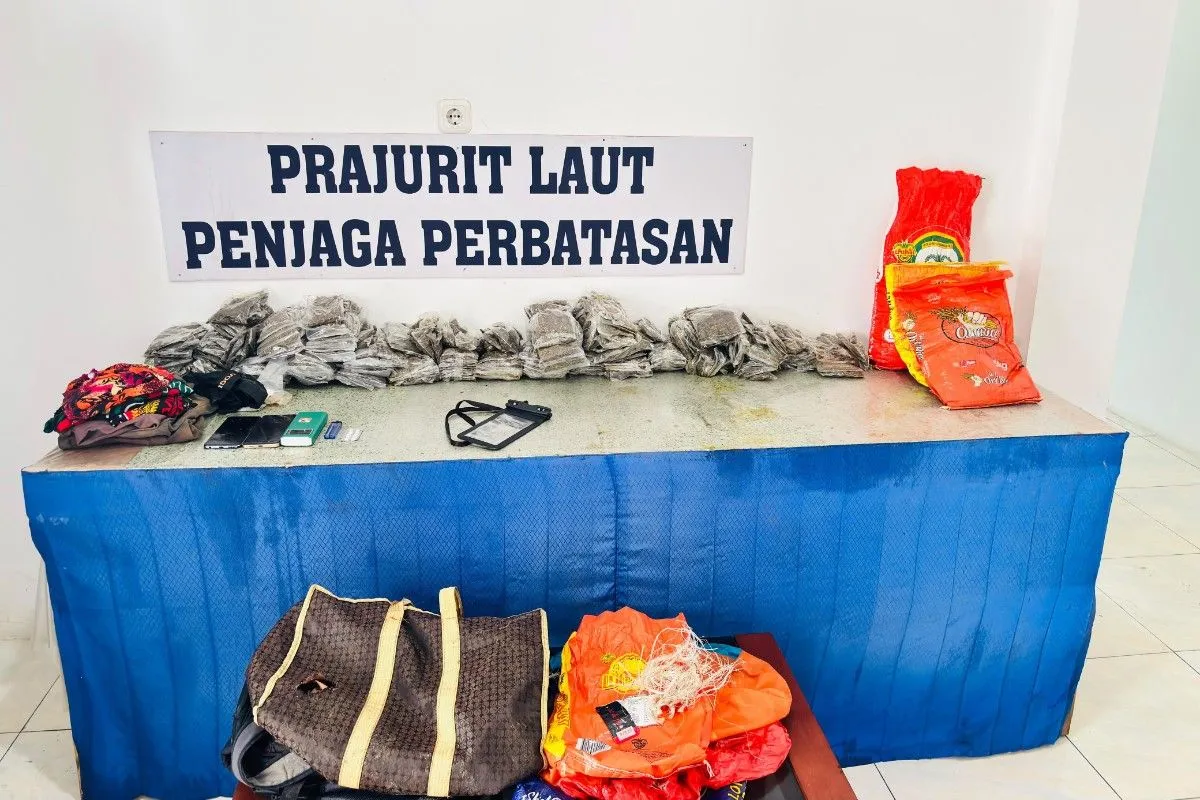
A routine maritime patrol in Papua’s Skouw Sae waters turned into a significant border security operation on August 18, when personnel from the Indonesian Navy’s Skouw Sae Post under Naval Regional Command X (Kodaeral X) intercepted an attempted shipment of 14 kilograms of cannabis from Papua New Guinea (PNG) toward Jayapura. The seizure, reported by Indonesian news agency ANTARA and Pasific Pos, highlights the continuing challenge of preventing narcotics from moving through the porous maritime and land border between Indonesia and PNG.
The operation also demonstrated the practical difficulties faced by security personnel operating along one of Indonesia’s most geographically complex frontier areas. According to Kodaeral X Commander Maj. Gen. TNI (Mar) Sugianto, seven PNG nationals allegedly involved in the shipment were traveling in a motorboat powered by a 40-horsepower engine. When pursued by Indonesian personnel, they threw sacks containing the cannabis into the sea before turning back toward PNG waters. The Indonesian patrol team nevertheless succeeded in recovering the narcotics.
The incident is significant beyond the quantity of drugs seized. Papua’s border with PNG serves as a strategic corridor that connects communities, markets, and waterways, but criminal networks can also exploit its geography. Strengthening maritime surveillance, therefore, forms part of a broader effort to keep border communities safe, protect legitimate economic activity, and prevent Papua from becoming a transit or destination point for illegal narcotics.
A Maritime Interception at Skouw Sae
The interception took place in the waters of Skouw Sae, Muara Tami District, Jayapura City, an area directly adjacent to PNG. ANTARA reported that the smugglers attempted to evade the Indonesian patrol by throwing the cannabis cargo overboard. After a chase, the boat returned to PNG territory, preventing Indonesian personnel from apprehending those on board.
The episode illustrates an important characteristic of border enforcement in Papua. Unlike operations conducted entirely on land, maritime interdiction requires security forces to operate within clearly defined territorial waters while responding rapidly to vessels capable of crossing an international boundary.
In this case, the smugglers’ boat had a considerable speed advantage. The vessel reportedly used a 40-horsepower engine, while the patrol speedboat operated by the Skouw Sae Naval Post was equipped with a 15-horsepower engine. That difference made a direct pursuit difficult, even though Indonesian personnel managed to recover the abandoned cargo.
The outcome nevertheless prevented 14 kilograms of cannabis from reaching its intended destination. From a law enforcement perspective, recovering the narcotics before they entered the domestic distribution chain represents an important preventive success.
The Cargo Was Abandoned at Sea
The decision by the suspected smugglers to discard the sacks was a crucial moment in the operation. Rather than allowing the cargo to continue toward Jayapura, the patrol personnel secured the packages after they were thrown into the water.
According to the reports, the seven people on board subsequently fled toward PNG. Their escape means that the operation primarily resulted in the seizure of the narcotics rather than arrests. Further investigation and cross-border cooperation would be necessary to determine the broader network behind the shipment.
The case also shows why border security cannot depend solely on arrests at the point of interception. Intelligence gathering, surveillance, cooperation among Indonesian agencies, and communication with neighboring authorities remain important components of an effective strategy against transnational narcotics trafficking.
Strengthening Patrol Capacity Along Papua’s Border
The Indonesian Navy has responded to the operational challenge by increasing its maritime patrol capacity. Kodaeral X has deployed a Rigid Buoyancy Boat (RBB) equipped with two engines, each rated at 300 horsepower. According to Sugianto, the additional vessel is intended to improve the ability of Indonesian personnel to pursue fast-moving boats involved in smuggling activities from PNG.
The deployment is particularly relevant in Papua, where the border environment presents a combination of difficult terrain, scattered settlements, and waterways. Security personnel must balance enforcement responsibilities with the need to facilitate legitimate movement and economic interaction between communities.
A stronger patrol capability can therefore serve more than one purpose. It can deter criminal activity while also giving authorities greater confidence in monitoring maritime approaches to Indonesian territory.
The 14-kilogram seizure demonstrates why such capabilities matter. A small motorboat can potentially move quickly through coastal waters, and once a vessel reaches another country’s jurisdiction, Indonesian authorities face legal and operational limitations. Faster patrol assets can reduce the time available for smugglers to escape.
Why Papua’s Border Matters for Drug Control
Narcotics trafficking is not simply a criminal justice issue. In border regions, it can affect public health, household security, youth welfare, and local economic conditions.
Papua’s proximity to PNG makes the province particularly important within Indonesia’s broader border management strategy. The Skouw area is also a point of interaction between communities on both sides of the international boundary. Most cross-border activity is legitimate, including social, cultural, and economic exchanges. The challenge for authorities is to distinguish and protect legitimate activity while disrupting criminal trafficking.
This requires an approach that does not treat border communities themselves as security threats. Instead, effective enforcement depends on cooperation with residents, improved surveillance, stronger customs and law enforcement coordination, and accessible channels for reporting suspicious activity.
The latest seizure provides a concrete example of how frontline personnel can prevent illegal commodities from moving deeper into Indonesian territory.
Protecting Communities, Not Restricting Them
For international observers, Papua’s border security should also be viewed through the wider question of community welfare. Narcotics trafficking can impose costs on communities that have no involvement in the criminal networks behind it.
When illegal drugs reach local markets, the consequences can extend to schools, families, and workplaces. Preventing drugs from entering the domestic distribution chain is therefore part of protecting the social environment in which Papua’s communities are expected to develop.
At the same time, security operations need to remain proportionate and consistent with Indonesian law. Effective border management is strongest when enforcement is combined with community engagement, economic opportunity, and public awareness.
A Broader Challenge for Indonesia and PNG
The Skouw Sae incident also underscores the inherently cross-border character of narcotics trafficking. A shipment may originate in one country, travel through coastal waters, and eventually be distributed in another. No single patrol or institution can address the entire chain by itself.
Indonesia and PNG share a long and complex frontier. Cooperation between the two countries is therefore important not only for combating drugs but also for addressing other forms of transnational crime.
The latest incident involved seven alleged smugglers who, according to Indonesian authorities, returned to PNG after abandoning their cargo. This aspect of the case demonstrates the importance of information exchange between authorities on both sides of the border.
The seizure itself may stop one shipment, but identifying the people who organized, financed, and intended to distribute the drugs would provide a more lasting law enforcement benefit. Such investigations require evidence, intelligence, and appropriate coordination across jurisdictions.
Border Security and Papua’s Development
Security and development in Papua are closely connected. Roads, ports, markets, telecommunications networks, and border facilities are intended to expand economic opportunities and improve connectivity. Yet improved connectivity can also be exploited by criminal actors if security systems do not develop alongside infrastructure.
For Indonesia, this creates a dual responsibility. Border areas must remain open enough to support legitimate commerce and social interaction while being sufficiently monitored to prevent illegal trafficking.
The Skouw Sae operation illustrates that balance. The authorities did not close the border or restrict legitimate economic activity. Instead, they targeted a specific suspected criminal activity and prevented the shipment from reaching Jayapura.
That distinction is important when considering Papua’s long-term development. A secure border can support legitimate trade, tourism, and community mobility, while an uncontrolled border can create opportunities for illicit markets.
The latest operation, therefore, has relevance beyond the 14 kilograms of cannabis. It demonstrates the role of security institutions in creating an environment where economic and social development can proceed with greater confidence.
From Seizure to Prevention
The recovery of the cannabis is an immediate operational success, but its longer-term value will depend on what happens next.
Authorities can use the case to investigate the shipment’s organization, origin, intended recipient, and how to detect similar shipments in the future. The information obtained could help strengthen risk profiling and maritime surveillance.
The deployment of the faster RBB patrol boat is one visible response. But technology and equipment alone will not eliminate trafficking. Intelligence, trained personnel, interagency cooperation, and community participation remain essential.
The same principle applies to public education. Communities living near border areas can become important partners in preventing illegal activity when they have access to clear information and safe mechanisms for reporting suspected trafficking.
A Stronger Security Architecture for Papua
The Skouw Sae seizure comes at a time when Papua continues to receive substantial national attention in the areas of security, infrastructure, public services, and economic development. Maintaining stability along the international frontier is part of that wider agenda.
For Papua’s residents, effective security is ultimately about creating conditions in which daily life and legitimate economic activity can continue without intimidation or criminal disruption. For Indonesia, it is also a matter of maintaining the integrity of its international borders.
The successful recovery of the 14-kilogram shipment demonstrates that frontline security personnel can make a tangible difference. The next challenge is to transform individual successes into a sustained prevention system.
This means combining maritime patrols with intelligence-led enforcement, cooperation with PNG authorities, and stronger engagement with communities on both sides of the border. Such an approach is likely to be more effective than relying exclusively on reactive arrests or seizures.
Conclusion
The interception of 14 kilograms of cannabis allegedly being smuggled from Papua New Guinea into Jayapura is a reminder that Papua’s security challenges extend beyond isolated criminal incidents. The Skouw Sae operation showed both the determination of Indonesian personnel and the practical difficulties of policing an international maritime frontier.
The fact that the suspected smugglers escaped back into PNG waters also demonstrates the limits of enforcement when criminal activity crosses national boundaries. Indonesia’s decision to strengthen patrol capability through the deployment of a faster RBB is therefore a logical step toward improving deterrence and response capacity.
For Papua, however, security should not be viewed separately from development. Preventing narcotics trafficking protects families and communities, supports lawful commerce, and helps maintain an environment in which education, employment, and investment can grow. The objective is not simply to seize illegal drugs but to prevent criminal networks from taking root in communities that are pursuing a more stable and prosperous future.
The Skouw Sae case ultimately conveys a clear message: Indonesia’s border security institutions are increasingly prioritizing the prevention of illegal commodities from reaching Papua’s communities. Sustained enforcement, combined with cooperation with PNG and meaningful engagement with border residents, will be critical to turning that response into long-term security.

