
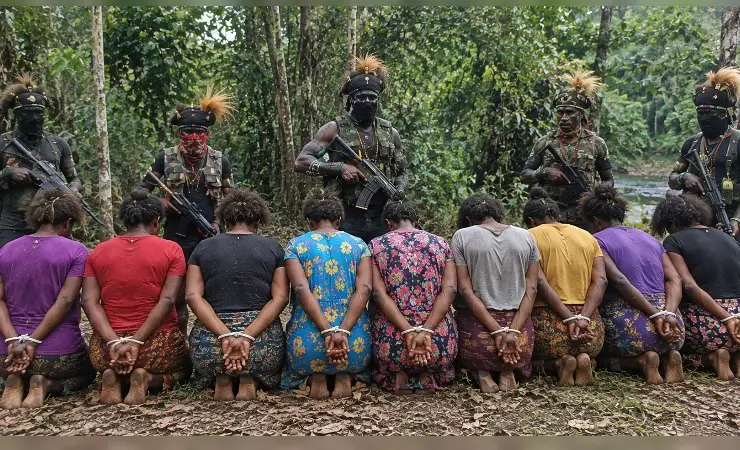
Nine women have been reported abducted in Kampung Pasir, Jila District, Mimika Regency, Papua Tengah (Central Papua) Province, following an armed clash in the remote district on 17 August, according to local reports. One woman was subsequently found dead with a gunshot wound, while another injured woman was reportedly found after being thrown into a ravine. The incident occurred on the same day Indonesia marked its 81st Independence Day, adding to security concerns in an area already affected by armed violence.
Local reporting cited information from residents who said that as many as 11 women had initially been affected. Two were subsequently located, leaving nine whose whereabouts and condition remained unknown at the time of reporting. The reports describe the incident as occurring after a clash involving an armed group in Jila.
The case has also been linked to an earlier attack on an Indonesian military post in Jila in which one soldier, Private First Class Rizki Kurniawan, was killed and two others were wounded. The West Papua National Liberation Army from the Free Papua Movement (TPNPB OPM) spokesperson Sebby Sambom separately claimed responsibility for the attack on the military post, saying the group had attacked it on 17 August.
The allegations surrounding the women, however, require careful verification. While local reports describe the women as victims of alleged hostage-taking, information available publicly at the time of publication does not establish every detail of their circumstances independently. The priority now is locating those still missing, protecting civilians, and establishing the facts through credible investigation.
Violence Escalates in Remote Jila
Jila is a mountainous and relatively isolated district in Mimika Regency. Its geography can make communication, transportation, and emergency response considerably more difficult than in urban areas such as Timika.
Against this backdrop, reports of civilian casualties following an armed confrontation have raised immediate humanitarian and security concerns.
According to Fajar Papua, information from residents indicated that 11 women were initially believed to have been affected. Two were later found. One woman, Neregingget Magai (48), had died from a gunshot wound to the abdomen, while another woman, Inkolung Aim, was reportedly found after being thrown into a ravine and suffering a broken leg. The injured woman was evacuated by residents to Kampung Pilikogom for medical treatment.
Nine women were still reported missing at the time of the report. The nine residents are Nemerina Wamang (17), who is in the early stages of pregnancy; Alin Mesawarol (6th-grade elementary student); Nopi Aim (4th-grade elementary student); Opinte Meswaro (3rd-grade elementary student); Yonita Senawatme (18); Meria Nibilingame (15); Wena Katagame (18); Ilimin Onawame (18); and Miante Nibilingame (13).
The circumstances surrounding the women remain particularly serious because civilians can become highly vulnerable during armed confrontations in isolated communities. When fighting occurs near villages, residents may have limited access to safe routes, medical services, or communications with authorities.
The immediate humanitarian concern is therefore straightforward: determine where the nine women are and ensure their safe return.
One Confirmed Death Adds Urgency
The death of the woman reportedly found with a gunshot wound has intensified concerns about the consequences of the violence.
Her death also illustrates the danger faced by civilians when armed confrontations take place close to populated areas. Regardless of the competing claims surrounding the incident, civilian protection must remain central to the response.
The second woman, who was reportedly found injured after being thrown into a ravine, also demonstrates the potential severity of the situation. Her evacuation by local residents points out the necessity of community networks in remote Papua, particularly where access to formal emergency services can be difficult.
For authorities, establishing a reliable account of what happened will require statements from survivors, witnesses, and local officials, alongside medical and forensic evidence where available.
Military Post Attack Preceded the Reports
The reported abduction case came in the aftermath of a separate armed attack on a military post in Jila.
TPNPB OPM spokesperson Sebby Sambom claimed responsibility for the attack in a statement reported by Galeri Papua. According to the statement, the group said it attacked an Indonesian military post in Jila at around 8 a.m. on 17 August and claimed that Private First Class Rizki Kurniawan was killed, while two other soldiers, identified as Private First Class Y. Pasaribu and Private First Class Kiki Febrio, were wounded.
These are claims made by the group’s spokesperson and should be distinguished from independently verified facts.
Multiple Indonesian media outlets have reported the death of Rizki Kurniawan. His death occurred on the country’s Independence Day, when communities throughout Indonesia were holding ceremonies and public celebrations.
The juxtaposition is stark. While much of Indonesia was celebrating the national holiday, a remote community in Papua was experiencing an armed confrontation with fatal consequences.
The Security Implications
The sequence of events has renewed attention to the security environment in parts of Papua Tengah.
Armed attacks involving Indonesian security personnel have the potential to trigger broader security operations, restrict civilian movement, and disrupt economic and social activities. In remote districts, even a relatively localized incident can have wider consequences because transportation routes and communication infrastructure are limited.
For residents, uncertainty can itself become a serious burden.
Farmers may hesitate to travel to fields. Families may restrict children’s movement. Health workers can face difficulties reaching patients. Government services may also become harder to deliver when security conditions deteriorate.
That is why protecting civilians should remain a central component of any security response.
The Nine Missing Women Are the Immediate Priority
The most pressing issue is not the political rhetoric surrounding the conflict but the fate of the nine women who were still reported missing.
The available reporting does not provide sufficient independently verified information to establish their precise location, condition, or the circumstances in which they disappeared.
This distinction matters.
In a conflict environment, additional witnesses are interviewed and authorities gain access to affected areas, leading to changes in early reports. Responsible reporting therefore requires separating confirmed information from allegations and claims.
At the same time, uncertainty should not reduce the urgency of the search.
Community Assistance Is Critical
The role played by local residents in locating and evacuating two women demonstrates the importance of community involvement.
Residents often possess the most immediate knowledge of difficult terrain, traditional routes, and locations that may not be easily accessible to outside personnel. Cooperation between communities and authorities can therefore be crucial in locating missing civilians.
Humanitarian principles also require that civilians be protected regardless of their political views or affiliations.
The women who are reported missing should be prioritized as civilians whose safety is at risk.
Independence Day Raises Additional Concerns
The timing of the violence has attracted particular attention because the attack occurred on 17 August, Indonesia’s Independence Day.
The national anniversary is one of Indonesia’s most prominent public occasions. In Papua, celebrations were held in numerous districts, including communities in Mimika. Fajar Papua reported that the Independence Day ceremony in Mimika Barat proceeded safely and orderly, with students, teachers, health workers, government personnel, and community representatives participating.
That contrast is significant.
It indicates that the security situation in Papua is not uniform. Violence in one remote location does not mean that all communities across the region experienced disruption.
At the same time, incidents around nationally significant dates can generate heightened public concern because they attract considerable attention from the national media and international observers.
The government therefore faces the dual task of responding firmly to armed attacks while ensuring that security measures do not unnecessarily disrupt civilian life.
Separating Security from Civilian Protection
The latest incident also highlights the difficult balance involved in maintaining security in Papua.
The state has a responsibility to protect its personnel and civilians from armed violence. At the same time, security operations must remain subject to Indonesian law and appropriate standards for civilian protection.
This distinction is essential for maintaining public confidence.
A strong response does not necessarily mean a purely military response. Effective security in remote areas also depends on functioning civilian administration, reliable communications, healthcare access, transportation, and community engagement.
In places such as Jila, development and security are closely connected.
When communities have reliable roads, communications, and public services, authorities can respond more quickly to emergencies. When communication networks are weak and transportation depends heavily on difficult terrain, misinformation and uncertainty can spread rapidly.
Development is Part of Long-Term Stability
Papua’s security challenges cannot be considered separately from its development conditions.
Infrastructure projects, education, healthcare, and economic opportunities can strengthen the resilience of communities. Better connectivity can also allow emergency services to reach isolated areas more rapidly.
This does not mean development alone can resolve armed conflict. Security threats require appropriate law enforcement and security responses. But sustainable stability depends on more than security personnel.
It depends on whether civilians feel safe enough to work, attend school, access healthcare, and participate in community life.
A Pattern of Violence with Wider Consequences
The Jila incident follows a series of armed confrontations involving TPNPB OPM and Indonesian security forces in different parts of Papua.
The latest attack is particularly serious because it reportedly resulted in the death of a soldier and injuries to two others, followed by reports of civilian casualties and missing women.
For international observers, the situation illustrates why Papua’s security environment requires careful, fact-based reporting.
Statements from armed groups, government authorities, local residents, and media organizations can differ substantially. Each claim, therefore, needs to be identified clearly rather than presented as independently established fact.
The claim of responsibility issued by Sebby Sambom is significant because it provides an account from the armed group itself. But a claim of responsibility is not equivalent to independent verification of every allegation associated with the broader incident.
That distinction is particularly important when civilians are involved.
Protecting Civilians Must Come First
Regardless of the investigation’s final findings, the reported death of one woman and the disappearance of nine others should remain the primary focus.
The Indonesian government and security authorities face a clear responsibility to pursue information about the missing women and facilitate safe evacuation where possible.
Local communities also have an important role to play by providing credible information and supporting humanitarian efforts.
For media organizations, the responsibility is equally important. Reporting on Papua requires accuracy, context, and restraint, particularly when information emerges during an active security incident.
Sensational descriptions can deepen fear. Unverified accusations can inflame tensions. Clear reporting, by contrast, can help the public understand what is known, what remains disputed, and what authorities are doing to address the situation.
Avoiding Collective Blame
The incident should also not be used to stigmatize Papua’s wider population.
The overwhelming majority of civilians in Papua are not participants in armed violence. Residents continue to work, attend school, operate businesses, celebrate cultural events, and participate in national activities.
The reported violence in Jila should therefore be understood as a security incident involving specific actors and circumstances, rather than as a reflection of Papuan society as a whole.
This distinction is important for both public safety and social cohesion.
What Comes Next
The immediate priority is locating the nine women whose whereabouts remained unknown according to local reporting.
The second priority is establishing a reliable chronology of the events surrounding the military post-attack and subsequent civilian casualties.
The third is ensuring appropriate medical, psychological, and social support for survivors and affected families.
For the Indonesian government, the challenge will be maintaining security while protecting civilian communities and ensuring that legitimate investigations can proceed.
For Papua Tengah, the incident is another reminder that security and development cannot be separated. Remote communities need effective protection, but they also need functioning health services, communications, infrastructure, and access to government institutions.
The long-term objective should be a situation in which civilians are able to live and work without fear of armed violence.
Conclusion
The reported abduction of nine women in Jila, Mimika, following an armed clash on 17 August, has added a serious humanitarian dimension to an already tense security situation in Papua Tengah. One woman was reported dead from a gunshot wound, another was found injured, and nine others remained unaccounted for in the latest local reporting.
The incident came after an attack on an Indonesian military post in Jila that killed Private First Class Rizki Kurniawan and wounded two other soldiers. TPNPB OPM spokesperson Sebby Sambom claimed responsibility for that attack, although such claims should be distinguished from independently verified findings.
The immediate priority is the safety of the nine missing women and the protection of civilians. Beyond the immediate security response, the episode underscores the importance of stronger communication, emergency services, local governance, and infrastructure in remote Papua.
Ultimately, lasting stability will depend not only on preventing armed attacks but also on ensuring that communities can live, work, and access public services safely. A measured, lawful, and civilian-focused response is essential if Papua is to move toward greater security and sustained development.

