The Trans Papua Highway has reached another important stage as Indonesia’s Ministry of Public Works accelerates construction on two strategic sections designed to improve mobility across Papua. The Jayapura to Wamena corridor and the Mamberamo to Elelim segment have both recorded significant progress, with the latter surpassing 51 percent completion. Authorities are targeting November 2026 for completion, reflecting continued efforts to strengthen transportation infrastructure in one of Indonesia’s most geographically challenging regions.
For communities living in Papua’s mountainous interior, improved road connectivity represents more than a transportation project. Reliable roads are expected to shorten travel times, reduce the cost of transporting essential goods, improve access to healthcare and education, and strengthen economic links between highland districts and coastal areas.
Government officials have emphasized that the Trans Papua Highway forms part of a broader national strategy to reduce regional disparities while encouraging more inclusive development throughout eastern Indonesia.
Trans Papua Highway Reaches an Important Construction Phase
Construction activities continue simultaneously on several strategic sections of the Trans Papua Highway, with the Jayapura to Wamena route remaining one of the project’s highest priorities.
According to the Ministry of Public Works, engineers are focusing on completing sections that will eventually provide continuous land access between Papua’s northern coast and its central highlands.
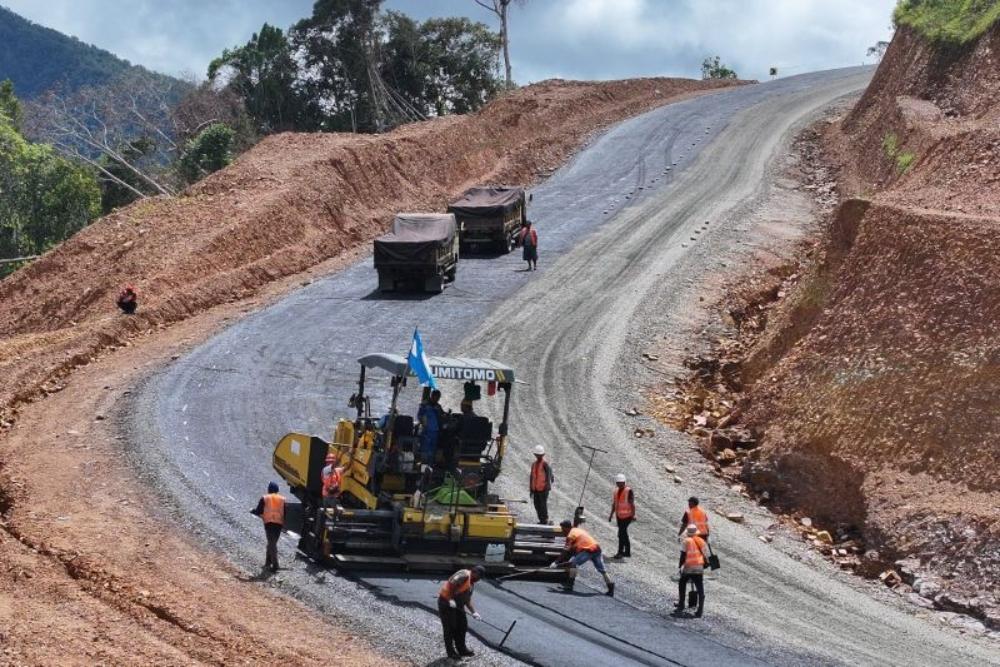
Another major component of the project, the Mamberamo to Elelim segment, has reached more than 51 percent physical progress, placing the project on schedule toward its targeted completion in November 2026.
Officials describe this progress as an important milestone considering the considerable engineering and logistical challenges associated with constructing roads across Papua’s mountainous terrain.
Steep slopes, dense forests, high rainfall in many areas, and limited access for heavy equipment require extensive planning before construction can proceed safely.
Despite these challenges, work has continued through close coordination among engineers, contractors, and government agencies responsible for transportation and public infrastructure.
The project reflects Indonesia’s long term commitment to expanding land transportation networks across Papua while improving accessibility for remote communities.
Connecting Jayapura and Wamena
The corridor linking Jayapura, Papua’s provincial capital, with Wamena, the principal urban center in the central highlands, represents one of the most strategically significant transportation projects currently underway.
Historically, travel between the two regions has depended largely on air transportation because mountainous terrain makes road construction exceptionally difficult.
Although aviation remains essential, limited transportation alternatives have contributed to relatively high logistics costs for consumer goods, construction materials, healthcare supplies, and agricultural products.
The Trans Papua Highway seeks to complement existing transportation modes by providing more reliable overland access.
Government officials expect the completed corridor to improve mobility for residents while creating more efficient distribution routes connecting coastal ports with inland districts.
Improved road access is also expected to facilitate public services by enabling healthcare workers, teachers, government officials, and emergency responders to reach communities more efficiently.
For residents, greater transportation options may reduce travel costs while improving access to educational institutions, regional markets, and administrative services.
Lowering Logistics Costs Through Better Connectivity
One of the principal objectives of the Trans Papua Highway is reducing the high cost of transporting goods throughout Papua.
Many everyday necessities currently depend upon complex supply chains involving maritime transport followed by air cargo or limited land transportation.
These logistical constraints contribute to higher prices for food, construction materials, fuel, medical supplies, and other essential commodities in remote districts.
By expanding road connectivity, authorities expect transportation costs to become more efficient over time.
Lower logistics costs may allow consumer goods to reach communities more quickly while reducing overall distribution expenses.
Government officials have repeatedly emphasized that improved transportation infrastructure plays an important role in supporting more affordable living costs.
For households in Papua’s interior, reduced transportation expenses could eventually contribute to lower prices for essential goods while strengthening local economic activity.
The Ministry of Public Works therefore views road construction not only as an engineering achievement but also as an investment supporting broader economic development and improved public welfare.
Infrastructure Supports Social Development
The significance of the Trans Papua Highway extends well beyond transportation.
Road connectivity often influences multiple aspects of regional development simultaneously.
Reliable roads improve access to hospitals, schools, universities, government offices, agricultural markets, and employment opportunities.
They also strengthen disaster response capacity by enabling emergency services to reach affected communities more rapidly during natural disasters or humanitarian emergencies.
For Papua, where geographical isolation has historically limited mobility in many districts, transportation infrastructure provides an important foundation for broader social development.
Government planners note that improved accessibility encourages greater interaction among communities while supporting public service delivery throughout remote regions.
As additional road sections become operational, communities may experience gradual improvements in mobility alongside expanded opportunities for commerce, tourism, agriculture, and regional cooperation.
Infrastructure Drives Economic Growth Across Papua
Beyond improving transportation, the Trans Papua Highway is expected to become an important driver of regional economic development by strengthening connections between production centers, markets, and public services.
For decades, Papua’s challenging topography has contributed to high logistics costs, making the transportation of food, fuel, construction materials, and consumer goods significantly more expensive than in many other parts of Indonesia. Limited land connectivity has also influenced the movement of agricultural products from rural areas to larger commercial centers.
Government planners believe that expanding road access will gradually improve the efficiency of supply chains while creating new opportunities for local businesses.
Farmers will be able to transport crops more efficiently to regional markets.
Small and medium enterprises may gain wider access to customers and suppliers.
Local producers could reduce transportation expenses that have historically affected competitiveness.
Improved accessibility may also encourage greater investment in sectors such as agriculture, fisheries, tourism, logistics, and small scale manufacturing.
Transportation economists generally agree that reliable infrastructure plays a central role in supporting long term economic growth because it reduces transaction costs while improving the movement of people, goods, and services.
For Papua, where geographical isolation has long shaped economic activity, improved road networks have the potential to strengthen regional integration while expanding opportunities for communities throughout the interior.
Improving Access to Essential Services
The benefits of the Trans Papua Highway extend beyond commerce.
Improved transportation infrastructure also contributes to better access to essential public services that directly affect quality of life.
Healthcare providers serving remote districts often face considerable logistical challenges when transporting medicines, medical equipment, and emergency supplies.
Improved road connectivity can shorten delivery times while supporting more reliable access to health facilities for patients requiring specialized treatment.
Education also stands to benefit.
Students traveling between villages and educational institutions may experience shorter travel times, while teachers and educational resources can reach remote schools more efficiently.
Government agencies responsible for public administration likewise benefit from improved accessibility, allowing services to reach communities that have traditionally faced transportation constraints.
Emergency response capabilities also become stronger when road access improves.
During natural disasters or humanitarian emergencies, transportation infrastructure enables faster deployment of emergency personnel, relief supplies, and medical assistance.
These broader social benefits illustrate why infrastructure development is often viewed as an investment in human development as well as economic progress.
Supporting Inclusive Regional Development
The Ministry of Public Works has consistently emphasized that the Trans Papua Highway forms part of Indonesia’s broader strategy to promote more equitable development across the archipelago.
Infrastructure projects in eastern Indonesia aim not only to expand transportation networks but also to reduce development disparities by improving access to opportunities.
In Papua, where geographical conditions have historically limited connectivity between districts, improved transportation can strengthen interaction among communities while supporting more balanced regional growth.
Road construction also complements investments in ports, airports, telecommunications, electricity, healthcare facilities, schools, and other public infrastructure.
Together, these initiatives create a more integrated development framework designed to improve living standards while encouraging sustainable economic activity.
Observers note that infrastructure alone cannot resolve every development challenge.
However, reliable transportation remains a fundamental prerequisite for expanding education, healthcare, investment, tourism, agriculture, and public services.
The Trans Papua Highway therefore represents one important component within a broader effort to improve social and economic opportunities throughout Papua.
Looking Ahead
With the Mamberamo to Elelim segment now exceeding 51 percent completion and construction continuing along the Jayapura to Wamena corridor, attention is increasingly focused on achieving the government’s target of completing these strategic sections by November 2026.
Engineers will continue addressing technical challenges presented by Papua’s mountainous landscape while maintaining construction quality and environmental standards.
Upon completion, the highway is expected to strengthen regional mobility, improve logistics efficiency, and support more effective delivery of public services across multiple districts.
Government officials also anticipate that improved connectivity will contribute to lower transportation costs over the long term, helping stabilize prices for essential goods while creating additional opportunities for local economic development.
As complementary investments in education, healthcare, digital connectivity, and regional infrastructure continue, the Trans Papua Highway is expected to play an increasingly important role in supporting Papua’s sustainable development.
Conclusion
The continued progress of the Trans Papua Highway, particularly along the Jayapura to Wamena corridor and the Mamberamo to Elelim segment, reflects Indonesia’s long term commitment to improving connectivity across Papua’s geographically challenging landscape.
With the Mamberamo to Elelim section surpassing 51 percent completion and authorities targeting November 2026 for completion, the project marks another important milestone in expanding transportation infrastructure throughout eastern Indonesia.
Beyond constructing roads, the initiative seeks to improve mobility, reduce logistics costs, strengthen public services, and encourage more inclusive economic development.
Lower transportation costs are expected to make essential goods more affordable while improving access to healthcare, education, and regional markets for communities across Papua’s interior.
As construction continues, the Trans Papua Highway illustrates how strategic infrastructure investment can contribute to stronger regional integration, enhanced economic resilience, and improved quality of life for communities throughout Papua.