
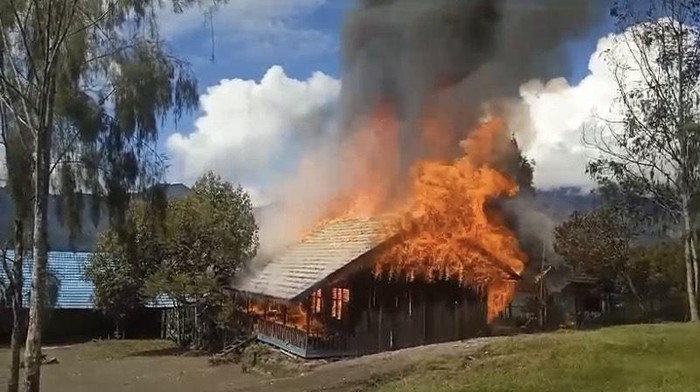
Over the past two years, some students in remote parts of Papua returned to class after holidays to find something no child should ever have to face: their school was gone.
In several districts affected by armed violence, classrooms, which were once used for lessons, examinations, and community activities, were reduced to blackened timbers and twisted roofing sheets. Teachers who had worked for years in difficult conditions suddenly found themselves without a place to teach. Children who already had long commutes to school were forced to learn elsewhere, if they could learn at all.
At least ten school buildings have been burned in Papua in the past two years, with the Indonesian Army blaming the attacks on the armed separatist group known as the TPNPB OPM, according to information released by the Indonesian Army and reported by Indonesia Defense.
Complete list of 10 arson attacks carried out by OPM in the Papua region
1. Feb 14, 2025: The burning of a building of Agandugume Middle School in the district of Agandugume, Puncak Regency, Papua Tengah (Central Papua) Province, by the OPM Kodap III Sinak Group.
2. Burning of 5 (five) empty buildings of Kiwirok High School in Sopamikma Village, Kiwirok District, Pegunungan Bintang Regency, Papua Pegunungan (Papua Highland) Province, on September 27, 2025, by the OPM Group, Armed Front, Kodap XV/Ngalum Kupel.
3. October 28, 2025: The TPNPB-OPM Armed Front Kodap XV/Ngalum burned down the Kiwirok Middle School Teachers’ Housing building in Oksibil District, Pegunungan Bintang Regency, Papua Mountains Province.
4. On January 11, 2026, an attempt to burn down a classroom at SMPN 2 Dekai, Dekai District, Yahukimo Papua Mountains, was made by the Armed Front Kodap XVI Yahukimo OPM Group.
5. On 10 February 2026, the OPM group affiliated with the Armed Front of Kodap XVI, Yahukimo, burned a classroom at SMAN 2 Ninia in the Dekai District, Yahukimo, Papua Mountains.
6. The OPM Group from the Armed Front of Kodap XVI, Yahukimo, burned SMAN 2 Ninia in the Dekai District, Yahukimo, Papua Mountains, on February 14, 2026.
May 20, 2026: Burning of the Koaserama Middle School building in Dekai District, Yahukimo, Papua Mountains, by the OPM Group of the Armed Front of Kodap XVI Yahukimo 7.
8. May 22, 2026: Burning of the office building of the SMPN 2 Dekai unit in Dekai District, Yahukimo, Papua Mountains, by the Armed Front of Kodap XVI Yahukimo OPM Group.
On June 4, 2026, the OPM Group set fire to one school building, two houses, and one health facility in Manggelum Village, Boven Digoel, Papua Selatan (South Papua).
10. June 4, 2026: TPNPB-OPM Kodap XXX The Noukai Group burned two buildings and nine classrooms at Yapis Waghete I Elementary School, Tigi District, Deiyai, Papua Tengah.
The figure has sparked discussion among policymakers, educators, religious leaders, and representatives of the community about the long-term impact of violence on education in Papua, a region where improving human resource development remains one of the highest priorities for the government.
For many Papuans it’s more than just damaged buildings.
It is about the future of children.
It is about access to education in some of the more challenging geographical areas of Indonesia.
And increasingly it’s about whether young Papuans will have the opportunities they need to compete in a rapidly changing economy.
A Pattern of Attacks on Education Facilities
The latest argument has been prompted by a series of incidents in a number of strife-torn districts when educational institutions have been the target of arson.
Military officials said the destruction of ten school buildings over the last two years adds to concerns about the vulnerability of civilian infrastructure in remote areas.
Schools are important institutions in Papuan communities, and the statement resonated for this reason.
In many villages, a school is more than just a classroom. It often serves as a community hub, a venue for social activities, and a source of hope for families seeking new opportunities for their children.
The consequences are vast when a school is destroyed.
Students lose time for learning. Teachers are left uninformed. Communities have to come up with interim solutions until reconstruction.
Education Remains One of Papua’s Biggest Priorities
The attacks come at a time of heavy investment in educational development throughout Papua by national and regional governments.
Recently, authorities have expanded scholarship programs, built new schools, improved teacher recruitment, and increased education infrastructure investment.
This year, the Indonesian government began a massive school revitalization program that included schools in Papua and the newly created autonomous provinces.
Education is important to improve the quality of life of Orang Asli Papua and strengthen local human resources, officials have repeatedly said.
That objective has become particularly important as Papua undergoes profound economic and social change.
Many of the jobs that are likely to be created in areas such as infrastructure, agriculture, tourism, fisheries, healthcare, and digital services will require a better-educated workforce.
For this reason, many see schools not just as public facilities but as strategic investments in Papua’s future.
Why Schools Matter Beyond the Classroom
In remote areas of Papua, education frequently serves as the initial step toward greater opportunities.
In the mountainous and remote districts, teachers often speak of classrooms as places where children are exposed to ideas and possibilities outside of their immediate environment.
For many families, sending children to school is a giant sacrifice.
Some students walk long distances over rough terrain. Some travel by boat or have limited transportation networks.
Many parents believe education is the surest means of social mobility and economic advancement.
That’s part of why attacks on education facilities often provoke strong reactions from local communities.
The Impact on Indigenous Papuan Children
The consequences are often the most severe for indigenous Papuan students.
Many of the districts hit have geographical, transportation, and public service access challenges already.
When a school building is damaged or destroyed, educational disruption can take months.
There may not be any temporary classrooms available right away. Teaching materials could be lost. Student attendance might fall.
Education experts often make the point that interruptions during primary school years can have long-lasting effects on learning outcomes.
For children in remote areas, making up for lost instructional time is often much more difficult than in urban areas.
Competing Narratives Around Civilian Infrastructure
The armed group has said that some civilian facilities were connected to security operations at times.
But government officials, local leaders, and education authorities have repeatedly said schools are civilian institutions with a primary purpose of serving students and communities.
The destruction of educational facilities has become a sensitive issue, for it directly affects the ordinary residents and not only the state institutions.
Community leaders in Papua have repeatedly urged schools, churches, health centers, and other public facilities to remain out of the conflict.
They are concerned about something bigger – the will to protect essential services that keep our daily lives going.
Development and Security Intersect
The debate also highlights a larger challenge for Papua.
Development programs and security situations frequently intertwine.
A stable environment is essential for infrastructure projects, educational investments, and public services to achieve their intended impact.
Recurrent attacks on schools lead to increased reconstruction costs and divert funds that could otherwise enhance access to education.
This is why the issue of education development remains a prominent topic in discussions about Papua’s future.
Government Efforts to Expand Educational Access
The Indonesian government has made education a priority throughout Papua despite security challenges.
Recent initiatives have included school revitalization programs, scholarship opportunities for Indigenous Papuan students, teacher development programs, and infrastructure improvements designed to reach remote communities.
Provincial governments also have stepped up efforts to upgrade educational services in newly created autonomous regions.
Officials say one of the best ways to reduce inequality and create long-term economic opportunities is still to improve human resources.
The speeches of national and regional leaders have repeatedly returned to the theme of education.
“Many policymakers view education investment as key to preparing Papua’s younger generations for future leadership roles.
Looking Beyond the Damage
The destruction makes the headlines, but local communities usually want to know a different question: what happens next?
Rebuilding schools is important, but so is ensuring continuity of learning.
Teachers, parents, religious leaders, and local officials often play an important role in helping students to resume their education after disruptive events.
Communities across Papua have mobilized to set up temporary learning spaces and assist with reconstruction in response to cases involving public facilities.
These responses illustrate the resilience many communities have developed in the face of geographic and logistical challenges.
Education as a Foundation for Papua’s Future
Few issues command such widespread agreement across Papua as the importance of education.
Political views can vary. Development priorities may differ.
But there is wide consensus that we need to do more to improve educational outcomes to better support Indigenous participation in economic development and public life.
That’s why many see attacks on schools not just as attacks on buildings but as attacks on opportunity.
They affect the very institutions that are supposed to prepare the next generation.
Conclusion
Papua has seen the burning of 10 schools in the past two years, and the impact of violence on education and community development is a concern. Authorities are still trying to repair damaged facilities and expand educational programs, but the incidents highlight the challenges of improving human resources across the region.
For many Papuan families, the matter is ultimately basic. “Every child deserves a safe place to learn. Protecting schools is protecting opportunity, and protecting potential remains one of the most important investments in Papua’s future.”

