
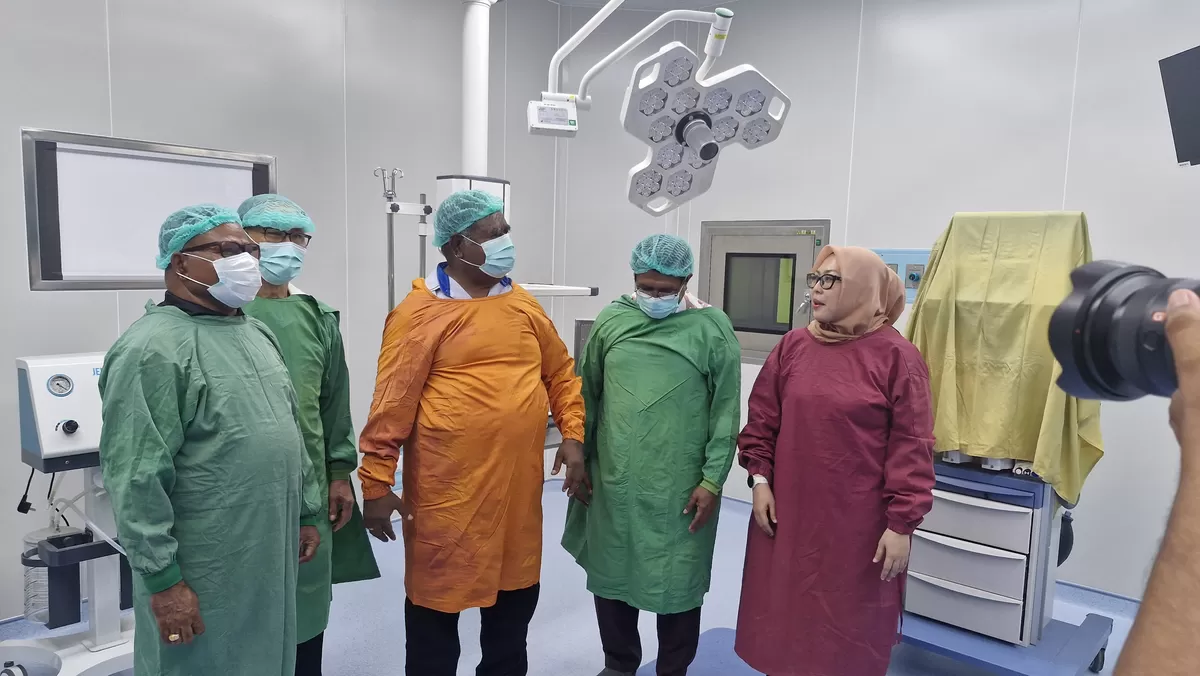
Healthcare in Indonesia’s easternmost regions has always been a challenge, largely due to the terrain. The vastness of the area, combined with poor infrastructure and scattered coastal villages, often makes it hard for people to receive necessary medical care. Sorong Selatan Regency has been no different, with these issues affecting the lives of its people. But, a significant shift began on January 31, 2026.
The Papua Barat Daya (Southwest Papua) provincial government officially provided Rp12.1 billion worth of medical equipment to RSUD Scolo Keyen, the main public hospital in Sorong Selatan. This assistance is expected to strengthen the hospital’s capacity, improve the standard of care, and help address the persistent disparities in healthcare access that southern Papua’s communities have long experienced.
This grant represents more than just a routine administrative transition; it’s a signal of a broader policy realignment.
It puts healthcare development front and center in Papua Barat Daya’s regional growth plans, acknowledging that health services are essential for social cohesion, economic vitality, and the well-being of individuals.
A Hospital at the Core of a Flourishing Region
RSUD Scolo Keyen, situated in Sorong Selatan, is a crucial provider of medical care to a population dispersed across forests, coastal regions, and island communities. For many, it’s the only referral hospital within practical reach. Serious medical issues often necessitate expensive and time-consuming travel to Sorong City or even outside the province, a situation that has, in the past, led to delayed treatment and heightened health risks.
Understanding this, the provincial government has made RSUD Scolo Keyen a strategic healthcare focal point.
The Rp12.1 billion medical equipment grant was designed not only to modernize facilities but also to ensure that essential services can be delivered locally, safely, and consistently.
The equipment package includes a modular operating theater built with modern insulated panel technology, dozens of hospital beds, diagnostic devices such as ultrasonography machines, heart monitoring equipment, and a mobile health clinic boat.Each item responds to specific service gaps identified by health authorities and hospital management.
Leadership Commitment to Public Health
The handover ceremony was led by Elisa Kambu, who used the occasion to underline the provincial government’s commitment to improving public health services across Papua Barat Daya.
Speaking to local officials, healthcare workers, and community representatives, the governor emphasized that development cannot be separated from health. According to her, quality healthcare is not a luxury but a basic right that must be accessible to all citizens, regardless of where they live.
She recognized that the equipment, though not a panacea for all the hospital’s struggles, was a substantial and tangible improvement. The provincial administration, she added, was committed to a steady and sustainable bolstering of healthcare infrastructure.
Her words struck a chord in a region that has frequently felt sidelined in national development discussions. By focusing on healthcare, the Papua Barat Daya government showed a dedication to development that prioritizes its citizens.
Modern Equipment for Real-World Challenges
A modular operating theater is a central component of the grant. For RSUD Scolo Keyen, this facility signifies a considerable shift.
Surgical services, once constrained by cramped quarters, a lack of essential gear, and facilities that hadn’t seen an upgrade in ages, have seen a transformation. The hospital’s new operating theater now allows for a wider range of procedures, all conducted in a safer, more controlled environment.
Maternal and child health services have also received a boost, thanks to the addition of ultrasonography machines. This is especially important in regions where pregnancy complications remain a significant threat to health. Early ultrasound scans can identify potentially life-threatening problems, helping to protect both mothers and their babies.
Heart health has also improved, courtesy of ECG Holter monitors. These valuable tools enable doctors to continuously monitor patients with heart conditions, catching issues that might otherwise go unnoticed. For those who previously had to travel considerable distances for these tests, this development alone can be a game-changer.
Adding more hospital beds addresses a persistent issue. Overcrowding during peak periods has long burdened hospital staff and strained resources. More beds translate to greater patient comfort, reduced wait times, and a more manageable workload for healthcare professionals.
Reaching the Most Isolated Communities
The mobile Puskesmas boat, a floating clinic, is a key component of this assistance. Valued at approximately Rp6.5 billion, this vessel is designed to deliver healthcare to coastal villages and island communities lacking fixed medical infrastructure.
In Papua, rivers and seas are not barriers; they are essential lifelines.
By harnessing water routes for healthcare delivery, the provincial government is acknowledging the region’s distinctive geography and adapting public services accordingly. The mobile clinic will provide essential medical care, maternal health support, vaccinations, and health education to communities that have often been overlooked.
This initiative reduces the burden of difficult journeys and the unpredictability of travel for those in remote villages. It also strengthens preventive care by making services easily accessible within the community, rather than waiting for individuals to seek treatment when their health declines.
Beyond the physical infrastructure, the Papua Barat Daya government has emphasized that the quality of healthcare ultimately depends on its personnel. RSUD Scolo Keyen currently employs a dozen medical specialists, covering fields such as obstetrics, internal medicine, surgery, anesthesia, and clinical pathology.
For a hospital in a mostly rural area, this is a real win. But the provincial leaders know that to keep things getting better, they need to keep putting money into their people. As part of its 2026 development plan, the government has promised to pay for specialized training for fifteen more doctors.
This program is trying to fix a problem that’s been around for a long time in eastern Indonesia: getting specialized medical professionals to work in remote places. The province’s plan is to develop local talent and create clearer career paths, hoping to build a healthcare workforce that sticks around and understands the unique needs of the people who live there.
Building Trust in Local Healthcare
Improving facilities and staffing is about more than just better medical results.
The diminished capacity of hospitals has, over time, undermined public confidence in local healthcare systems. Numerous families, often incurring significant costs, opted to obtain medical care from external providers, citing doubts regarding the hospital’s capacity to handle intricate medical conditions.
The implementation of advanced technology and the expansion of services at RSUD Scolo Keyen offer a means to re-establish this trust. When communities perceive accessible, high-quality care within their vicinity, they are more inclined to pursue early treatment, adhere to medical recommendations, and engage in preventative health initiatives.
This transformation is crucial for effectively managing chronic health issues, including infectious diseases, malnutrition, and non-communicable diseases, which necessitate ongoing monitoring rather than solely emergency interventions.
Healthcare as a Catalyst for Regional Advancement
The Rp12.1 billion grant, when viewed through a wider lens, signals a recognition of the interconnectedness between healthcare and regional progress. Communities in good health are simply more productive. Children get to school more often, and families are less vulnerable to the financial strain that illness can bring.
In Papua Barat Daya, a region that has often struggled to keep pace with the rest of the country, bolstering healthcare infrastructure is a smart move. It boosts workforce participation, helps to lessen the impact of poverty, and builds social stability.
This provincial administration’s approach aligns with national goals to address the development gap between western and eastern Indonesia. By focusing on tangible improvements at the regional level, Papua Barat Daya is helping to create a more balanced path for national development.
A Model for Other Isolated Regions
The experiences of RSUD Scolo Keyen offer pertinent lessons for other isolated and newly established provinces across Indonesia. Strategic investments, guided by local needs and supported by political commitment, can lead to substantial improvements, even when financial resources are limited.
Rather than pursuing symbolic actions, the Papua Barat Daya government focused on practical measures that directly impact service delivery. As a result, this approach ensures that public spending translates into concrete benefits for the population.
Furthermore, coordination is emphasized through the collaborative efforts of provincial authorities, hospital administration, and healthcare professionals.
The transformation of service delivery extends beyond the mere provision of equipment; it demands meticulous planning, continuous upkeep, and sufficient training. Therefore, by incorporating these components, the project increases its likelihood of enduring success.
Looking forward, the medical equipment grant awarded to RSUD Scolo Keyen represents not an endpoint, but a crucial initial step. Several obstacles remain, including infrastructure maintenance, staff retention, and the expansion of services to meet growing demand. Despite these challenges, the progress achieved through this initiative demonstrates the potential of prioritizing healthcare, rather than treating it as a secondary priority.
For the residents of Sorong Selatan and its surrounding areas, the impact will be evident in the everyday details.
A smoother delivery, a swift diagnosis, a successful operation, or a doctor’s appointment that’s nearby, these are the real benchmarks of progress.
As Papua Barat Daya establishes itself as a new province, investments like this one illuminate the path ahead. It’s a journey where public policy is evaluated not just by expenditures and regulations, but by its tangible benefits to the population.
In a region where access to healthcare has frequently been a challenge, the improvement of RSUD Scolo Keyen demonstrates that quality care is within reach for all. Slowly, building by building, and community by community, Papua’s path to improved health is becoming increasingly apparent.

