
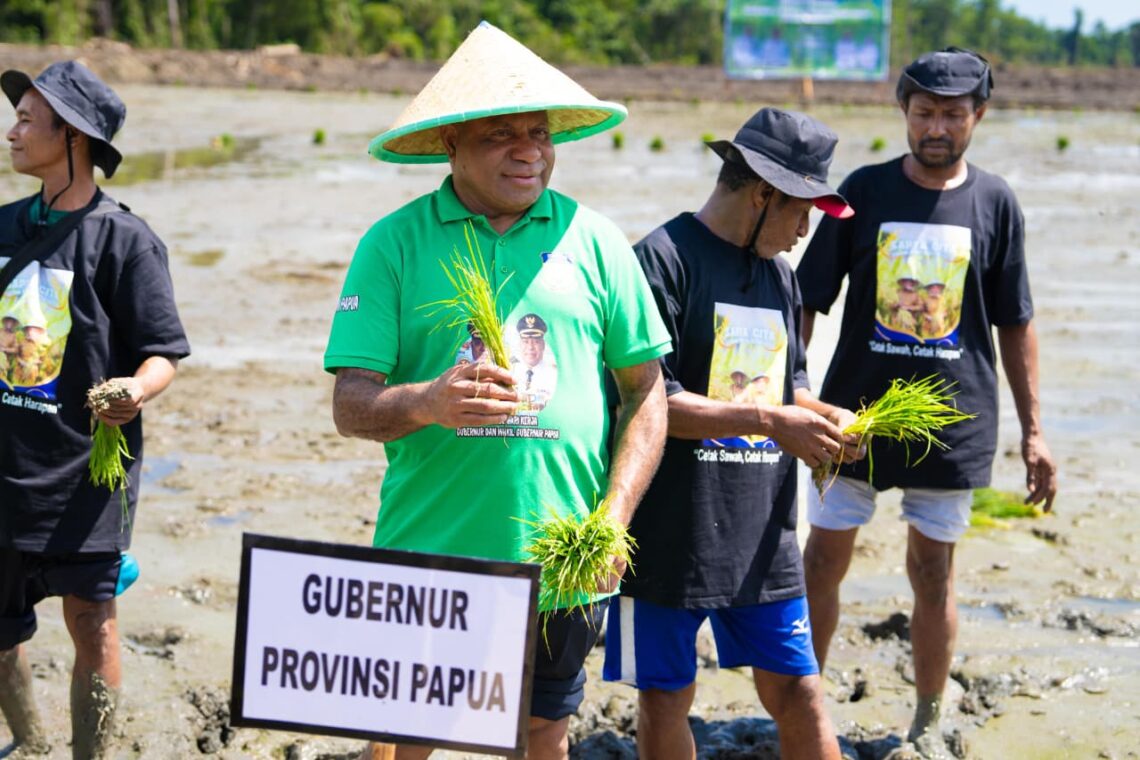
In a symbolic yet consequential move toward agricultural revitalization and national food resilience, Governor Matius D. Fakhiri led a first-ever rice planting ceremony on Saturday, December 13, 2025, in Kampung Tetom Jaya, Bonggo District, Sarmi Regency. The ceremony marked the launch of a strategic agricultural program aimed at strengthening local food production and paving the way for food self-sufficiency in Papua—a region historically reliant on rice imports and external supply chains.
The event brought together government officials, local community leaders, military support units, and farming families who gathered with hope and resolve to transform Papua’s agricultural landscape. It was more than a symbolic planting; it was the first step in a broad initiative to reshape how food security is pursued in Indonesia’s easternmost frontier.
A Strategic Vision for Food Security in Papua
Governor Fakhiri’s commitment to agriculture is rooted in a broader national imperative. In recent years, the Indonesian government has doubled down on efforts to achieve rice self-sufficiency nationwide. National agricultural data shows significant increases in rice production in 2025, with projections that output may reach levels exceeding domestic consumption needs.
Papua’s contribution to this national effort has been limited historically. According to provincial agricultural statistics, the region’s rice production and paddy cultivation lag behind other parts of Indonesia, due in part to geographic challenges, limited irrigation infrastructure, and logistical constraints. However, this situation is now changing.
Under Governor Fakhiri’s leadership, the provincial government has embraced agricultural development as a priority. By officially inaugurating the 640-hectare rice planting program in Sarmi as part of a National Strategic Program (Program Strategis Nasional, PSN), Papua is signaling that it intends to be more than a participant in national food policy; it aims to be a model for sustainable agricultural transformation.
The Sarmi Initiative: Planting the Seeds of Change
At the heart of the initiative lies the farmland of Kampung Tetom Jaya, chosen for its arable soil and potential to become a cornerstone of Papua’s agricultural output. Governor Fakhiri personally joined farmers in planting young paddy seedlings, a gesture that underscores both political commitment and grassroots mobilization.
“It is our belief that Papua has the potential to achieve rice self-sufficiency, not just for a short season but as a sustainable foundation for future food resilience,” Fakhiri said in his address to attendees. He noted that, under national targets, Indonesia expects to utilize approximately 50,000 hectares for expanded rice cultivation, yet Papua would only need 5,000 to 20,000 hectares of productive land to meet the region’s own needs.
Governor Fakhiri’s remarks highlighted both optimism and realism. While Papua’s terrain can present logistical challenges, the government believes that with targeted investment, training, and infrastructure support, it can meaningfully contribute to food security goals.
Mobilizing Multi-Sector Support
The Sarmi rice planting was not just a gubernatorial photo opportunity; it was a coordinated effort involving multiple layers of government and institutional support. Local officials worked alongside community members, while units like Batalyon Infanteri TP 809/NTM provided logistical assistance during the planting process.
This kind of collaboration reflects an emerging model for rural development in Papua: one that blends civil authority with community engagement and military logistics where needed to ensure that goals are achieved on schedule and with broad participation.
In addition to supporting rice cultivation directly, Fakhiri announced that the provincial government plans to promote agricultural diversification, encouraging farmers to develop cash crops such as coffee and tropical fruits, as well as ventures in fisheries and plantation crops with high economic value.
These efforts seek to ensure that agriculture in Papua is not mono-focused on rice production alone but diversified for economic impact and resilience against market or climate shocks.
A Push for Local Economic Growth and Value Addition
Governor Fakhiri’s agricultural vision extends beyond the fields to the processing facilities that will transform raw crops into market-ready products. He has championed the construction of rice milling facilities and processing plants across Papua’s agricultural regions, including Sarmi.
“Building processing facilities here will keep value within the community,” he noted, emphasizing the objective of job creation and economic empowerment. “If the community can process its own harvests, we increase incomes, strengthen regional economies, and contribute to broader social progress.”
This approach aligns with global agricultural development strategies that prioritize upstream and downstream integration, connecting production with processing, marketing, and distribution networks to maximize the economic benefits of farming.
Farmer Empowerment and Community Participation
For many farmers in Kampung Tetom Jaya, the ceremony was an affirmation of long-awaited support from the provincial government. Smallholder farmers, who make up the majority of Papua’s agricultural workforce, have historically faced barriers such as limited access to quality seeds, irrigation, and technical training.
Under the new program, local farmers will receive support packages that include improved inputs, training in modern agricultural practices, and access to cooperative networks that can help them scale production and connect with broader markets.
Fakhiri stressed that government assistance should focus on tools and capacity building, rather than one-off handouts. “We must not give basic rice aid alone,” he remarked. “We need to equip farmers with the tools, the knowledge, the equipment, and the infrastructure that allow them to thrive independently.”
His philosophy echoes principles advocated in development circles worldwide: that empowerment and sustainability come from enhancing local capacity, not dependency.
Challenges Ahead: Infrastructure, Irrigation, and Scale
While the initiative has drawn widespread praise, it also faces significant challenges. Papua’s rural terrain presents complex obstacles, from soil variability to limited irrigation systems. Experts note that successful crop production at scale requires reliable water sources, mechanization support, and transportation networks to bring products to market.
National efforts to expand irrigation infrastructure, such as food estate programs in other regions, provide a useful reference for Papua’s own agricultural ambitions. These programs have highlighted the importance of irrigation systems in enabling multiple crop cycles per year and expanding productive land use.
For Papua to successfully scale up rice production to anything close to full self-sufficiency, coordination with national infrastructure projects, increased investment, and private sector engagement will be vital.
Political and Social Implications
Governor Fakhiri’s leadership in rice planting has resonated beyond the agricultural sector. It reflects a broader political strategy anchored in inclusive development, community empowerment, and collaboration between state and local actors.
The initiative also dovetails with Indonesia’s national policy priorities under President Prabowo Subianto’s administration, which has emphasized food security and agricultural production as cornerstones of national resilience in 2025. National projections suggest that Indonesia is on track to reach high levels of rice production, further decreasing reliance on imports and boosting domestic food reserves.
In Papua, where food price volatility and supply chain disruptions have been persistent issues, localized production offers a way to stabilize availability, reduce costs for consumers, and enhance community self-reliance.
Voices from Sarmi: Farmers and Residents Speak Out
At the rice planting site, the atmosphere was one of cautious optimism. Farmers spoke of the potential for transformation in their communities.
“This is not just a planting ceremony,” said one local farmer. “It shows that our leaders believe in our ability. We hope that with continued support, we will not only feed our families but help feed Papua.” Community elders echoed this sentiment, emphasizing that agriculture has always been central to Papua’s identity and livelihood.
Their hopes reflect a larger narrative: one in which agricultural development becomes a bridge between tradition and modern economic opportunities, rooted in local knowledge, yet expanded through government support and innovation.
The Road Ahead: Beyond the First Planting
The ceremonial planting in Sarmi is the starting point for what Governor Fakhiri describes as a long-term commitment to agricultural transformation. Over the coming months and years, the program aims to expand paddy cultivation, support diversified agricultural ventures, and build infrastructure that sustains profitability for farmers.
If successful, Papua could contribute significantly to broader national goals of rice self-sufficiency and food security. Moreover, the initiative may set a precedent for how underdeveloped regions can leverage local potential with supportive governance, inclusive planning, and community engagement.
Governor Fakhiri’s message is clear: food security is not merely a production statistic; it is a foundation for dignity, economic empowerment, and regional resilience.
Conclusion
The inaugural rice planting in Sarmi spearheaded by Governor Matius Fakhiri represents more than a ceremonial event; it symbolizes a strategic pivot toward sustainable agricultural growth in Papua. As the seedlings take root in the fertile soil of Kampung Tetom Jaya, so too does a broader vision, one in which Papua can stand as a self-sufficient contributor to Indonesia’s food security and a model for rural agricultural transformation.
With continued collaboration between government, communities, and strategic partners, the seeds planted in Sarmi may flourish into a future where Papua’s farmers are not merely growers of rice but architects of economic prosperity and guardians of food resilience.

