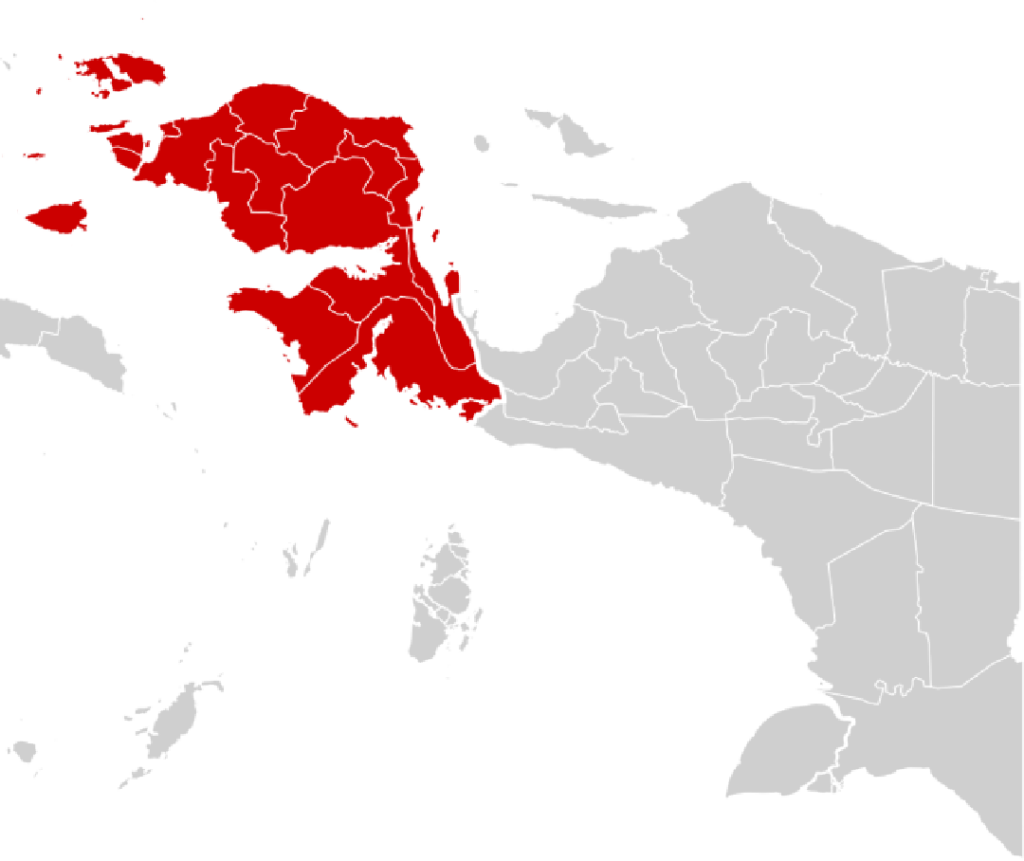
On the morning of December 1, 2025, a colorful procession began winding through the streets of Merauke, the capital hub of Papua Selatan South Papua) Province. The air was alive with music: drumbeats, hymns, and church choirs echoing across the town. Men, women, and children walked side by side—some in formal clothes, many in the traditional garments of Papua’s diverse ethnic tapestry. At the heart of this pageant of faith and culture stood the banner of the 2025 “Christmas Parade Papua Selatan 2025,” a public celebration of Christmas that seeks more than festivity: it aims to embody unity, tolerance, and shared identity in one of Indonesia’s most diverse regions.
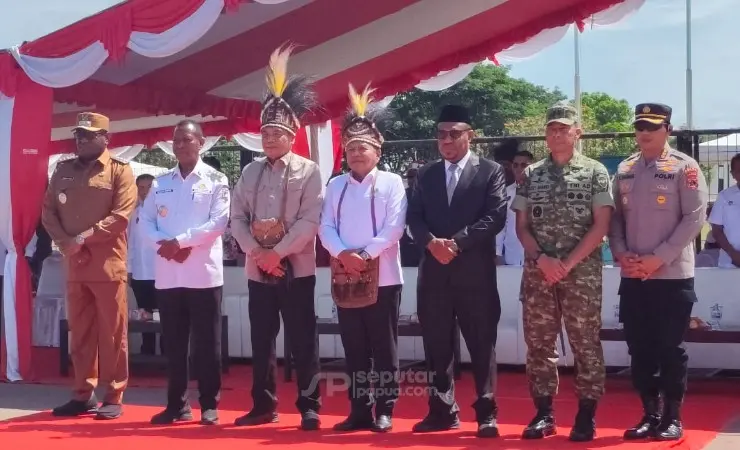
The parade was officially flagged off by Djamari Chaniago, Indonesia’s Coordinating Minister for Political, Legal, and Security Affairs (Menko Polkam) and Muhammad Herindra, Chief of the State Intelligence Agency (BIN), along with regional leaders—symbolizing the close collaboration between central and local authorities to promote peace and inclusion.
“Gema ”Natal”—Calling the entire region to celebration
Preparations for the Christmas celebration in Papua Selatan began weeks earlier. The provincial government, Pemerintah Provinsi Papua Selatan (Pemprov Papua Selatan), officially declared December 2025 as “Gema Natal 2025” (Christmas Echo 2025), inviting all communities across the four regencies—Merauke, Boven Digoel, Mappi, and Asmat—to take part.
In a coordination meeting on November 15, 2025, the provincial secretary (Sekda), Ferdinandus Kainakaimu, emphasized inclusive participation: public offices, religious institutions, transport hubs, and even social media should reflect the spirit of Christmas. Decorations, public announcements, and communal readiness would mark the region’s commitment.
Beyond visual ornamentation, the government promised to prioritize public services—ensuring that facilities, transport, crowd control, and security were ready to accommodate thousands expected to join the festivities. As Sekda Ferdinandus underscored, “If the people are to be truly satisfied, we must work harder.”
From Regencies to Pavements—a parade of diversity
The Christmas Parade wasn’t limited to Merauke city alone. Under guidance from Pemprov Papua Selatan, the event was designed to involve residents from all regencies, including Boven Digoel, Mappi, Asmat, and other communities. Organizers invited participants from various church denominations—both Protestant and Catholic—as well as representatives of local paguyuban (community associations), ethnic groups, civil servants, and social institutions.
Participants were encouraged to don traditional attire—clothing, ornaments, and cultural regalia reflective of their ancestral heritage. This created a vivid tapestry of Papua’s many ethnic identities marching under the common banner of Christmas. Such inclusivity transformed the parade from a religious or civic ritual into a statement: that difference in tradition, ethnicity, or origin does not prevent shared celebration.
The parade’s route began at a public office in Merauke—commonly identified as the Kantor Bupati (Regent’s Office)—and ended at the central Lapangan Mandala (Mandala Field), where cross-regional participants now gather as one community.
More than spectacle—meaning, celebration and social cohesion
At first glance, one might see the Christmas Parade as a festive spectacle: music, decorations, processions, and cultural displays. But for many, it was far more profound. It was a public affirmation of shared values: solidarity, mutual respect, and belonging. In a region as diverse—ethnically, culturally, and religiously—as Papua Selatan, such moments foster social cohesion and reinforce a sense of unity.
For local communities, the parade offered a rare opportunity to see their neighbors—sometimes from very different backgrounds—walking alongside them, celebrating together, smiling, singing, and sharing water, laughter, and songs. Elders clad in traditional woven cloth, youth with painted faces, and children in church outfits—all becoming part of a singular, collective rhythm.
Church choirs performed across denominations. Cultural groups danced, displaying traditional songs, rhythms, and movements. Government officials, community leaders, and ordinary citizens walked side by side. It was a moment when institutional authority and civic life converged, but more importantly—it felt communal, humane, and inclusive.
Such an event also helped challenge stereotypes and narrow narratives. Outsiders—or even neighbors with different backgrounds—could witness the humanity behind the headlines. Young people, especially, found in the parade an alternative narrative: one where diversity is not division, but strength; where difference is not danger, but celebration.
The State’s Role—Promoting peace and inclusion
The active support and presence of government institutions—from local regents to the central minister—highlight how the state plays a role in nurturing social harmony. By facilitating such large-scale inclusive events, the government signaled that it sees diversity not as a problem to manage but as an asset to celebrate.
Moreover, the logistical and administrative preparations—coordinating multiple regencies, mobilizing public offices, institutions, and religious bodies—reflect a commitment to ensuring that such celebrations are not symbolic only but accessible. By planning public services, transport, security, and event readiness, the authorities helped make the parade not a privilege for the few, but a public festival for all.
This also underscores another message: in a plural Indonesia, religious celebrations need not be exclusive or private. They can—and perhaps should—be part of the public sphere when conducted with respect, openness, and inclusion.
A Template for Future Communal Celebrations
The Christmas Parade 2025 in Papua Selatan could set a precedent—a template for how religious and cultural celebrations can be organized in a plural, multiethnic society.
First: make participation broad and inclusive. By inviting church members, ethnic communities, paguyuban, government agencies, civil society, and even youth organizations, the parade created a space of shared ownership.
Second: honor cultural diversity while uniting under a common theme. The use of traditional dress and cultural performances didn’t clash with Christmas; instead, they enriched it—offering a distinctly Papuan flavor to a global holiday.
Third: ensure institutional support. Government facilitation—from planning to transport to security—allowed the parade to be safe, accessible, and mass-participatory. Without such support, community gatherings might remain fragmented or marginal.
Fourth: foster visibility and mutual respect. The public nature of the parade makes difference visible—not hidden—but in a respectful, celebratory way. As thousands of people march together, the ordinary boundaries of ethnicity, origin, and social role blur in favor of shared humanity.
Challenges and the Way Forward
Of course, organizing such a large-scale, multi-layered event is not easy. Logistical challenges—managing participants from remote regencies, coordinating transport, ensuring security, providing necessities such as water and sanitation—can be daunting. Indeed, local officials emphasized these logistical concerns during preparatory meetings.
Moreover, sustaining momentum beyond a single parade will require continued effort. It is one thing to gather for a grand celebration and another to build ongoing social cohesion, mutual understanding, and respect. Authorities may need to follow up with community dialogues, interfaith cooperation, and shared social programs.
There is also the challenge of inclusivity. Despite efforts to involve people from across regencies and social strata, remote communities far from Merauke might feel left out. Ensuring the ripple effect of the parade reaches deeper into villages and isolated areas—via local events, broadcasts, or community visits—will be essential to ensure the celebration resonates broadly.
Yet, the 2025 parade offers hope. It shows that with political will and communal goodwill, even deeply diverse regions can create moments of shared belonging. It suggests that religious holidays—often associated only with specific communities—can become bridges across difference, instead of dividing lines.
Why It Matters: Lessons for Indonesia’s Plural Future
Indonesia is more than a nation of islands—it is a mosaic of ethnicities, religions, cultures, and languages. Maintaining national unity in such diversity is no small task. Events like the Christmas Parade in Papua Selatan signal one approach: one that doesn’t demand assimilation but encourages celebration of differences under a shared national identity.
By supporting and participating in the parade, the state legitimizes plural identity. By walking side by side—Christians, indigenous Papuans, government officials, youth, elders—ordinary people experience unity. By putting culture front and center, the parade resists homogenization and instead embraces richness.
This matters especially now. As Indonesia under the leadership of Prabowo Subianto continues to navigate complex political and social terrain, moments of grassroots unity—rooted in shared celebrations—may help anchor stability, foster social trust, and strengthen national cohesion.
In the remote corners of Papua Selatan, far from Jakarta’s bustle, ordinary citizens may rarely engage with high-level policy. But when they see communities across religions and ethnicities marching together, singing together, celebrating together—they inhabit a living ideal of what Indonesia aspires to be.
Conclusion
As the December sun dipped below the horizon over Merauke’s Lapangan Mandala, the 2025 Christmas Parade drew to its official end. Yet for many, the end of the procession was only the beginning of something more enduring. Conversations sparked between strangers. Young people exchanged contact. Cultural groups made plans for future performances. Church leaders, government officials, and community elders spoke quietly about next year.
The taunts and jeers of skepticism—about whether such a parade could be more than a temporary spectacle—have been met with laughter, music, and unity.
For one shining night, Papua Selatan didn’t just celebrate Christmas. It lived an experiment in unity. It offered a vision—of a plural Indonesia where difference is not feared but embraced; where faith does not separate but connects; where the public sphere belongs not only to the government or majority but to all.
Whether that vision endures will depend on what happens next: whether the spirit of “Gema Natal,” the commitment of government, and the openness of society can carry beyond December—into everyday life, local traditions, and community bonds. But for now, Papua Selatan has taken a bold step: it has placed unity—in motion, in song, in shared footsteps—at the heart of its Christmas. And in doing so, offered a silent but powerful message to all of Indonesia: in diversity, we stand together.