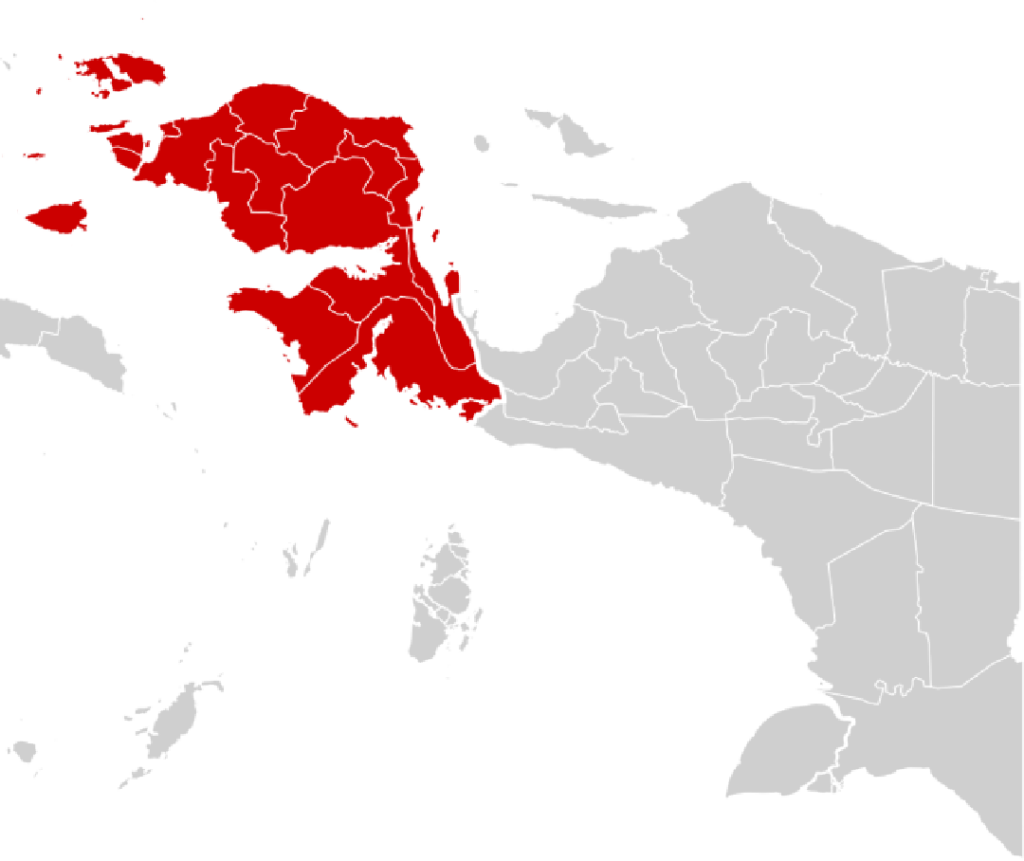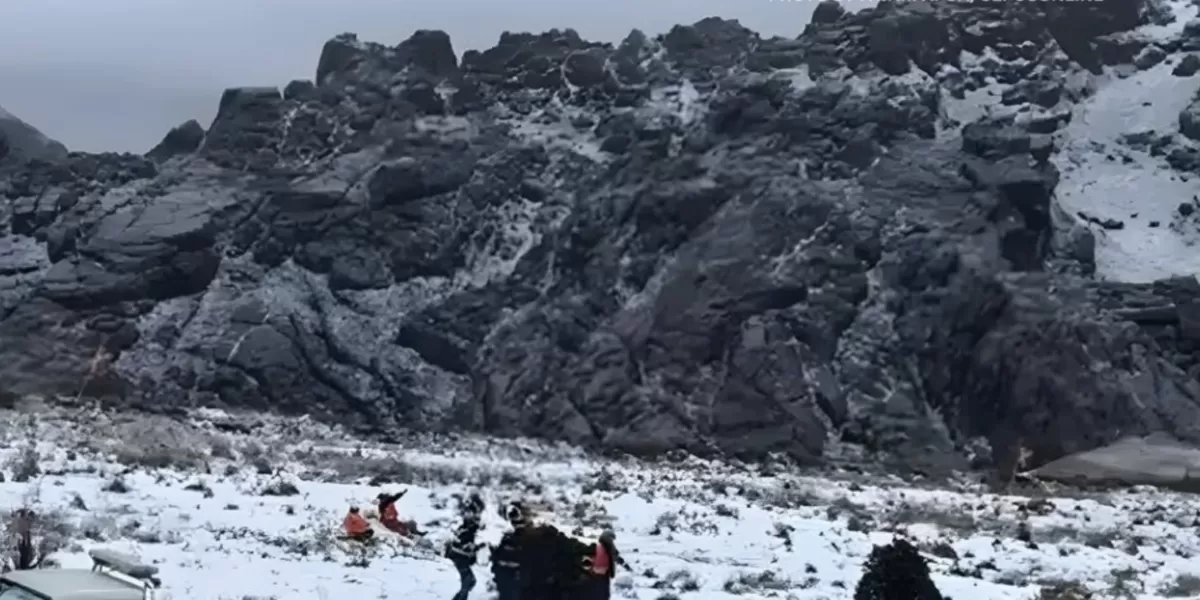
On January 26, 2026, a remarkable weather event unfolded in Mimika Regency, Papua Tengah (Central Papua) Province. Snow, a rarity in this part of the world, descended upon the Grasberg highlands, a region typically associated with mining rather than wintry weather. The snow was observed in the vicinity of PT Freeport Indonesia’s operations, close to the town of Tembagapura. Frost-like precipitation briefly covered the rugged landscape. Videos and photos quickly spread across the internet, capturing the unusual sight as workers documented the moment the flakes fell upon slopes that had, just days before, been green and devoid of ice. This occurrence sparked local interest and curiosity, capturing the attention of people throughout Indonesia and beyond.
This rare snowfall is more than just a fleeting visual oddity.
It all comes down to the distinctive geography and atmospheric quirks of Papua’s highlands. Here, the interplay of temperature and altitude creates weather patterns that are, frankly, unusual for the tropics.
So, why does it snow in Papua?
Grasberg is nestled in Central Papua’s highlands. The Tembagapura district, home to the renowned Grasberg mine, sits at elevations between 2,500 and nearly 2,800 meters. These heights mean the area experiences a climate that’s considerably cooler than the lowland tropics below, where sea-level temperatures frequently approach 30 degrees Celsius.
Meteorologists point to elevation as a key factor in Grasberg’s snowfall. As you climb, temperatures plummet. When moisture-laden clouds and cold air masses converge above the highland slopes, tiny ice crystals can form and start to descend.
In the case of the snowfall in January 2026, the Meteorology, Climatology, and Geophysics Agency (BMKG) Timika office reported that layers of mid-level clouds with temperatures around minus 28 degrees Celsius were present above Tembagapura in the early morning hours. The combination of cold cloud layers and precipitation allowed ice crystals to descend without melting before reaching the ground, resulting in snow-like precipitation at these heights.
It is important to note that this phenomenon occurs primarily at these high elevations and only under specific atmospheric conditions. In lower elevations, such as in the Timika lowlands, rainfall continued as usual, and no snow was observed. The stark contrast between the weather in the highlands and the tropics below highlights the remarkable climatic diversity within Papua.
A Rare but Not Unprecedented Event
Though the sight of snow in a tropical country like Indonesia may seem surprising to many, scientists and local observers point out that it sometimes occurs in the high mountainous regions of Papua. Historical data confirms that the Grasberg area has experienced snow and hail before. Snowfall was recorded in previous years, such as 2003, 2007, 2009, and most recently, 2023. This suggests that the region occasionally sees the right conditions for snow to develop.
The 2023 snowfalls, like those before, highlight the fact that, though infrequent, these events are a part of the local highland climate. Seasonal changes and specific atmospheric conditions, especially during times of significant cloud development in the mid- and upper troposphere, play a role in these occurrences.
For those living and working in the area, including the people of Tembagapura and the mine’s employees, these rare snowfalls offer a fascinating glimpse into their distinctive environment. Workers were observed enjoying the snow, taking photos and videos, and sharing the experience with their loved ones.
It was, for many, a strange sight: tropical Papua, but with a weather pattern more at home in the polar mountains.
BMKG’s Explanation: The Science of the Snow
The BMKG Timika station was instrumental in clarifying this odd weather. Meteorologists observed that mid-level clouds, combined with temperatures well below freezing at those heights, were key to the snow crystals’ formation, instead of the usual tropical rain. This specific set of circumstances allowed moisture to freeze where it was, then fall as ice before it could melt.
Climate scientists stress that such precise conditions are necessary for snow to form in the tropical highlands.
Condensation of water vapor necessitates high altitudes and extremely low temperatures, a condition seldom encountered in tropical regions, save for the most elevated mountain ranges and plateau areas. In Papua, however, the combination of topography and elevation facilitates the occurrence of such phenomena, albeit with limited frequency.
Although the BMKG identified the immediate causes, they also emphasized that this specific type of snow event does not, in and of itself, signify wider global climatic alterations. Instead, it is more consistent with localized atmospheric interactions, which are influenced by elevation and cloud formations, rather than long-term climate patterns. Nevertheless, these unusual weather occurrences offer valuable data for meteorological research and for understanding the dynamics of high-altitude tropical climates.
Local Reaction: Awe and Documentation
The sudden snowfall became a local sensation. Employees at the Grasberg mine and the people of Tembagapura immediately began posting about it online. Videos showing the snow accumulating on the ground quickly spread across Instagram and TikTok, offering a view of this unusual event to people throughout Indonesia and elsewhere.
For many, seeing snow in Papua upended their usual understanding of Indonesia’s climate. The country is generally associated with tropical rainforests and equatorial heat, so the notion of snow falling there was both surprising and intriguing.
Local guides and residents of the highlands, who know the area’s weather well, viewed the event as a demonstration of Indonesia’s varied natural landscapes.
In low-lying regions, life went on as usual, with people enduring the warmth or humidity. Meanwhile, up above, the world briefly resembled a winter wonderland.
From a scientific angle, the snowfall underscores the intricate relationship between geography and weather patterns. The mountainous heart of Papua, a component of the New Guinea highlands, boasts elevations that reach into the realm of atmospheric processes usually associated with chillier regions. This unique geography allows for the possibility of snow, even close to the equator.
Culturally, the event has increased understanding of Papua’s environmental intricacies.
The sight of snow, along with accompanying images, sparked conversations among educators, researchers, and those passionate about climate, all pondering the area’s geography and the science behind such unusual occurrences.
Both tourism boards and environmental groups have floated the idea that these events could boost interest in Papua’s highland areas, potentially bringing in adventurers and scientists keen to see tropical snowfall in person. Still, getting to places like Grasberg, with its high altitude, presents real difficulties, thanks to the tough terrain and the lack of developed infrastructure.
Wider Consequences and Environmental Understanding
The snowfall in Grasberg also highlights Indonesia’s diverse climate zones. Though often thought of as a land of tropical beaches and dense rainforests, the country also includes ecosystems with far more extreme weather.
The presence of snow in the highlands invites deeper appreciation and study of the country’s environmental diversity.
Climate scientists who look at weather patterns at high altitudes near the equator see events like the Grasberg snowfalls as useful pieces of information. They help improve understanding of how moisture, temperature, and topography interact under different atmospheric conditions. This knowledge can contribute to better forecasting and climate modeling, particularly for regions where data is sparse but the terrain is complex.
In a world facing shifting climate patterns and increasing weather extremes, observing how local climates behave in unique settings like Papua’s highlands adds depth to global climate knowledge. While this particular snowfall does not directly indicate a wider climate trend, it reminds observers that Earth’s weather systems can produce astonishing results when local conditions align just right.
Conclusion
The snowfall in the Grasberg highlands of Mimika on January 26, 2026 was a unique and significant occurrence, garnering global attention. This event illuminated the concealed complexities of Papua’s climate, illustrating how the interplay of elevation, temperature, and atmospheric factors can generate unexpected weather patterns.
Rather than undermining Indonesia’s tropical character, these highland snowfalls contribute to it, demonstrating that the equatorial region encompasses areas of considerable climatic variation. For inhabitants, researchers, and worldwide observers, the snow at Grasberg transcended a transient weather phenomenon. It served as a prompt to deepen understanding and appreciation of the intricate environmental fabric present within one of the most biodiverse and geographically diverse countries on the planet.