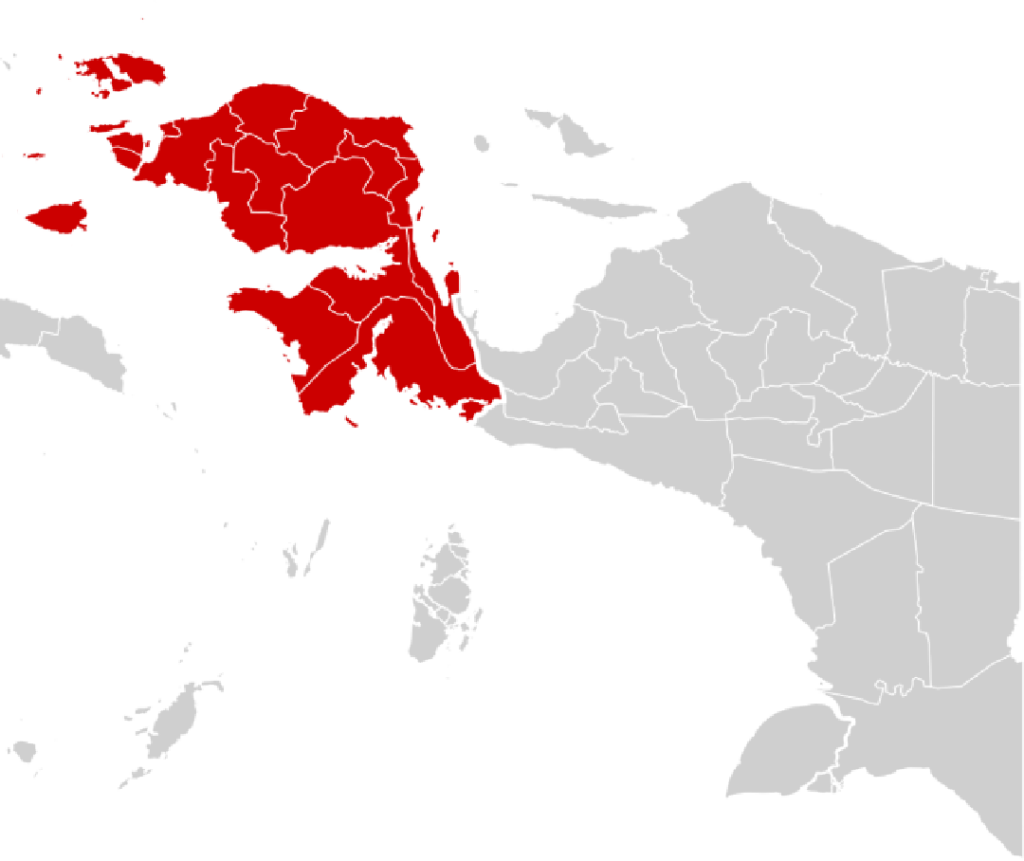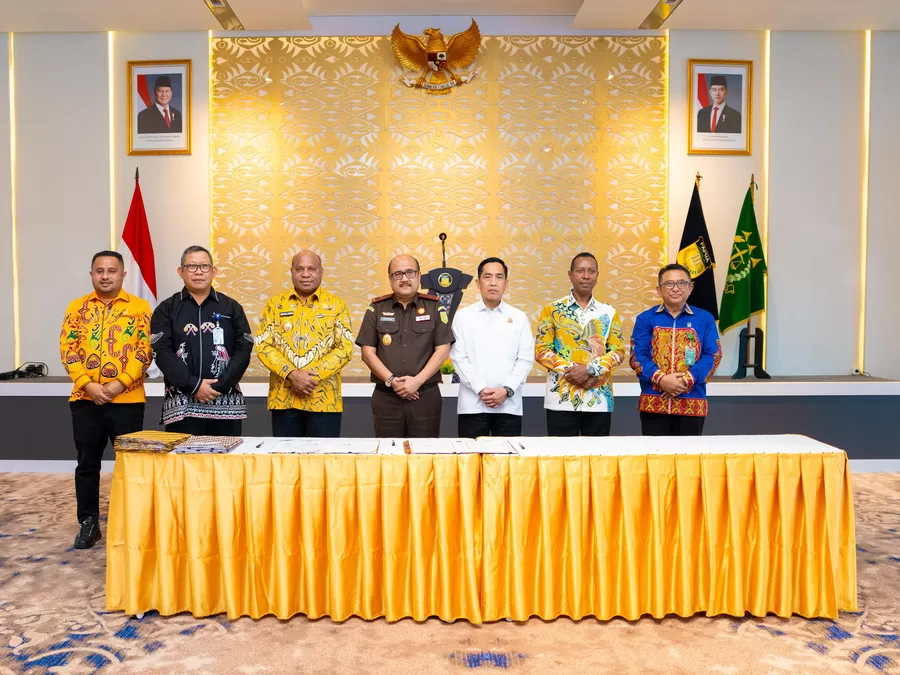
In the cool dawn air of Jayapura, the heart of Papua province, a gathering of government officials, prosecutors, civil servants, and community leaders unfolded at the provincial governor’s office. On Friday, 12 December 2025, this group did more than sign papers—they etched a new chapter in Papuan justice with a Memorandum of Understanding (MoU) between the Government of Papua Province and the High Prosecutor’s Office of Papua (Kejaksaan Tinggi Papua). The accord signals a deliberate and forward-looking commitment to strengthen the rule of law, broaden access to justice, and align legal enforcement with deepening principles of restorative governance.
At its core, this collaboration is about transforming how justice works—moving beyond traditional punitive frameworks and toward systems of social accountability, rehabilitation, and community integration. The partnership comes at a moment of major change in Indonesia’s legal landscape, as the nation prepares to implement a new national Criminal Code (KUHP) in early 2026—a code that emphasizes rehabilitation, social work sanctions, and restorative justice over incarceration.
Justice Reimagined: Breaking with Tradition
Papua, Indonesia’s largest and most diverse province, has long been a focal point of national policy—politically, culturally, and judicially. For decades, law enforcement in Papua has battled not just crime, but also the suspicion, misunderstanding, and historical grievances that sometimes accompany legal authority in regions marked by remote geography and strong indigenous identities.
In this fraught context, the signing of a legal cooperation agreement between the provincial government and the High Prosecutor’s Office represents more than bureaucratic protocol—it reflects a deliberate reimagining of justice. Gone are the days when punitive incarceration was seen as the primary solution to wrongdoing. Instead, Papua’s leaders are exploring how law enforcement can weave into broader social goals: education, community empowerment, rehabilitation, prevention, and reintegration.
The MoU signed in Jayapura formally commits both institutions to implement “pidana kerja sosial”—a form of social work sentencing stipulated in the new KUHP as a primary penal measure. Rather than warehousing offenders in prison, the approach emphasizes productive public service tasks that teach responsibility, restore dignity, and contribute to communal well-being. Legal thinkers describe this as restorative justice in practice, not just in theory.
A Shared Vision: Government Meets Prosecutorial Authority
In Papua’s tropical capital, the exchange of signatures was accompanied by speeches laden with purpose and optimism. Governor Matius D. Fakhiri, a former national police commissioner turned political leader, framed the cooperation as essential to the province’s broader developmental agenda. For Governor Fakhiri, law enforcement should be part of a holistic effort to improve public safety while advancing health, education, character development, and economic productivity.
He emphasized that social work sentencing offers offenders “space to learn, work, and improve themselves so they can return to society as more productive and capable individuals.” In this view, justice is not merely about holding individuals accountable but about restoring relationships—between the individual and their community, between law and daily life, and between state authority and local aspirations.
Such a partnership draws on a broad interpretation of public safety: one that is not measured solely by arrest rates or prison occupancy but by the degree to which people feel secure, invested in society, and confident that the law works for rather than against them.
Law Enforcement with Humanity: Prosecutors at the Forefront
For the Kejaksaan Tinggi Papua, the agreement reflects a significant evolution in prosecutorial practice. Traditionally perceived primarily as an institution that prosecutes crimes and seeks convictions, the prosecutor’s office is now positioning itself as a central player in a more humane justice system—one that takes into account individual circumstances, social roots of crime, and the value of rehabilitation.
In statements following the MoU, Kejati officials stressed that their participation underscores a shared commitment to adapt prosecutorial functions to meet the needs of the people of Papua. The cooperation includes not only the implementation of social work sanctions but also coordination on case planning, community engagement, and mechanisms to ensure that justice is both fair and effective.
Kejati leadership has emphasized that this partnership goes beyond mere compliance with the new Criminal Code. It is a proactive stance to ensure that the law serves human dignity, reflects local realities, and creates a justice system that Papuans can trust and participate in.
Restorative Justice in Practice
At the heart of this cooperation is the principle of restorative justice—a philosophy that seeks to repair the harm caused by wrongdoing through processes that involve victims, offenders, and communities. While imprisonment remains available for severe offenses, social work sanctions offer a nuanced alternative for many forms of minor or nonviolent transgressions.
Under the new KUHP regime, social work sentencing is recognized as a primary form of punishment, positioning incarceration as a last resort. This shift matches global trends—seen in jurisdictions around the world—that aim to decongest prisons and embrace more effective ways of reducing recidivism.
In Papua’s case, social work sentencing might involve a range of activities: environmental conservation projects, public service initiatives, vocational training, or community development tasks that help rebuild trust between offenders and the society they harmed. According to government statements, such measures are aligned with the province’s broader goals of promoting education, health, and human capital development.
Strategic Timing: Ahead of a National Legal Shift
The timing of the MoU could not be more strategic. Indonesia’s new Criminal Code, passed in 2023 and set to take effect on 2 January 2026, represents one of the most significant overhauls of the country’s penal system in decades. It abandons much of the colonial-era legal architecture and introduces concepts such as restorative justice, human-centered sentencing options, and alternative sanctions.
Papua’s proactive implementation of social work sentencing ahead of the nationwide enforcement underscores the province’s commitment to legal reform that is not only procedural but transformative. Local officials see this as a way to ensure that law enforcement does not lag behind changes in legal norms and that Papua’s justice system is prepared to translate national standards into local practice.
Bridging Law and Society
The partnership between the government and prosecutors in Papua also hints at a deeper intention: to bridge the gap between state law and societal values. Papua’s diverse ethnic groups, customary norms (adat), and strong community traditions have historically shaped how justice is understood and administered at the local level.
By incorporating restorative principles into formal law enforcement, leaders hope to craft mechanisms that resonate with customary values of harmony, reconciliation, and collective responsibility—while still upholding constitutional and legal standards. This clean-slate approach avoids the alienation that can arise when legal systems are seen as detached from lived experience.
Challenges and Expectations Ahead
The road ahead is not without its challenges. Realizing the promise of this cooperation will require investments in capacity building, training, monitoring, and community outreach to ensure that social work sentencing is implemented effectively and equitably. The success of such punitive alternatives hinges on trust—between offenders and authorities, between communities and courts, and between institutions themselves.
Moreover, political, administrative, and cultural complexities inherent in Papua’s landscape mean that progress will be incremental, adaptive, and occasionally contested. Real change requires not just policy documents but shifts in mindset among law enforcement personnel, public officials, civil society, and the judiciary.
However, the momentum behind Papua’s initiative—built around cooperation, shared goals, and a clear vision for humane justice—offers hope that these challenges can be met. Officials have underscored their belief that restorative, socially oriented law enforcement can contribute to a safer, fairer, and more inclusive Papua.
Toward Harmonious Development
As the sun climbed over Jayapura that day, the formal signing of the MoU was celebrated not merely as an administrative milestone but as a step toward a broader vision: transforming Papua into a region that is safe, just, and vibrant, where law enforcement complements social progress rather than obstructing it.
Governor Fakhiri captured this sentiment when he described the partnership as a foundation for enhancing the quality of law enforcement and expanding social benefits for Papuans, with an emphasis on justice, humanity, and inclusive development.
In the months and years ahead, the success of this cooperation will be measured not only by legal metrics but by the extent to which Papua’s communities feel protected, respected, and included in the journey toward justice. If realized, this new era of law enforcement—grounded in collaboration, empathy, and social responsibility—could serve as a model for other regions navigating the complex intersections of law, culture, and development.
Conclusion
The cooperation between the Papua Provincial Government and the Papua High Prosecutor’s Office marks a significant turning point in the region’s approach to law enforcement. Through this strategic partnership, Papua is not only strengthening the rule of law but also redefining how justice is delivered—placing greater emphasis on restorative, humane, and community-based legal practices.
By aligning local policies with Indonesia’s new Criminal Code (KUHP), particularly through the implementation of social work sentencing, the province demonstrates readiness to move beyond punitive models toward rehabilitation and social responsibility. This collaboration reflects a shared commitment to legal certainty, institutional coordination, and public trust, while also acknowledging Papua’s unique social and cultural context.
Ultimately, the agreement lays a foundation for more effective, fair, and inclusive law enforcement in Papua. If implemented consistently, it has the potential to reduce recidivism, strengthen community cohesion, and serve as a model for other regions in Indonesia undergoing similar legal transitions.