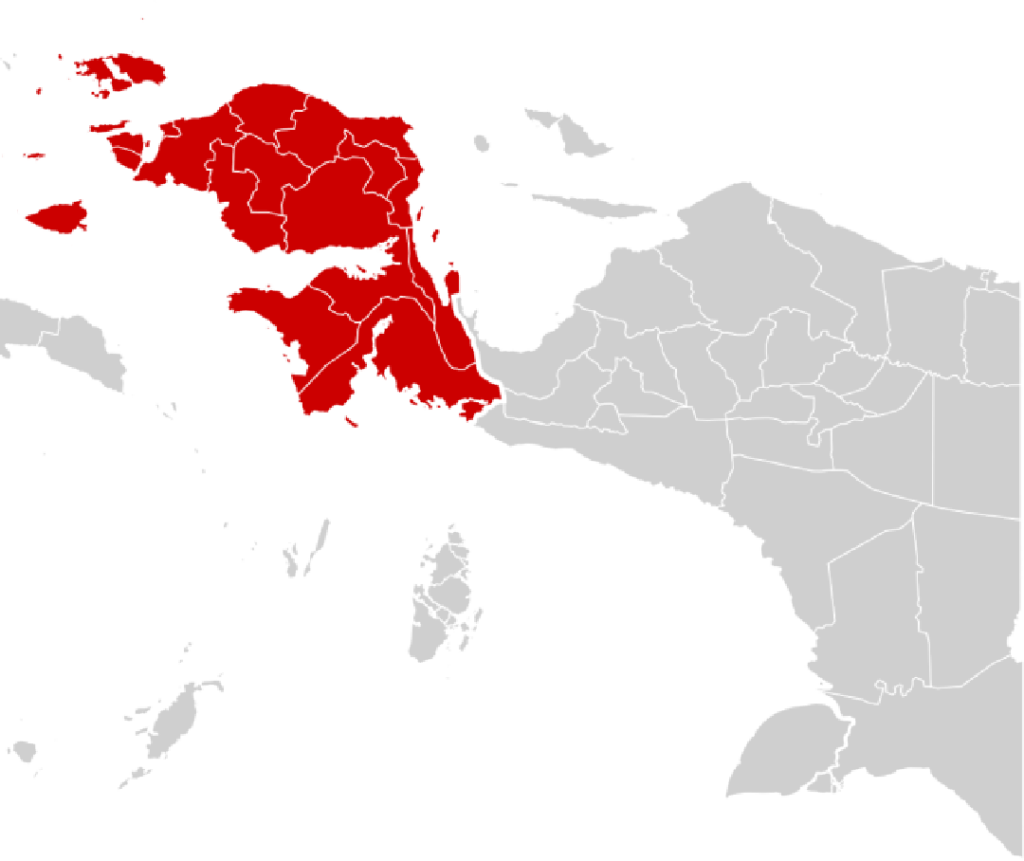
SLH Gunung Moria is not an ordinary school. Tucked away in Tangerang, far from the lush valleys and mountainous terrain of Papua, it serves as a transformative bridge for children who journey thousands of kilometers in search of a better future. Under the umbrella of Yayasan Pendidikan Harapan Papua (YPHP), the institution provides education specifically for children from remote Papuan regions—areas where access to consistent schooling is often hindered by geography, limited infrastructure, or the absence of qualified teachers. In these villages, schools may exist only in name, teachers rotate too quickly, and students walk hours through forests and steep hills simply to reach a classroom. SLH Gunung Moria exists to address these gaps, offering a safe, structured, and nurturing environment that Papuan children rarely experience at home.
These students, around 300 in total, embarked on a challenging journey by sea to Karawaci, Tangerang—hundreds of kilometers away from their villages—in order to continue their learning from elementary or kindergarten level to junior high school. Their journey is not merely physical; it is emotional and cultural. Many leave behind families who rely on them for daily chores, younger siblings they care for, and communities that struggle with limited resources. Yet, despite the sacrifices, the children come with hopes stronger than the waves they crossed. For them, SLH Gunung Moria represents more than a school; it symbolizes a doorway to new opportunities, a path toward stability, and a promise of safety—things that many Papuan children cannot always count on.
For many of these young students, the move is not just about textbooks or classrooms. It is about developing a sense of identity, discipline, and self-worth. SLH Gunung Moria aims to instill essential skills and strong character values—integrity, responsibility, and empathy—while nurturing academic excellence. The vision is clear: when these students eventually return to Papua, they will be equipped not only with knowledge but also with the confidence and determination to contribute to their communities. The hope is that they will become teachers, health workers, social leaders, and agents of positive change who can uplift their people and strengthen the social fabric of Papua’s remote districts.
Puan Maharani’s Visit: Dialogue, Empathy, and Solidarity
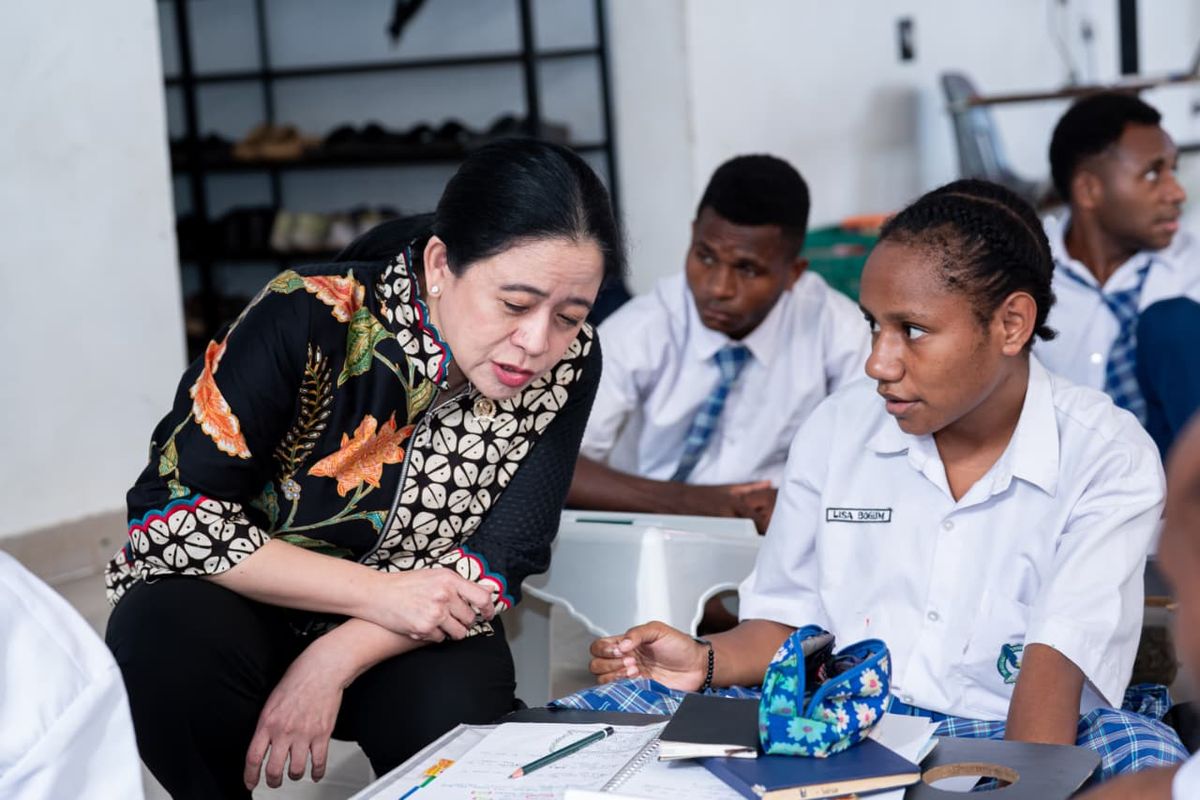
When Indonesia’s Parliament Speaker, Puan Maharani, arrived at SLH Gunung Moria, she was welcomed warmly by the school’s founder, Aileen Hambali Riady, along with teachers and students who had prepared songs, traditional dances, and short presentations. Yet, rather than focusing on ceremonial gestures, Puan immersed herself quickly in genuine conversations with the children. She sat with them, asked questions, and listened closely as they shared their struggles, dreams, and the long journeys that brought them to Tangerang. Her approach was personal and heartfelt, allowing the children to speak freely and feel acknowledged.
In her remarks, Puan highlighted how the school’s mission aligns with Indonesia’s national values—especially the principle of gotong royong, the spirit of mutual cooperation that underscores unity and shared progress. “In the spirit of gotong royong, no one must be left behind,” she said, reminding everyone present that education should never be a privilege limited to geography or wealth. She emphasized that if children in Java or other developed regions enjoy access to proper classrooms, learning facilities, and trained teachers, then so too should the children of Papua, who are equally part of Indonesia’s future.
Puan commended the dedication of YPHP and the educators who work tirelessly at SLH Gunung Moria. She praised their vision of not simply producing graduates but cultivating lifelong learners—young Papuans who will one day feel a calling to return home and contribute to the development of their regions. “I hope these children will someday go back to Papua and serve their communities, so our brothers and sisters in Papua can stand at the forefront of Indonesia’s progress,” she said. Her message underscored the belief that national development can only be meaningful when all regions grow together, with local leaders emerging from their own communities.
Beyond offering words of encouragement, Puan and her parliamentary delegation also delivered assistance to support the school’s educational activities. This gesture symbolized institutional recognition for the grassroots efforts that organizations like YPHP undertake. It also reaffirmed the importance of collaboration between government bodies and community-based institutions in addressing long-standing educational inequalities.
Voices from Papua: Dreams Born of Hardship and Hope
During the visit, several students bravely shared their personal stories—stories that reveal both the hardships faced by Papuan children and the powerful hope that education brings. One student, named Yonce, stood up and described how her day in Papua used to begin at 3:00 a.m. She had to walk through forests, cross rickety bridges, and climb hills in complete darkness just to reach her school by morning. “I was scared and tired,” she said, her voice trembling slightly as she remembered those early journeys. For many children in Papua, such daily struggles are not unique; education often requires overcoming physical obstacles that would discourage even the strongest adults.
Today, far from those challenging paths, Yonce dreams of becoming a doctor. She wants to return to her village someday and help people who suffer without adequate healthcare. Her voice brightened with determination as she spoke of wanting to assist mothers, children, and the elderly who have limited access to medical services. Another student, Emma Grace from Papua Pegunungan Tengah, expressed her aspiration to become a teacher or healthcare worker—someone who can return home not only to provide services but also to help older generations learn Bahasa Indonesia, enabling them to communicate better and access important information.
Their dreams resonated deeply with Puan. She later said that she was moved by the courage and resilience of these young students. She reminded them that their education should not merely be a pathway to personal success but a tool to bring change to their families and communities. “Keep dreaming and keep studying,” she urged. “Your education is not just for yourselves—it is for the people waiting back home.”
Education Equity and National Unity: From Metaphor to Policy Reflection
Puan’s visit to SLH Gunung Moria carried significance beyond symbolic leadership. It highlighted a growing national awareness of the need for equitable education across Indonesia’s vast and geographically fragmented archipelago. She stressed that quality education must not depend on where a child is born—whether in a metropolitan city, a small island, or a remote highland village. “No child should be left behind,” she said, reiterating the principle that should guide national education policy.
By acknowledging and supporting the initiatives of YPHP, Puan also emphasized the crucial role that civil society organizations, philanthropic groups, and private institutions play in complementing government efforts. The work of SLH Gunung Moria illustrates how collaborative approaches can create meaningful opportunities for children from underserved regions like Papua. This aligns with a broader national strategy: strengthening human capital in remote provinces by empowering young people to return, contribute, and lead.
In a nation as diverse and geographically expansive as Indonesia, unity is strengthened not only through political statements but also through practical measures that uplift marginalized communities. Puan’s visit served as a narrative that binds national ideals—equality, inclusion, and shared prosperity—with grassroots actions that directly change lives.
Conclusion
As the visit drew to a close, Puan left the students of SLH Gunung Moria with a message that echoed both compassion and expectation. She encouraged them to continue learning, continue dreaming, and never forget where they came from. “Dream as high as the sky,” she said, “because we are building an Indonesia where every child—including those from Papua—can realize their dreams.”
This message, simple yet profound, may become a turning point in the lives of many young Papuans. For them, education is not merely a pathway to personal advancement; it is the lantern that guides them back home—a lantern that can illuminate the future of Papua with hope, progress, and opportunity. Whether they grow up to become teachers, doctors, community leaders, or advocates, these children will carry not only diplomas but also a mission: to uplift and transform their homeland.
For Indonesia, their return represents more than individual achievement. It symbolizes the fulfillment of a national promise—that equal opportunity is not just a slogan, but a reality lived by every child in every corner of the nation.