On March 17, 2026, the morning did not begin with speeches.
It began with people arriving quietly.
Some came early, long before the event officially started. A few stood in small groups under the trees, talking in low voices. Others sat on plastic chairs arranged in rows, waiting, watching as more people gathered.
They were not ordinary attendees.
Most of them were ondoafi, traditional leaders, or tribal heads from across Jayapura Regency. Men who, in their own communities, are often the first to be called when something goes wrong.
A land dispute. A family conflict. A disagreement that could grow if left unresolved.
In places where formal institutions do not always reach quickly, they are the ones people turn to.
That morning, they were there for something different.
Recognition.
A Ceremony Without Noise
When the event began, it did not feel grand.
There were officials, yes. There were formalities. But the tone remained calm, almost understated.
One by one, names were called.
Each person stepped forward, received a bank book, and shook hands with local officials.
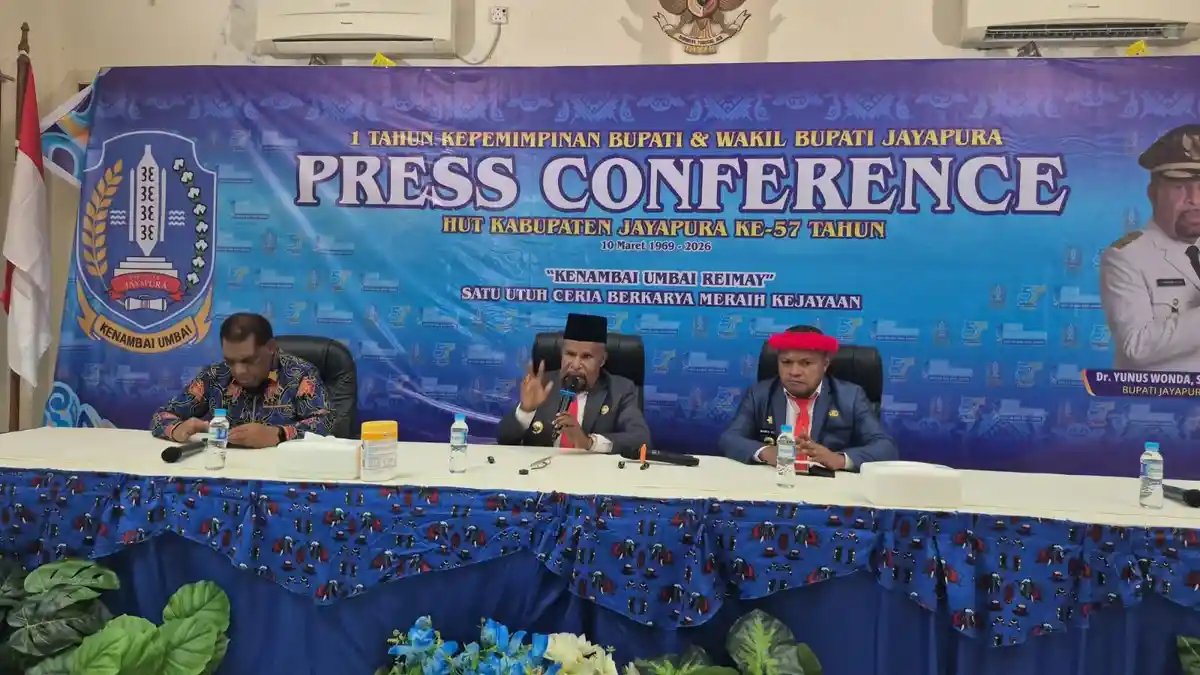
Inside those bank books was an incentive. The Jayapura Regency Government under Regent Yunus Wonda provided a financial allowance.
But if you watched closely, it became clear that the money was not the main point.
It was the act itself.
What It Means to Be Ondoafi
Outside Papua, the role of an ondoafi can be difficult to explain.
There is no exact equivalent.
They are not elected officials. They are not appointed by the state.
Their authority comes from tradition.
From lineage. Their authority stems from their recognition within the community.
They are guardians of customary land. They oversee social order. They settle disputes that might otherwise escalate.
They perform these duties without receiving a formal salary.
For years, their work has existed in a space that is essential but often overlooked, highlighting the need for recognition and support for their contributions to community harmony and conflict resolution.
The Decision to Provide Incentives
The program introduced by the Jayapura government provides financial incentives to 210 traditional leaders, including ondoafi and tribal heads.
Each receives Rp1.5 million every three months.
It is not a large amount, especially when measured against the responsibilities they carry.
But that is not how most of them describe it.
“It is not about how much,” one leader said after the ceremony. “It is about being seen.”
He held the bankbook in his hand as he spoke, turning it over slowly, as if still getting used to it.
A Form of Acknowledgment
This formal recognition of their role is a first for many of the recipients.
They have always been important within their communities.
But this is different.
This comes from the government.
It signals that their role is not separate from the state but connected to it.
That matters in a place like Papua, where two systems often run side by side.
Living Between Two Systems
In Jayapura, as in much of Papua, there are two ways of organizing society.
There is a formal system.
Government offices, laws, and regulations.
And there is the customary system.
Traditions, clan structures, and unwritten rules that guide daily life.
Neither exists in isolation.
They overlap, sometimes smoothly, sometimes not.
For years, traditional leaders have been navigating that overlap.
They speak with government officials. They represent their communities. They translate policy into something people can understand.
But they have often done so without formal support.
The Weight of Responsibility
One of the ondoafi at the event described what his role involves.
“If there is a problem, people come to us first,” he said.
Occasionally the problems are small.
A disagreement between neighbors.
Sometimes they are larger.
Land issues. Conflicts between groups.
“We have to listen to both sides,” he added. “We cannot take sides.”
It is work that requires patience, experience, and trust.
And it does not follow office hours.
Why This Matters for Development
For the government, the program is not only about welfare.
It is also about strengthening the foundation of development.
In Papua, projects often depend on local acceptance.
A road cannot be built without agreement on land.
A school cannot operate without community support.
Traditional leaders play a key role in that process.
They help ensure that development does not disrupt social balance by mediating between the school and the community, fostering collaboration, and addressing any concerns that may arise.
A Subtle Change in Relationship
By providing incentives, the government is making a subtle shift.
It is acknowledging that traditional leadership is not outside governance.
It is part of it.
That shift may seem small.
But over time, it can change how policies are implemented.
It can improve communication.
It can build trust.
Conversations After the Ceremony
After the formal part of the event ended, the atmosphere became more relaxed.
Leaders gathered in small groups, talking among themselves.
Some compared their experiences. Others discussed issues in their villages.
A few joked quietly, laughing in a way that suggested familiarity rather than formality.
One of them said he planned to use the money for community needs.
“Maybe for meetings,” he said. “Or to help people when they need it.”
The others nodded.
For them, the incentive is not purely personal.
It is tied to their role.
The Question of Fairness
Programs like this also raise questions.
Who is included?
Who is not.
In regions where customary structures can vary, defining leadership is not always straightforward, which can lead to confusion about who is included in decision-making processes and who is not.
The government says it has worked to ensure that the recipients are accurately identified.
But maintaining that accuracy over time will require attention, particularly through regular audits and community engagement to ensure ongoing compliance with the identification criteria.
A Broader Effort
The incentive program is part of a wider set of initiatives by the Jayapura government.
Other programs focus on social welfare, including assistance for families during difficult times, such as food aid, financial support, and access to healthcare services.
Together, they reflect an approach that looks beyond infrastructure, emphasizing the importance of community well-being and social support systems.
An approach that focuses on people.
A National Context
At the national level, Indonesia has placed increasing emphasis on development in Papua.
Infrastructure projects have expanded. Social programs have been introduced.
But there is also recognition that development cannot be imposed.
It must involve local communities.
Programs like this are one way of doing that.
What Changes, and What Stays the Same
For the ondoafi and tribal leaders, the incentive does not change their role.
They will continue to do what they have always done.
Resolve disputes. Guide their communities. Protect customary land.
But it changes how that role is acknowledged.
It brings it into the formal system.
A Quiet Moment of Meaning
As the gathering began to disperse, the field slowly emptied.
Some leaders left immediately, heading back to their villages.
Others stayed a little longer, finishing conversations.
There was no dramatic ending.
No final announcement.
Just a gradual return to normal.
But if you looked closely, you could see something in the way people carried themselves.
A small sense of validation.
Looking Ahead
The success of the program will not be measured only in numbers.
It is not about how much money is distributed.
But in what it leads to.
Better communication between government and communities.
Stronger support for development programs.
Greater trust.
These are outcomes that take time.
More Than an Incentive
In the end, the program is not only about financial support.
It is about recognition.
Recognizing that leadership in Papua does not exist only in offices.
It exists in villages.
In traditions.
In people who carry responsibilities that are rarely written down but always understood.
And for those 210 leaders in Jayapura, that recognition may be the most important part of all.