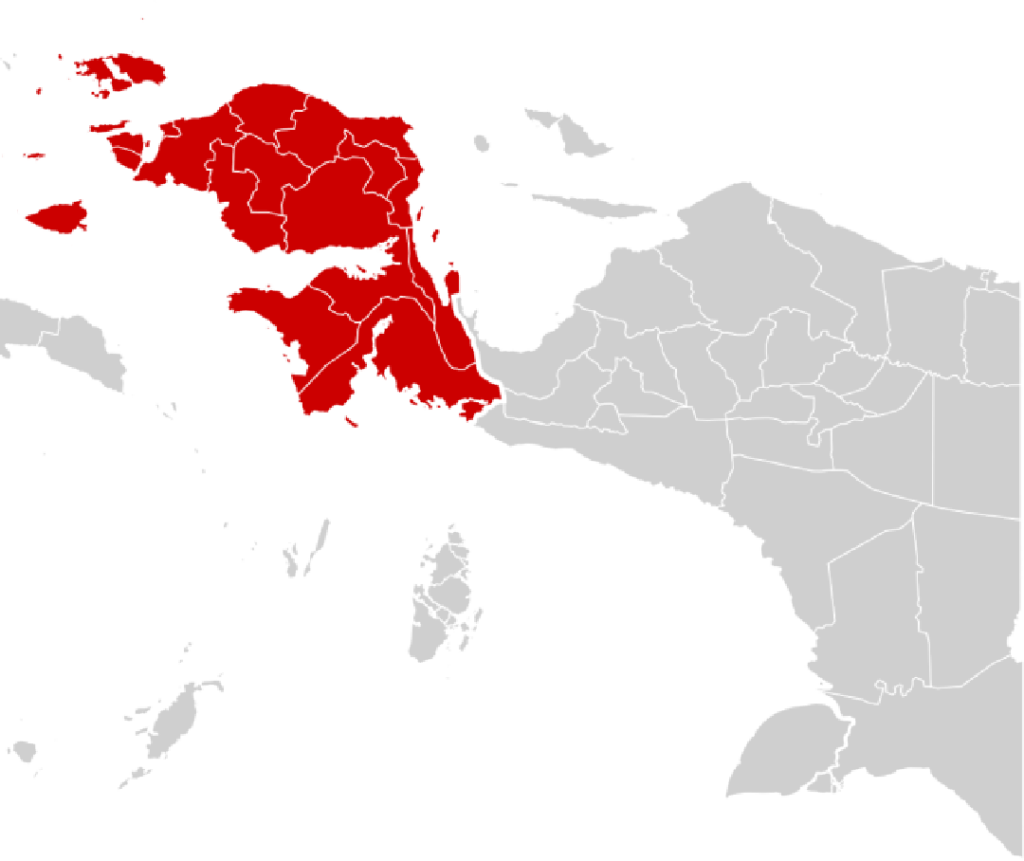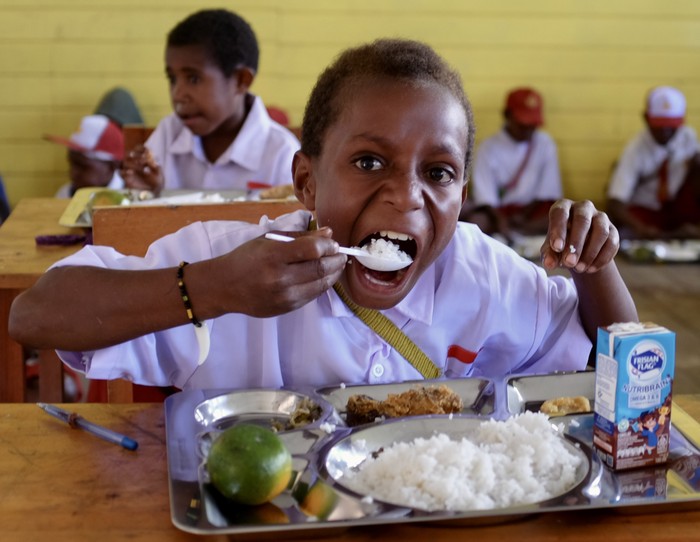
In the remote classrooms of Papua, where mountains, forests, and oceans often separate children from opportunity, a quiet but powerful change is taking place. Each school day, nearly 200,000 children across the region sit down to a nutritious meal, sometimes for the first time in their lives. This is the tangible impact of Indonesia’s Free Nutritious Meal program, known nationally as Makan Bergizi Gratis (MBG). More than a welfare initiative, the program is increasingly seen as a strategic investment in human development, especially in Papua, a region long affected by inequality, geographic isolation, and limited access to basic public services.
The presence of a warm, balanced meal at school may seem simple, even ordinary. Yet in Papua, it represents a profound shift. For decades, food insecurity and malnutrition have shaped childhood experiences, often forcing children to learn while hungry, tired, and unable to focus. The MBG program changes this daily reality. By ensuring that children receive adequate nutrition during their most critical years of growth, the program is laying the foundation for healthier bodies, sharper minds, and a more hopeful future.
From Policy Vision to Daily Reality
The MBG program is part of a broader national vision initiated under the leadership of President Prabowo Subianto, who has placed food security and human capital development at the center of Indonesia’s long-term strategy. While the program is designed to benefit millions of Indonesians nationwide, its implementation in Papua carries particular significance. Papua is home to some of the country’s most vulnerable communities, where poverty rates are higher than the national average and access to nutritious food is often inconsistent.
Turning a national policy into daily meals in Papua is no small task. The region’s challenging terrain—marked by rugged mountains, scattered islands, and limited transportation infrastructure—has historically complicated the delivery of public services. Despite these obstacles, MBG has managed to reach approximately 200,000 children every day through a growing network of community kitchens and school-based distribution points. These meals are prepared according to nutritional standards designed to meet children’s dietary needs, including carbohydrates for energy, proteins for growth, and essential vitamins and minerals.
The scale of this achievement becomes clearer when viewed in context. Each plate served represents a coordinated effort involving central and local governments, community workers, school administrators, and kitchen staff. In many villages, the arrival of the MBG program has been one of the most visible and consistent forms of state presence, reinforcing trust and strengthening the relationship between communities and public institutions.
Hunger, Learning, and the Power of a Meal
The relationship between nutrition and education is well established. Children who are hungry struggle to concentrate, retain information, and participate actively in class. In Papua, where many families rely on subsistence livelihoods and face fluctuating food availability, this challenge has long undermined educational outcomes. Teachers frequently report that students arrive at school without breakfast, making it difficult to sustain attention throughout the day.
The MBG program directly addresses this issue. With a guaranteed nutritious meal provided at school, children are better prepared—both physically and mentally—to engage in learning. Teachers in participating schools describe noticeable changes: students are more attentive, more energetic, and more eager to participate in lessons. Over time, these daily improvements accumulate, supporting better academic performance and a stronger learning culture.
Equally important is the program’s effect on school attendance. For many parents, particularly in remote areas, the assurance that their children will receive food at school has become a powerful incentive to keep them enrolled and attending regularly. In this way, MBG does more than nourish bodies; it strengthens the education system by reducing absenteeism and reinforcing the value of schooling within families and communities.
Health Gains Beyond the Classroom
The benefits of MBG extend beyond education into broader public health outcomes. Childhood malnutrition has long been a concern in Papua, contributing to stunting, weakened immune systems, and long-term health risks. By providing consistent access to balanced meals, the program supports healthy physical development during critical growth periods.
For many children, the school meal may be the most nutritious food they consume in a day. Over time, this regular intake of essential nutrients helps improve overall health, reducing susceptibility to illness and supporting stronger physical development. Healthier children are not only better learners; they are also more likely to grow into productive adults, capable of contributing meaningfully to their communities.
The program also carries indirect health benefits by promoting better dietary awareness. Through exposure to balanced meals, children and families become more familiar with nutritious food combinations, potentially influencing eating habits at home. While MBG is not a substitute for comprehensive health and nutrition education, it serves as an important practical example of what a healthy meal looks like.
Economic Impact at the Community Level
One of the most significant yet often overlooked aspects of the MBG program in Papua is its local economic impact. Rather than relying solely on centralized food distribution, the program emphasizes the use of community kitchens, known as Satuan Pelayanan Pemenuhan Gizi. These kitchens employ local residents to prepare and distribute meals, creating new sources of income in areas where formal employment opportunities are limited.
In many locations, women from local communities play a central role in operating the kitchens. Their involvement not only supports household incomes but also fosters a sense of ownership and pride in the program. This community-based approach strengthens social cohesion and ensures that the program is responsive to local conditions and preferences.
Whenever possible, ingredients are sourced locally, supporting farmers, fishers, and small-scale producers. This creates a modest but meaningful stimulus to local economies, circulating funds within the community rather than directing them entirely outward. Over time, such linkages between social programs and local production can contribute to more resilient rural economies.
Political Support and National Commitment
The expansion of MBG in Papua has received strong backing from national lawmakers and policymakers, who view the program as a concrete expression of the state’s commitment to equity. Members of Indonesia’s legislature have repeatedly emphasized the importance of prioritizing frontier, outermost, and underdeveloped regions, often referred to as 3T areas in the program’s rollout.
This political support is critical for ensuring the program’s sustainability. Delivering free nutritious meals on a daily basis requires significant and consistent funding, as well as effective coordination across multiple levels of government. Continued legislative backing signals that MBG is not a temporary initiative but a long-term investment aligned with Indonesia’s broader development goals.
In Papua, this commitment carries symbolic weight. For communities that have long felt marginalized, the presence of a reliable, beneficial public program helps reinforce a sense of inclusion within the national framework. It demonstrates that development policies are not confined to urban centers but extend to the country’s most remote regions.
Challenges That Remain
Despite its achievements, the MBG program in Papua is not without challenges. Logistics remain a persistent concern, particularly in areas accessible only by air or water. Ensuring that food supplies arrive on time and in good condition requires careful planning and significant resources. Weather conditions, transportation costs, and infrastructure limitations can all disrupt delivery schedules.
Quality control is another important issue. Maintaining consistent nutritional standards across hundreds of kitchens in diverse locations is a complex task. Continuous monitoring, training, and evaluation are essential to ensure that every meal meets the program’s objectives. As the program expands, these systems will need to grow stronger and more sophisticated.
There is also the question of scalability. While reaching nearly 200,000 children in Papua is a major milestone, thousands more could still benefit. Expanding coverage without compromising quality will require sustained political will, increased capacity, and ongoing community engagement.
A Long-Term Investment in Human Capital
Viewed in isolation, a school meal may seem modest. Viewed over time and at scale, it becomes transformative. The MBG program in Papua illustrates how targeted social policies can address multiple challenges simultaneously—nutrition, education, health, employment, and social inclusion.
By nourishing children during their formative years, the program invests in Papua’s future workforce, leadership, and civic life. Healthier, better-educated children are more likely to pursue further education, participate productively in the economy, and contribute positively to their communities. These outcomes align with Indonesia’s long-term vision of building a strong, inclusive nation by 2045.
For parents in Papua, the impact is immediate and deeply personal. The daily assurance that their children will eat well at school brings relief, dignity, and hope. For teachers, it creates a more effective learning environment. For communities, it offers economic opportunities and a renewed sense of connection to national development efforts.
Conclusion
The Free Nutritious Meal program has become one of the most meaningful social interventions currently unfolding in Papua. By reaching nearly 200,000 children every day, it demonstrates how a simple, well-designed policy can produce wide-ranging benefits. From improved learning outcomes and better health to local economic stimulation and stronger social cohesion, the impact of MBG extends far beyond the classroom.
Challenges remain, and continued commitment will be essential. Yet the progress achieved so far offers a compelling lesson: when nutrition is treated not as charity but as a right and an investment, it has the power to change lives. In Papua, each meal served is more than food—it is a statement of hope, equity, and belief in the potential of the next generation.