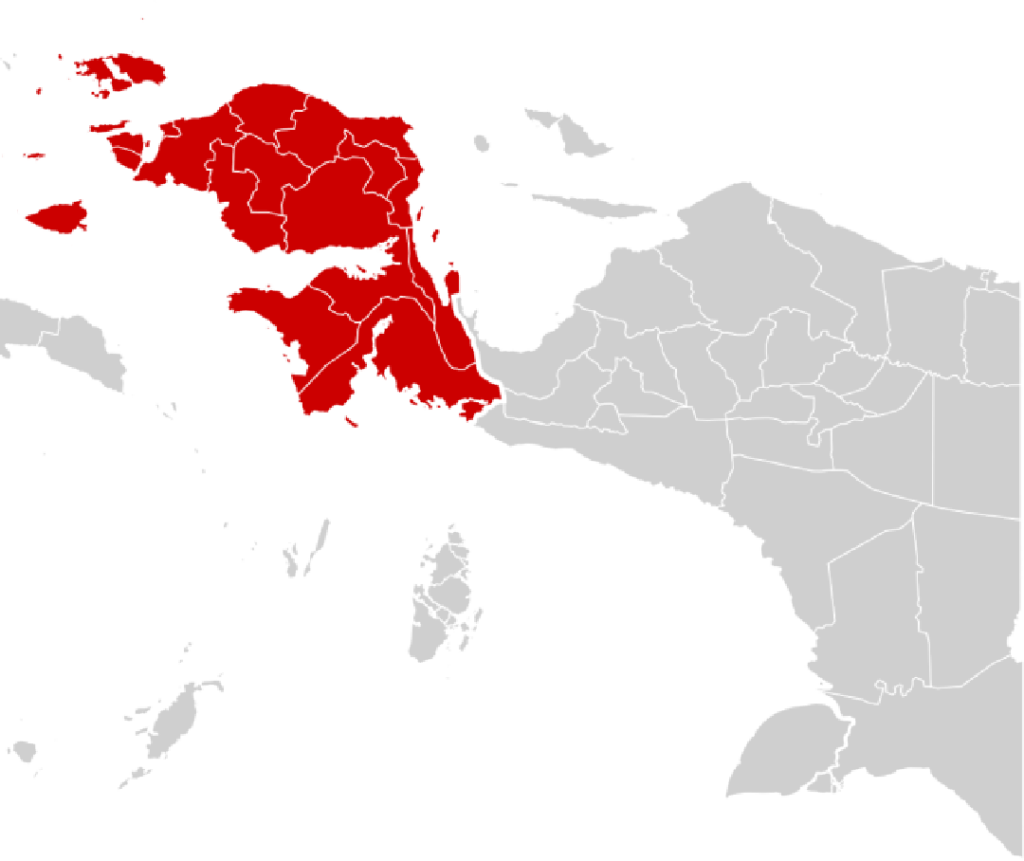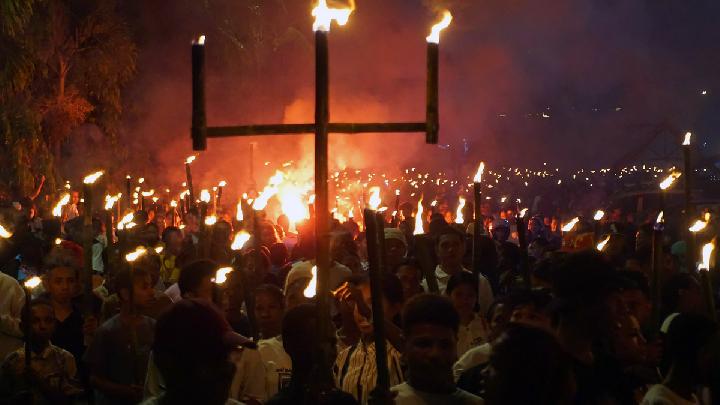
On April 5, 2026, before the sun rises over the mountains of Tolikara, people are already on the move.
It begins quietly. A few footsteps on damp ground. The faint glow of torches appearing one by one. Then, slowly, the road fills. Children walk beside their parents. Elderly men and women follow at a steady pace, some leaning on sticks, others supported by family members.
There is no rush. No loud signal that something has begun.
And yet, something clearly has.
This is how Easter morning often starts in Papua.
Not with noise, but with light.
Walking Together Before Dawn
The torchlight procession is one of the most recognizable traditions during Easter across Papua. In Tolikara, thousands of people took part this year, moving together in a long line through the early morning darkness.
From a distance, it looks like a stream of fire stretching across the hills.
Up close, it feels very different.
It is calm. Reflective. Almost personal.
People carry their torches carefully, protecting the flame from the wind. Some sing softly. Others walk in silence. No one needs to explain what the moment means. It is understood.
“It feels peaceful,” said a young participant who joined with his family. “You feel like you are part of something bigger.”
That sense of belonging is what stays with people long after the procession ends.
From Highlands to Coastal Cities
While Tolikara stood out for the scale of its procession, similar scenes unfolded across Papua.
In Jayapura, thousands gathered before dawn at churches such as GKI Petrus Waena. The setting was more urban, but the feeling remained the same. People arrived quietly, joining others in prayer and reflection as the sky slowly began to brighten.
Further west, in Nabire, Easter celebrations blended formal church services with community gatherings. Congregations filled churches early in the morning, listening to messages centered on hope and renewal.
In southern parts of Papua, smaller communities marked the occasion in their own ways. Some combined religious observance with local traditions, creating a celebration that felt both spiritual and cultural.
Each place had its own rhythm.
But the meaning was shared.
More Than a Religious Celebration
Easter in Papua is deeply connected to Christian belief. That is clear in the prayers, the hymns, and the sermons delivered throughout the day.
But it is also something more than that.
It becomes a moment when people step back from daily routines and focus on values that matter beyond the church.
Peace. Unity. Hope.
These themes appeared again and again in messages delivered by religious leaders and local officials.
Representatives from the Ministry of Religious Affairs noted that the meaning of Easter goes beyond spiritual reflection. It also serves as a reminder of the importance of togetherness, especially in a region where diversity is part of everyday life.
At one service in Nabire, a priest spoke in simple terms.
“Do not lose hope,” he said. “Hope is what keeps us moving forward.”
There was nothing complicated about the message.
But people listened.
A Day That Feels Close
In many parts of the world, large religious events can feel distant or formal.
In Papua, Easter feels closer.
After church services, people stay. They gather outside. They talk. They share food.
Children run around churchyards. Adults sit in small groups, catching up on conversations that do not always happen during busy days.
It is not organized.
It just happens.
A woman in Jayapura described it simply.
“Easter is when we remember that we are together,” she said.
That sense of closeness is difficult to measure, but visible and easy to notice.
Tradition and Identity
Tradition plays a strong role in how Easter is celebrated in Papua.
The torchlight procession is one example, but there are many others. Choirs rehearse for days leading up to Easter. Churches are decorated carefully. Families prepare meals to share after services.
In some areas, cultural elements are part of the celebration. Traditional songs and local customs appear alongside church rituals, creating something that feels natural rather than staged.
It is not about mixing two separate things.
It is about expressing faith in a way that reflects local identity.
Keeping the Celebration Safe
With large gatherings taking place across different regions, security becomes an important part of the process.
This year, local authorities worked closely with communities to ensure that Easter celebrations remained safe and orderly. In Tolikara, where thousands joined the procession, the situation stayed calm throughout the event.
Police presence was visible, but not intrusive.
Officers helped manage traffic, guided participants, and coordinated with community leaders. The goal was not to control the event but to support it.
Officials later noted that cooperation from residents made a difference.
People followed guidance. They respected the flow of activities.
And as a result, the celebrations remained peaceful.
Moments for Children
For children, Easter carries a different kind of meaning.
They may not fully understand the religious significance, but they feel the atmosphere.
The early morning excitement. The glow of torches. The sense that something special is happening.
In several areas, small activities were organized for them. Games, simple gifts, and shared moments added a layer of joy to the day.
A volunteer in Nabire explained why this matters.
“When children feel happy during events like this, they remember it,” she said. “Later, they will understand more.”
It is a quiet way of passing on tradition.
A Message That Lasts Beyond the Day
As the day comes to an end, the energy begins to settle.
People return home. Roads become quiet again. The routine of daily life slowly resumes.
But the message of Easter is not meant to end there.
Religious leaders across Papua emphasized that the themes of peace and unity should continue beyond the celebration.
Not just as words, but as actions.
In how people treat each other. In how communities handle differences.
It is not always easy.
But it is something people are encouraged to carry forward.
Seeing Papua Differently
Papua is often discussed in terms of its challenges.
Geography. Development. Complexity.
Those conversations are important.
But they are not the whole story.
Easter offers another perspective.
It shows communities coming together without being asked. It shows traditions that continue across generations. It shows a sense of connection that is not always visible from the outside.
For those who experience it, the impression is lasting.
Conclusion
Easter in Papua is not defined by one place or one event.
It is defined by people.
From the torchlight processions in Tolikara to the church gatherings in Jayapura and Nabire, the celebration reflects something shared.
A sense of faith.
A sense of community.
And a reminder that even in a region often seen as distant, there are moments that bring people closer together.
Not through grand statements.
But through simple acts of walking, gathering, and being present.measure but