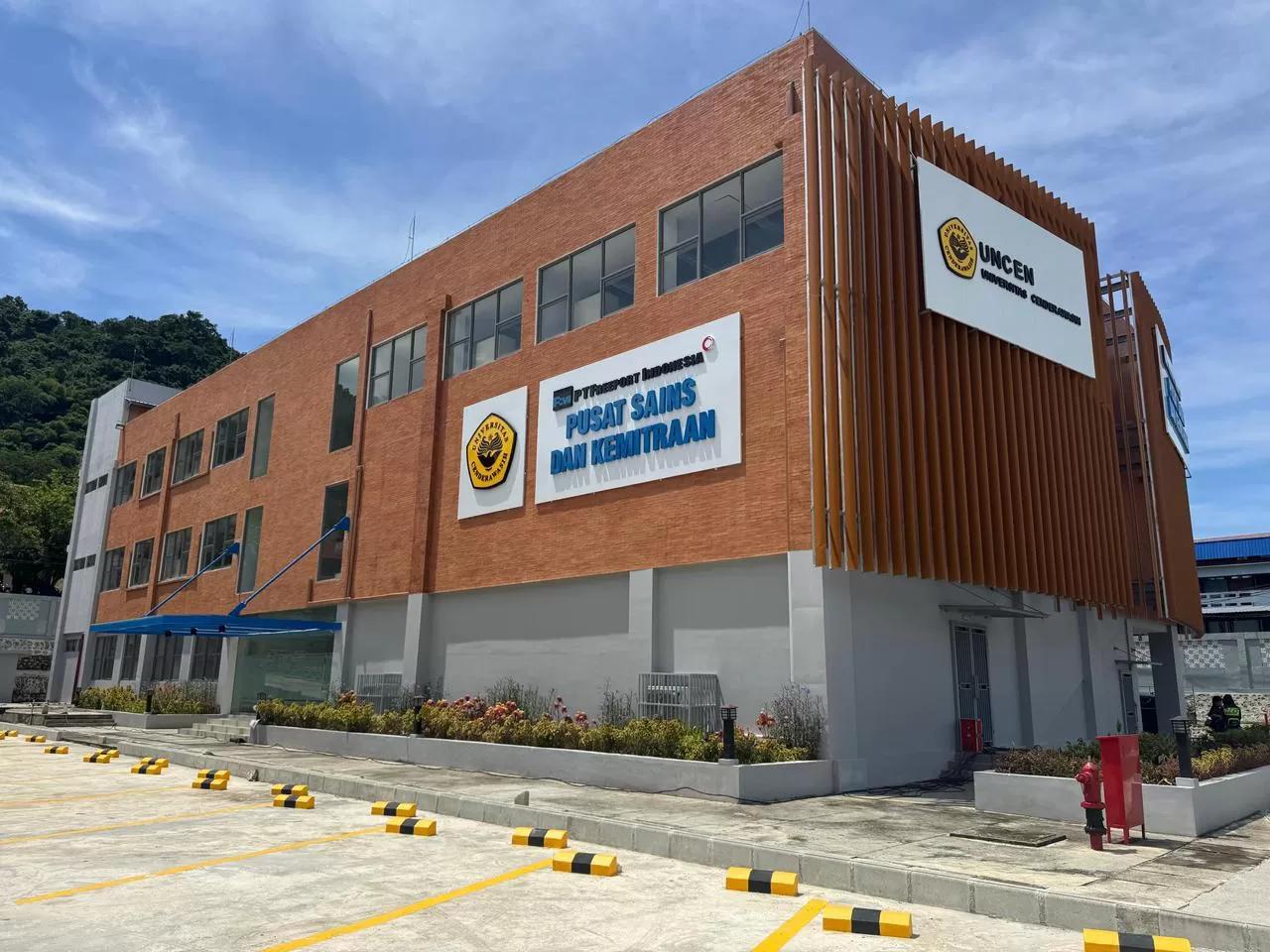
The morning air in Abepura, Jayapura—crisp with the scent of damp earth and the quiet hum of early traffic—felt different on 8 December 2025. It was warmer somehow, not from the sun but from a sense of possibility. Students in modest uniforms drifted towards the gates of Cenderawasih University (UNCEN), curious, hopeful, and perhaps a little awed. They had come not just for class but for a ribbon-cutting: the handover of a brand-new science facility, a gift from Freeport.
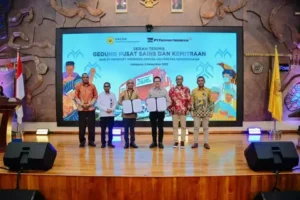
As the ribbon fell and the keys were handed over, the moment carried more weight than any formal ceremony—it carried the promise of a future where education, research, and opportunity could flourish even in Papua’s remote reaches.
More Than a Building: A Symbol of Commitment
For many in Papua, such a modern, well-equipped building had seemed like a distant dream. Institutional neglect, infrastructural challenges, and geographical remoteness—these had long conspired to make quality higher education a privilege for few. But with Freeport’s investment, that narrative is beginning to shift.
The facility, named the “Gedung Pusat Sains dan Kemitraan UNCEN (UNCEN Center for Science and Partnership Building),” was donated by Freeport to UNCEN. It is not just a symbolic gesture: the building spans 2,800 m² on a 4,800 m² plot, rises three stories, and is outfitted with modern amenities.
Inside are 18 classrooms, each capable of hosting around 40 students, each equipped with air-conditioning, projectors, and laptops—enabling not only in-person but also hybrid and online learning.
There’s also a 170-seat auditorium with a 6 × 3 meter videotron—a space where lectures, seminars, public talks, and collaborative events can happen.
But perhaps what is most striking is how the building combines functionality with identity: each classroom bears a name inspired by mineral elements—“Cuprum” (copper), “Argentum” (silver), and “Aurum” (gold)—an unmistakable nod to Papua’s rich mineral heritage and to Freeport’s own mining operations.
The interior design weaves in local culture: motifs inspired by Papua’s natural beauty, art, and heritage adorn the auditorium. A mural in the stairwell—entitled “Tembaga untuk Kehidupan” (“Copper for Life”)—tells a story of resources transformed not just into wealth, but into sustainable hope.
On the roof, solar panels quietly soak up the equatorial sun. They are not just energy-saving infrastructure—they are a living classroom, a demonstration of renewable energy and sustainable design for students who may one day carry these lessons into Papua’s future.
From Words to Reality: The Handover and Its Meaning
At the handover ceremony, Freeport’s President Director—Tony Wenas—spoke simply but powerfully: “Progress for Papua must begin with strengthening educational and research facilities.”
He described the building as a gift “for the young generation of Papua,” intended to support learning and knowledge development in science, technology, engineering, and mathematics (STEM), and to equip Papuan youth with global competence and strong character so they can compete at international levels.
According to Freeport, the partnership between the company and UNCEN already has tangible results: there are 332 UNCEN alumni working at Freeport, and over the years Freeport has supported 255 scholarship recipients at UNCEN—with 51 students still active under the program.
For UNCEN, represented by its Rector, Oscar O. Wambrauw, the building is nothing less than a new engine for education and research—a bridge between university and industry, a space where young Papuans can aspire, learn, and contribute without leaving their homeland.
As he said, the hope is that this building will help realize a vision of “Papua Healthy, Papua Smart, Papua Productive.”
What It Means for Students, Community, and Papua’s Future
- “A Place to Learn, Belong, and Dream”
For students, especially those from remote parts of Papua, the building represents more than classrooms—it’s a place to belong, to grow roots, and to dream beyond limitations. Imagine a young Papuan woman from a highland regency arriving in Jayapura for her first university semester. In the past, lacking resources or modern facilities, she might have felt adrift—in other parts of the country or even abroad. Now, she walks into a brightly lit auditorium, sits for a physics lecture, logs into a virtual lab on a solar-powered laptop, and feels like she belongs.
That belonging matters. It signals that their aspirations are valid, that their home—Papua—values their intellect and potential. It says: you can study here, you can build here, and you can contribute here.
- Strengthening University–Industry Bridges
With Freeport’s living example of collaboration, UNCEN becomes more than a campus—it becomes a node in a broader network connecting education, industry, and community. The new building offers space for research, projects, internships, workshops, and partnerships. For students studying geology, mining engineering, environmental science, renewable energy, or social studies, the facility offers real-world relevance.
Those 332 alumni already working at Freeport hint at a pipeline: education leading to employment, academic knowledge translating into practical contribution. For Papua, this means building human capital that understands the land, cares about community, and can help steer responsible development.
- Education Meets Sustainability
In Papua—a land blessed with natural resources but burdened by environmental and social challenges—sustainability is not an abstract ideal. The solar panels on top of the science building do more than power lights: they stand as a symbol of what responsible development can look like. For students learning about energy, environmental management, or engineering, the building itself becomes a classroom.
This alignment between infrastructure and values may help nurture a generation of Papuan professionals who approach development not just as exploitation, but as stewardship—balancing progress with care for the land and people.
- Restoring Trust and Inclusion
Historically, many communities in Papua felt left out of national progress. Remote villages, limited access to education, and lack of infrastructure—all compounded feelings of marginalization. The Freeport–UNCEN science building is more than architecture: it’s a gesture of inclusion. It tells Papuans: we see you, we support you, and we believe in your potential.
It may not solve all problems—but it is a step. A material, concrete step. And for many, that counts.
Beyond the Ceremony: Challenges, Responsibilities, and What Comes Next
Yet, for all its promise, the new building—and the goodwill behind it—faces real challenges.
- Access and Equity Across Papua
Papua is vast, with rugged terrain, remote regencies, and scattered communities. For many young people living far from Jayapura—in highlands, islands, or coastal areas—simply reaching UNCEN remains daunting. Travel costs, lodging, and financial constraints—these remain barriers.
For the building to serve as a real catalyst, stakeholders must ensure inclusive admission policies, scholarships, living support, outreach programs, and bridge scholarships for remote students. The long-term impact depends on more than infrastructure: it depends on access, equity, and support.
- Maintaining Standards—Infrastructure and Academic
A modern building with high-tech amenities needs maintenance—and reliable funding. It also needs faculty, labs, updated curricula, partnerships, and continuous institutional support. Without these, the risk is that the building remains underused or becomes another under-resourced facility.
- Bridging Education with Real Opportunities
It’s one thing to educate; it’s another to translate education into opportunities. For Papua’s youth, ideally, research and learning at UNCEN should link with real projects—in industry, environment, social sectors, and community development. Ensuring that graduates can contribute meaningfully, stay in Papua if they wish, and find work is crucial.
- Respecting Communities, Heritage, and Environment
Papua’s history with extractive industries has often been fraught. For education-based efforts to truly succeed, they must be accompanied by respect for indigenous rights, the environment, social justice, and local voices. The building is a symbol—but meaningful change requires engagement, transparency, and collaboration with local communities.
A Glimpse of What Could Be—If the Promise Holds
Picture this: five years from now, UNCEN’s science building is buzzing. Labs are filled with students working on renewable energy projects. A local engineering team studies sustainable mining practices suited for Papua’s unique ecosystem. Community outreach programs bring science education to remote highlands. Magnificent murals still line the stairwell, reminding every visitor that copper, silver, and gold are not just minerals—they are life, opportunity, and responsibility.
Alumni of UNCEN and former scholarship recipients from remote villages work in sectors ranging from mining to environmental management and from education to sustainable tourism—helping build Papua from within.
What started as a handover ceremony becomes a movement: knowledge rooted locally but reaching globally.
Conclusion
The handover of the Gedung Pusat Sains dan Kemitraan UNCEN by Freeport is more than charity. It’s a gesture of belief—in Papuan youth, in education, in a future where geography does not dictate opportunity. It is a chance to change narratives: from resource-centered to people-centered development, from extraction to education, and from marginalization to inclusion.
For the students walking into those 18 classrooms, sitting in that auditorium, switching on laptops powered by solar energy—this building holds a promise. A promise that their dreams matter. That their potential is seen. That Papua can produce scholars, scientists, engineers, and leaders—not just miners.
But a building alone does not change futures. What changes the future is commitment: from institutions, from communities, and from stakeholders. Commitment to access, equity, maintenance, opportunity, and inclusion.
If that commitment holds—if UNCEN, Freeport, the government, and Papuan communities walk together—then perhaps this humble building in Jayapura will become a cornerstone of a Papua that is not only rich in resources but also rich in knowledge, opportunity, and hope.