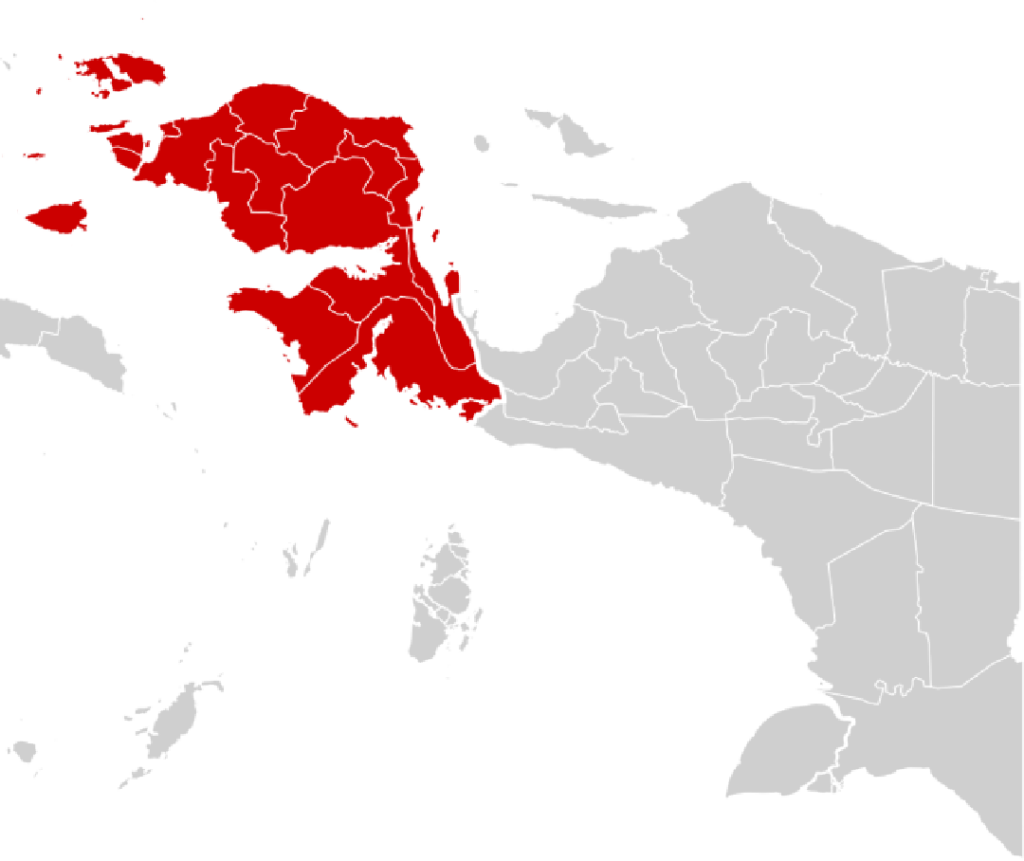
If you walk long enough through the forest near Kampung (Village) Topo, the sounds begin to blur together.
Leaves brushing against each other. Distant birds. The occasional crack of a branch underfoot. It is the kind of place where movement can disappear quickly, swallowed by trees and distance.
For people who live nearby, the forest is familiar.
For those who patrol it, it represents a completely different experience.
A place where silence can mean many things.
On the morning of March 21, 2026, that silence did not last.
A Routine Patrol, At First
The soldiers who moved through the area that day were not there by accident.
They were part of a routine patrol, one of many carried out across parts of Papua Tengah (Central Papua) in response to reports of suspicious activity.
Nothing unusual at first.
Just another movement through terrain that requires patience more than speed.
But somewhere along the route, something shifted.
A sign.
Movement.
Or maybe just a feeling that something was not quite right.
The First Contact
According to official reports, the patrol encountered a group believed to be affiliated with TPNPB OPM, an armed separatist organization that has operated in Papua for decades.
What followed was brief.
A burst of gunfire.
Not a prolonged battle.
Not a large-scale confrontation.
Just a short exchange that ended as quickly as it began.
By the time it was over, the armed group had retreated deeper into the forest.
The patrol was left with a different situation.
What Was Found
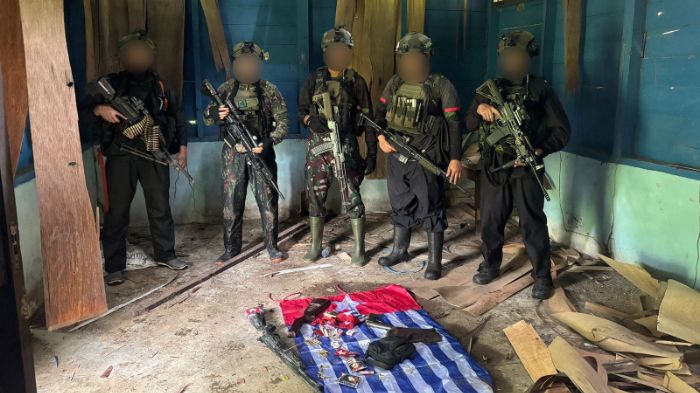
After securing the area, soldiers began to search.
The location they had reached was not random.
It showed signs of use.
A temporary base.
A place where people had stayed, even if only for a short time.
Among the items left behind were one P1 pistol, one air rifle, 14 rounds of 5.56 mm caliber ammunition, eight rounds of 9 mm caliber ammunition, a Morning Star flag, cash, and other equipment. There were also other belongings, including cash and equipment believed to be connected to the group.
To someone unfamiliar with the region, it might not seem like much.
But in Papua, where armed groups often operate with limited resources, even a small cache matters.
A Soldier’s Reflection
One soldier who has spent months in similar operations described what these moments feel like.
“It is not always about what you see,” he said.
“It is about what you sense.”
He explained that patrols are often long and uneventful.
Hours of walking.
Listening.
Watching.
Then suddenly, everything changes.
“Sometimes it is very fast,” he added. “You don’t have time to think too much.”
A Pattern That Has Emerged
The incidents in Kampung Topo are not unique.
Earlier in March, another operation in Nabire led to the discovery of a larger cache, including hundreds of rounds of ammunition, communication devices, and other equipment linked to armed activity.
Each operation follows a similar rhythm.
Information comes in.
A patrol is organized.
Contact may or may not occur.
Then comes the search.
Sometimes nothing is found.
Sometimes, as in this case, there is evidence.
Why These Seizures Matter
Weapons in Papua are not easily replaced.
Many are acquired through limited and often risky channels.
Some are smuggled.
Some are bought illegally.
Others are taken during attacks on security forces.
This means that every weapon seized reduces capability.
Every round of ammunition removed from circulation limits what can be used later, thereby decreasing the potential for future attacks and enhancing the overall safety of security forces.
It is not a complete solution.
But it is part of a broader effort.
The Forest serves as both a source of cover and a challenge.
The terrain in Nabire plays a role in all of this.
Dense forest provides cover.
It allows groups to move without being easily seen.
It creates space where small units can operate.
But it also creates challenges.
For security forces, movement is slow.
Visibility is limited.
Communication can be difficult.
Operations require planning, patience, and often, a degree of uncertainty.
The Human Side of Operations
From a distance, these events are often described in simple terms.
Contact.
Retreat.
Seizure.
But on the ground, they are more complicated.
There is tension.
There is uncertainty.
There are decisions that must be made quickly.
And afterward, there is reflection.
A Village Nearby
Not far from Kampung Topo, a small village sits along a narrow path.
Life there continues much as it always has.
People wake early.
They work.
They gather in the evenings.
When asked about the operation, one resident spoke cautiously.
“We heard something,” he said.
He did not specify what.
But he did not need to.
In places like this, people often understand without needing full explanations.
Living Between Normal and Uncertain
For residents, the challenge is not only the incident itself.
It is the uncertainty that follows.
Will there be more activity?
Will things remain quiet?
Will life continue as usual?
These questions do not always have answers.
The Role of Information
Operations like the one in Nabire rely heavily on information.
Reports from communities.
Previous incidents.
Patterns of movement.
Without that information, patrols would move blindly.
With it, they can be more focused.
But gathering information is not always straightforward.
It requires trust.
And trust takes time.
Between Security and Daily Life
For authorities, the goal is clear.
Maintain stability.
Prevent escalation.
Protect communities.
But for residents, the perspective is different.
They want to live without disruption.
They want predictability.
They want to feel safe.
These goals overlap.
However, individuals may not always experience these goals in the same way.
A Quiet Outcome
What stands out about the Kampung Topo operation is how quiet it was.
No large-scale confrontation.
No dramatic aftermath.
Just a brief moment of contact.
Followed by recovery.
And then, a return to routine.
The Larger Picture
The Papua conflict is not defined by single events.
It is shaped by many small ones.
Incidents that happen in remote areas.
Operations that do not always make headlines.
Each one adds to the overall situation.
Each one changes it slightly.
Looking Ahead
The seizure of weapons in Nabire will not end the conflict.
It will not resolve underlying issues.
But it does have an impact.
It disrupts activity.
It limits resources.
It creates space, however small, for stability.
A Soldier’s Closing Thought
When asked what success looks like in operations like this, one soldier paused before answering.
“It is when nothing happens,” he said.
Not because nothing is being done.
But because the situation remains calm.
This allows people to lead their lives uninterrupted.
Conclusion
By the afternoon, the forest near Kampung Topo had returned to its usual state.
The same sounds.
The same stillness.
But beneath that stillness, something had changed.
Weapons that could have been used were no longer there.
A small shift.
Not visible from the outside.
But meaningful for those who understand what it represents.
In Papua, change often comes like this.
Quiet.
Incremental.
And easy to miss, unless you are looking closely.