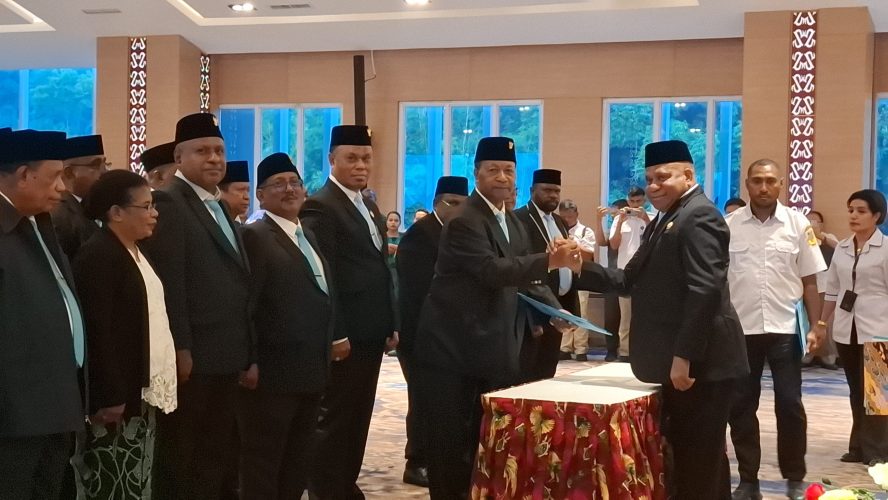
The Government of Papua has made an important move to speed up development and improve local economic organizations by starting the Development Acceleration Team, along with new special staff and commissioners for PT Irian Bakti Mandiri. Led by Papua Governor Mathius Fakhiri, these appointments show a renewed commitment to better policy coordination, governance, and ensuring that local development projects are based on solid analysis and professional management.
The inauguration, held in Jayapura, shows that the provincial government understands that Papua’s development issues need not just funding but also strong organizations, clear policies, and skilled people. Governor Fakhiri stressed that the new team should generate ideas and solutions, rather than just serve as a symbolic advisory group.
This action is part of the Papua Provincial Government’s larger plan to make sure development planning is based on scientific research, local needs, and clear results. The creation of the Development Acceleration Team, called TP3C, along with the new special staff and BUMD commissioners, aims to improve decision-making in important areas and rebuild trust in regional economic institutions.
A Strategic Response to Papua’s Development Challenges
Governor Mathius Fakhiri stated that Papua’s development requires a more structured and evidence-based approach. According to him, policy decisions must be supported by rigorous analysis, accurate data, and a profound understanding of Papua’s social, geographic, and economic conditions.
The Development Acceleration Team was therefore tasked with conducting in-depth studies, producing policy recommendations, and offering strategic insights to support government programs. Fakhiri stressed that Papua cannot rely solely on routine administrative processes if it aims to catch up with other regions in terms of welfare, infrastructure, and public services.
He noted that Papua’s unique challenges, ranging from difficult terrain to disparities in human development, require innovative and context-sensitive solutions. The TP3C is expected to bridge the gap between academic research, field realities, and policy execution.
The Role of TP3C as a Center for Policy Analysis
One of the central messages delivered by Governor Fakhiri during the inauguration was that the Development Acceleration Team must serve as a motor of scientific study for Papua’s development. The team is expected to provide objective and professional input, free from political interests or short-term considerations.
According to Fakhiri, development policies must be rooted in research rather than intuition. He emphasized that TP3C should actively collaborate with universities, research institutions, and local experts to ensure that policy recommendations are grounded in credible evidence.
The team’s responsibilities include identifying development bottlenecks, evaluating ongoing programs, and proposing alternative solutions that are realistic and impactful. TP3C, acting as a think tank within the provincial administration, aims to enhance the quality of policymaking and minimize inefficiencies in government programs.
Strengthening Coordination Through Special Staff Appointments
Governor Fakhiri appointed special staff to enhance strategic coordination across government sectors, improving communication between his office and technical agencies to ensure effective implementation of policy directives.
Special staff members monitor program implementation, identify obstacles, expedite decision-making, reduce bureaucratic delays, and ensure development programs align with provincial priorities.
By appointing individuals with professional backgrounds and relevant expertise, the provincial government aims to improve responsiveness and adaptability in addressing emerging challenges. The special staff are expected to work closely with line agencies while maintaining accountability to the governor.
Reforming BUMD Governance Through New Commissioners
A significant part of the inauguration focused on the appointment of new commissioners for PT Irian Bakti Mandiri, one of Papua’s regionally owned enterprises. Governor Fakhiri underscored that reforming BUMD governance is essential to strengthening Papua’s economic foundation.
He acknowledged that regional enterprises have not always performed optimally and that governance weaknesses have undermined their potential contribution to local revenue and economic development. Therefore, the appointment of new commissioners aims to initiate structural reforms and enhance professionalism within the company.
Governor Fakhiri emphasized that PT Irian Bakti Mandiri must be managed transparently, efficiently, and with a clear business orientation. The company is expected to support regional development goals while adhering to sound corporate governance principles.
Restoring Public Trust in Regional Enterprises
Public trust in regionally owned enterprises has been a recurring concern in Papua. Governor Fakhiri stated that restoring this trust requires concrete action, starting with leadership reform and clear performance targets.
The new commissioners of PT Irian Bakti Mandiri have been tasked with evaluating the company’s operations, improving financial management, and ensuring that business activities deliver tangible benefits to the province. Fakhiri emphasized that BUMD should not burden the regional budget financially, but rather contribute to economic growth and job creation.
He also warned that poor performance and lack of accountability would not be tolerated. He stated that the provincial government would closely monitor the company’s progress and take necessary corrective action.
Aligning Development Acceleration With Special Autonomy
The broader framework of Papua’s Special Autonomy closely links the inauguration of TP3C and the reform of BUMD governance. Governor Fakhiri noted that special autonomy provides both opportunities and responsibilities for regional governments.
According to him, the effective use of Special Autonomy funds depends on strong planning, credible analysis, and disciplined execution. Therefore, we expect the Development Acceleration Team to play a critical role in ensuring the well-targeted and impactful implementation of Special Autonomy programs.
Fakhiri emphasized that special autonomy must translate into improved welfare for indigenous Papuans, better access to education and healthcare, and sustainable economic opportunities. Institutional strengthening, he said, is a prerequisite for achieving these goals.
A Call for Professionalism and Integrity
Throughout the inauguration ceremony, Governor Fakhiri repeatedly stressed the importance of professionalism and integrity. Governor Fakhiri reminded all appointees that their positions represent public trust and require responsible exercise.
The governor stated that Papua’s development cannot progress if institutions are weakened by personal interests or lack of discipline. Therefore, we expect members of TP3C, special staff, and BUMD commissioners to uphold ethical standards and prioritize the public interest.
He also urged the newly appointed officials to adopt a results-oriented mindset, emphasizing the importance of measurable outcomes over procedural formalities. He emphasized that real improvements felt by communities across Papua must reflect the acceleration of development.
Collaboration With Stakeholders and Communities
Governor Fakhiri underscored that the government alone cannot achieve development acceleration. He encouraged TP3C and other appointees to engage actively with local communities, traditional leaders, civil society organizations, and the private sector.
According to him, inclusive development requires dialogue and collaboration. Local knowledge, he said, must be integrated into policy planning to ensure that programs are culturally appropriate and socially accepted.
By fostering partnerships with various stakeholders, the provincial government aims to build a shared commitment to Papua’s development goals. This collaborative approach is expected to enhance policy effectiveness and reduce resistance to change.
Looking Ahead: Expectations and Accountability
The inauguration of the Development Acceleration Team, special staff, and BUMD commissioners marks the beginning of a new phase in Papua’s governance reform. Governor Fakhiri made it clear that appointments alone are not sufficient and that performance will be the ultimate measure of success.
He stated that regular evaluations would be conducted to assess progress and identify areas for improvement. Transparency and accountability, he said, are nonnegotiable principles in the pursuit of development acceleration.
The provincial government expects that within a reasonable timeframe, the work of TP3C and the reformed leadership of PT Irian Bakti Mandiri will produce visible results, both in policy quality and economic performance.
Conclusion
Governor Mathius Fakhiri’s choice to start the Development Acceleration Team, hire special staff, and change the leadership of PT Irian Bakti Mandiri shows a planned effort to improve Papua’s government and speed up development. By focusing on scientific analysis, effective governance, and accountability, the provincial government wants to tackle ongoing issues and unlock Papua’s development potential.
As Papua continues its journey under Special Autonomy, the effectiveness of these newly appointed bodies will have an important bearing on whether development policies translate into tangible improvements in welfare, economic opportunity, and public trust. The coming months will test the commitment of all involved to deliver on the promise of a more prosperous and well-governed Papua.