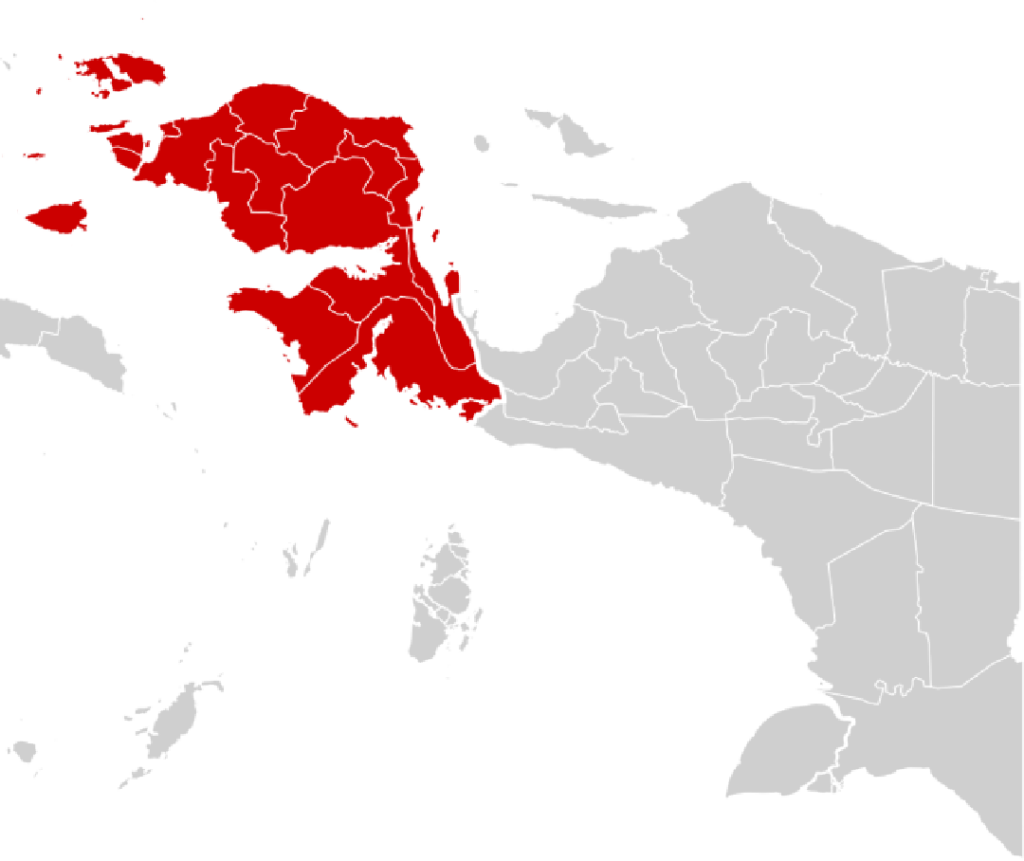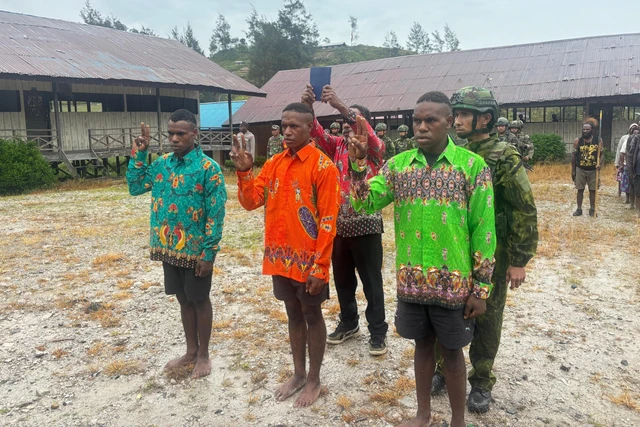
On March 28, 2026, in District Sinak, Puncak Regency, Papua Tengah (Central Papua) province, a small gathering took place that did not look extraordinary at first glance. There were no grand stages, no sweeping speeches, and no cameras from major international networks. Yet what happened there carried a weight that extended far beyond the valley.
Three men stepped forward. Their names were Nikanus Murib, Arendis Murib, and Ois Tabuni. For years, they had been associated with the armed separatist movement known as the Free Papua Movement (OPM) and its armed wing, the West Papua National Liberation Army (TPNPB). They had lived in the mountains, moved through dense forests, and been part of a conflict that has shaped Papua’s modern history, which includes struggles for independence and the impact on local communities.
That afternoon, they chose to walk back.
A Scene That Felt Personal
Those who witnessed the moment described it as quiet, almost intimate. There were Indonesian security personnel present, along with local leaders and residents who had gathered out of curiosity and cautious hope. The three men did not appear defiant. If anything, they looked reflective, as if carrying the weight of decisions made over many years.
When they declared their pledge of loyalty to Indonesia, it was not delivered with theatrical emphasis. It sounded more like a conclusion than a performance. A chapter closing.
Then came the moment that would resonate far beyond Sinak. One by one, they approached the Indonesian flag. They bent down and kissed it. The gesture was simple, but in a region where identity is deeply contested, it spoke volumes.
Some in the crowd reportedly fell silent. Others watched with a mixture of disbelief and emotion. For many, it was not just about politics. It was about seeing familiar faces return from a path that had long seemed irreversible, representing hope and the possibility of reconciliation for those affected by the conflict.
Lives Shaped by Conflict
To understand why this moment matters, it helps to look beyond the symbolism and consider the lives behind it.
Like many who joined armed groups in Papua, Nikanus Murib, Arendis Murib, and Ois Tabuni did not emerge from a vacuum. Decades of grievances, perceptions of marginalization, and uneven development have shaped the conflict in Papua. For some, joining an armed movement was considered a form of resistance. For others, it was about survival, identity, or belonging.
Reports indicate that the three men had previously been involved in armed incidents, including a shooting in the Sinak area. That history makes their decision to surrender more significant. Walking away from an armed group is often difficult. It involves risk, uncertainty, and the possibility of rejection from both sides.
A single statement cannot capture the changes they experienced. Decisions like this are often the result of long internal struggles, influenced by family, community, and the realities of life in the field, which can lead individuals to weigh their options carefully before making a choice.
The Role of Human Approach
Local officials and security personnel have pointed to one key factor behind the surrender: a sustained human-centered approach.
In recent years, Indonesian authorities have shifted parts of their strategy in Papua. While security operations remain, there has been a growing emphasis on dialogue, trust-building, and community engagement. Soldiers are not only deployed as enforcers but also increasingly as participants in local life. They visit villages, speak with elders, and try to understand concerns that go beyond security.
In places like Puncak Regency, where geography isolates communities and amplifies mistrust, this approach is not easy. It requires patience and consistency. Trust is not built overnight, especially in regions where suspicion has deep roots.
According to accounts surrounding the surrender, communication between the three men and local intermediaries had been ongoing. Community figures played a role. Assurances of fair treatment and the opportunity to rebuild their lives also played a role.
This kind of approach does not always produce immediate results. But when it does, it often carries more lasting impact than force alone, as it fosters a sense of trust and cooperation among the affected communities.
A Gesture That Carried Meaning
The act of kissing the red and white flag, Indonesia’s national symbol, quickly spread across local and national media. For some, it was a powerful sign of reconciliation. For others, it raised complex questions about identity and allegiance in Papua, particularly regarding how these feelings are influenced by the historical context of colonialism and ongoing tensions between local and national identities.
Symbols matter in conflict zones. They condense history, emotion, and political meaning into a single image. In this case, the gesture was interpreted by many as a sign that the three men were not simply surrendering but consciously choosing a different identity moving forward.
Yet even within that moment, there is room for nuance. Reconciliation is not always linear. It involves layers of personal reflection, social acceptance, and structural support.
For the people who stood in Sinak that day, the meaning was less abstract. It was about seeing change happen in front of them. It was about the possibility that conflict, which had long felt permanent, might actually come to an end.
A Shifting Landscape in Papua
The surrender of the three men comes at a time when Papua itself is changing.
In recent years, there has been increased attention toward development in the region. Roads, airports, schools, and healthcare facilities have expanded in some areas. While gaps remain and criticisms persist, these changes are beginning to alter daily life for many Papuans.
Younger generations, in particular, are growing up in a different context than their predecessors. Access to education and information is broader. Opportunities, while still uneven, are more visible.
In conversations with local leaders in Papua Tengah, a recurring theme has emerged. Many young people are shifting their focus from armed struggle to practical aspirations like jobs, education, and mobility.
This does not mean that grievances have disappeared. But it does suggest that the appeal of separatism is not as uniform as it once was, indicating that while some may still support it, many others prioritize stability and personal advancement over political ideologies.
The Difficult Road Back
For Nikanus Murib, Arendis Murib, and Ois Tabuni, the moment of surrender is only the beginning.
Reintegration is one of the most challenging phases in any conflict resolution process. Returning to civilian life involves more than laying down weapons. It requires rebuilding relationships, finding livelihoods, and navigating how others perceive you.
Authorities have indicated that support will be provided. This typically includes vocational training, counseling, and assistance in starting new economic activities. But institutional support alone is not enough.
Acceptance by the community is crucial. In tightly knit societies, social trust determines whether former combatants can truly move forward. Welcoming them back increases the chances of successful reintegration. If they are isolated, the risk of relapse into conflict remains, which can lead to further violence and instability within the community.
There is also the question of personal adjustment. Life in an armed group is structured differently from civilian life. Adapting to new routines, responsibilities, and expectations takes time.
Security Beyond the Headlines
From a broader perspective, moments like these have implications that go beyond the individuals involved.
Each surrender reduces the immediate capacity for armed activity. But more importantly, it can influence perceptions within the wider network of those still involved in conflict. When individuals step away and speak openly about their decision, it can create a ripple effect.
Security analysts often note that conflicts do not end only through decisive battles. They also end through gradual shifts in perception. When enough people begin to see an alternative path as viable, the logic of conflict starts to weaken.
In Papua, where the terrain is difficult and communities are dispersed, these shifts tend to be slow, often requiring years of sustained dialogue and community engagement to foster understanding and acceptance of new perspectives. But they are no less significant.
Between Hope and Reality
It would be easy to frame the surrender of these three men as a definitive turning point. But reality is more complex.
Papua’s challenges remain deeply rooted. Issues related to governance, inequality, and historical grievances continue to shape the landscape. There are still groups that reject integration and continue armed resistance.
At the same time, moments like the one in Sinak offer something that statistics and policy papers often cannot. They offer a human story. A reminder that behind every conflict are individuals capable of change.
For policymakers, the lesson is clear. Security measures alone are not enough. Development alone is not enough. Dialogue alone is not enough. It is the combination of these approaches, applied consistently, that creates space for transformation.
A Quiet but Meaningful Step
As the gathering in Sinak dispersed and the day returned to its usual rhythm, there was no immediate sense of historic drama. No declarations that the conflict had ended. No guarantees of what would come next.
But for those who were there, something had shifted.
Three men who once participated in an armed struggle in the mountains chose a different direction. They had stepped into uncertainty as well as possibility.
In a region often defined by its tensions, that choice carries its own significance.
It may not change everything overnight. But it adds to a growing sense that the future of Papua will not be determined solely by conflict but also by the quiet decisions of individuals willing to walk back from divisive actions and seek peaceful resolutions.