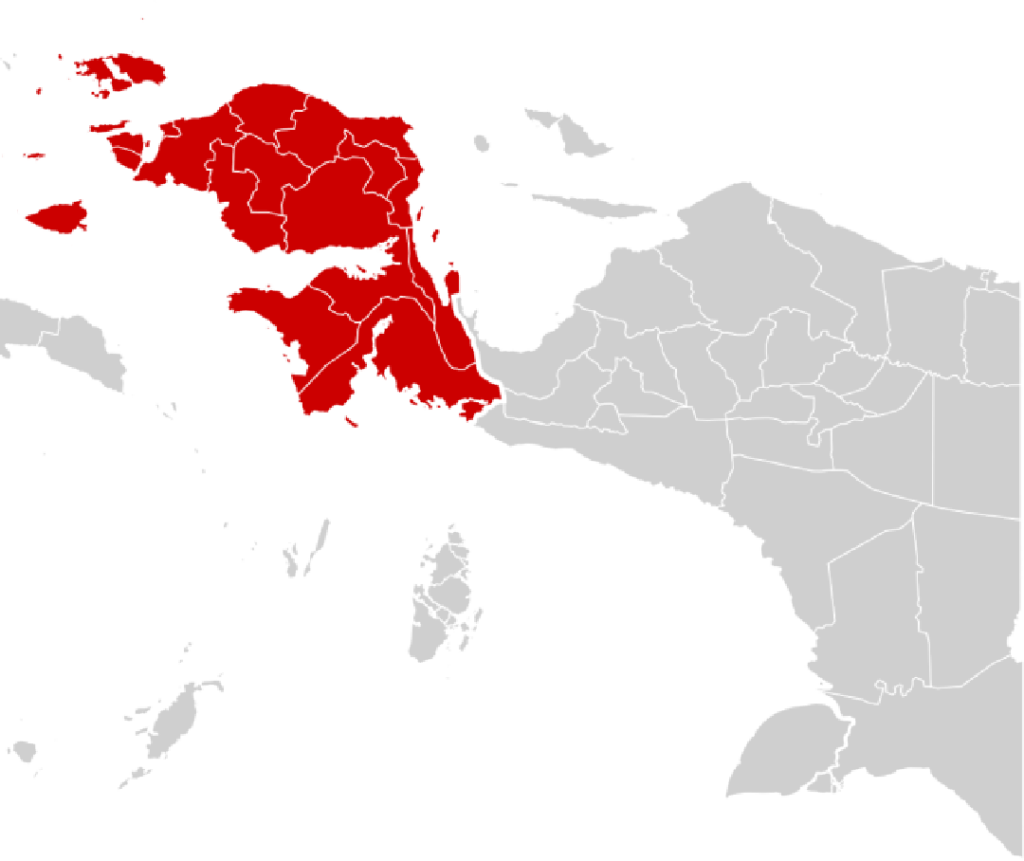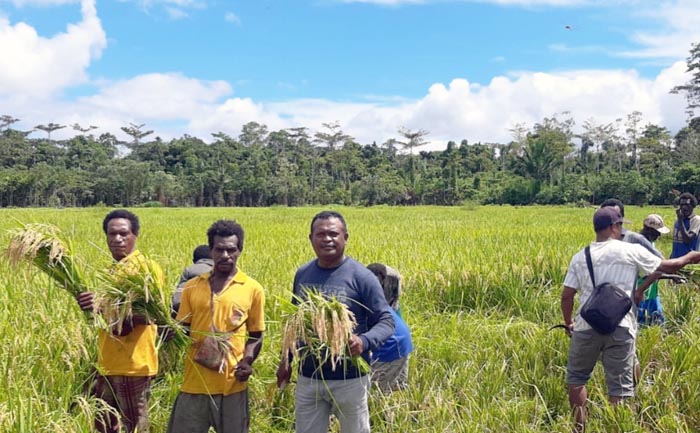
On a cool morning in Sarmi Regency in Papua, the smell of wet earth hangs in the air as sunlight filters through young rice shoots and banana palms. The fields are alive with movement. Farmers stoop low to inspect seedlings. Water buffalo trudge through muddy furrows. Children run between rows, laughing as they chase chickens.
It is hard to believe that just a few short years ago this scene was less common. Many fields were fallow or used only for subsistence gardening. But now, across Papua, something notable is happening. An agricultural transformation is slowly taking root, and it is creating jobs and changing the livelihoods of local people.
Recent figures show that employment in Papua is on the rise. According to official statistics, the number of people working in the province are 448.34 thousand in November 2025. A significant part of this growth is driven by work in agriculture, where food production and related activities have become engines of economic opportunity.
This is not just a statistic. It is reflected in the lives of young men and women who once struggled to find work, and families who once depended solely on subsistence living. For them, the fields have become more than farmland. They are now a place where hope grows.
A Shift in the Soil
For decades, Papua’s economy was widely recognized for its natural beauty, rich biodiversity, and mineral resources. Yet agricultural production remained limited by challenges such as poor infrastructure, lack of investment, and the difficulty of reaching distant markets. Many farmers worked small plots for their own families, but there was little commercial agriculture to speak of.
That began to change in recent years. Government initiatives, increased local participation, and growing awareness of Papua’s potential as a food-producing region brought new focus to agriculture. Fields that once lay unused became sites of planting and harvest. Training programs for farmers increased. Seed distribution and irrigation support arrived in areas that had long been neglected.
In the villages around Sarmi, for example, local farmers talk about the feeling of life “opening up.” They speak of times when jobs were limited to seasonal casual work or labor in distant towns. Now, there are tasks to be taken almost every day. Some families earn income from rice harvests. Others sell vegetables in local markets. Still others find work in logistics, transportation, or farm support services.
For the first time in a long while, many young people do not have to leave home to find work. They can contribute to family income while staying close to community and culture.
Numbers Reflect Growing Opportunity
According to recent reports, Papua’s employment landscape changed significantly in November 2025, with the number of employed people reaching 448.34 thousand. Compared to August 2025, employment increased by 1.432 million people. This growth was not accidental, as much of it was driven by sectors that rely on Papua’s natural strengths, particularly agriculture.
In Papua’s Vision for Food Self-Sufficiency, agriculture is at the heart of transformation. Four regions in particular, including Sarmi and neighboring areas, were highlighted as key to expanding food production and strengthening economic opportunities. State and local leaders have emphasized the potential for Papua to not only feed itself but to contribute to national food security.
This shift aligns with broader policy goals. The Indonesian government has encouraged regional food production as part of efforts to achieve balanced development and reduce reliance on imports. Papua, with its vast arable land and relatively untapped agricultural potential, has become a focus of these efforts.
The result is not just more food in the field. It is more hands in work boots, more wages in the family purse, and more young people choosing futures in their home villages rather than in distant cities.
Faces Behind the Figures
Statistics provide numbers, but the real story happens on the ground.
In Sarmi, Yohanis, a 28-year-old farmer, remembers the days when work was uncertain. He grew up helping his parents plant gardens for their own consumption. There was no surplus to sell. Cash was limited. Dreams of building a house or sending his sister to university seemed distant.
Then came support programs that offered training on rice cultivation and tools to improve yields. Yohanis participated. Slowly, his fields began producing more than enough for his family. Surplus rice went to market. Neighbors began asking for his advice. Soon, others invited him to help in their fields.
Today, Yohanis is known locally as a reliable farmer and mentor to younger workers. He employs several people during peak planting and harvesting seasons. For the first time, he feels confident that his work can support his ambitions.
Not far away, Maria, a young mother of three, found employment in a community agro-processing unit. Her job is to sort and package cassava flour and sweet potatoes. These products are now sold in larger towns, bringing income that her family once lacked.
Maria remembers nights when she wondered how to balance raising children and finding steady work. The arrival of new agricultural opportunities changed that. Now she has a role that gives her both income and dignity.
Their stories are repeated across villages, small towns, and rural landscapes. Work is changing because agriculture is changing.
Government Vision Meets Local Reality
Leaders from Papua have been visible advocates of agricultural transformation. In community gatherings, speeches, and planting festivals, provincial figures have spoken about food security as more than policy language. For them, it is personal.
In Sarmi, Governor Matias Fakhiri has been involved in rice planting celebrations alongside farmers, illustrating solidarity with those whose lives are tied to the land. These events are not symbolic. They reflect a strategy to bring government presence into local agricultural activities and encourage participation by farmers and youth.
The governor has articulated a vision where Papua contributes to national food production, not simply as a supplier of raw commodities, but as a place that produces staples like rice, maize, and tubers.
This strategy is appealing to local workers for both cultural and economic reasons. Agriculture, historically part of Papuan life, is now being revitalized with modern techniques, support for irrigation, access to markets, and opportunities for value-added processing.
For many families, this means not only work but economic stability.
A Ripple Effect in the Community
When agriculture grows, it does more than create jobs in the fields. It stimulates demand for services related to farming. Local repair shops fix tractors and hand tools. Transportation services move goods to market. Storage and packaging services open new small businesses. Young people who once saw few options now find opportunities in supply chains, logistics, and farm support roles.
Villages begin to feel lively in a new way. Markets buzz with activity on harvest days. Trade not only happens but flows. Farmers pay school fees more easily, parents solve healthcare costs with less worry, and youth who once left for jobs far away now stay closer to home.
In the coastal community of Biak Numfor, coconut farmers join forces to sell copra in bulk to processing centers. In the hills of Jayawijaya, sweet potato cooperatives have sprung up with local youth taking leadership roles. These are incremental changes, but they add up.
Local educators at community schools have noticed another outcome. Attendance gets better when families have stable income. Children arrive at school cleaned and fed. Parents speak about futures again, not only survival.
The ripple effect of agriculture is real when opportunities are sustained.
Facing Challenges Together
Growth does not come without struggle. Agricultural work can still be hard under the tropical sun. Access to credit remains limited in some areas. Roads and logistics remain barriers in remote regions. Markets can fluctuate with global supply and demand. Farmers sometimes face crop loss due to unpredictable weather.
Climate change looms as an additional risk. Periods of drought or heavy rain can threaten crops. Farmers have adapted by learning new techniques, diversifying crops, and working collectively. Local agricultural extension officers have been essential in delivering training and support.
Yet farmers like Yohanis and workers like Maria speak more about opportunities than fear. Their confidence stems from seeing growth around them, from knowing that work exists, and from watching their earnings support families.
Where once opportunities were sparse, now they are visible on every rice paddy and tuber field.
A Future Rooted in Land
Papua’s journey from under-utilized agricultural landscape toward a place where farming drives employment is ongoing. There are miles to go, and challenges will persist. But the progress of 2025 offers a glimpse of what can happen when effort, policy, and community engagement converge.
The increased number of people working in Papua, rising by more than a million, is not merely a headline figure. It reflects daily realities for families who wake early to tend fields, for youth who choose agriculture over urban migration, for women who fill roles in processing and distribution, and for entire communities that experience growth rather than stagnation.
Papua’s fields are not just land. They are living spaces where futures are being rewritten. They are places where the next generation sees opportunity, where labor becomes livelihood, and where hope takes root as firmly as rice and sweet potato into the fertile soil.
In the vivid green of new shoots and the golden hue of harvest sun, Papua’s agricultural transformation is more than economic growth. It is a human journey, full of effort, resilience, and promise.
The fields are alive again, and with them the dreams of thousands of families.em