The field did not look like much at first glance.
Just a stretch of land, slightly uneven, with water pooling between rows that had been carefully marked out. A few wooden stakes stood at the edges, and the soil, freshly turned, still carried the smell of damp earth.
For people passing by, it might have seemed ordinary.
But for those who gathered that morning in Kampung Swentab, it felt like something new was beginning.
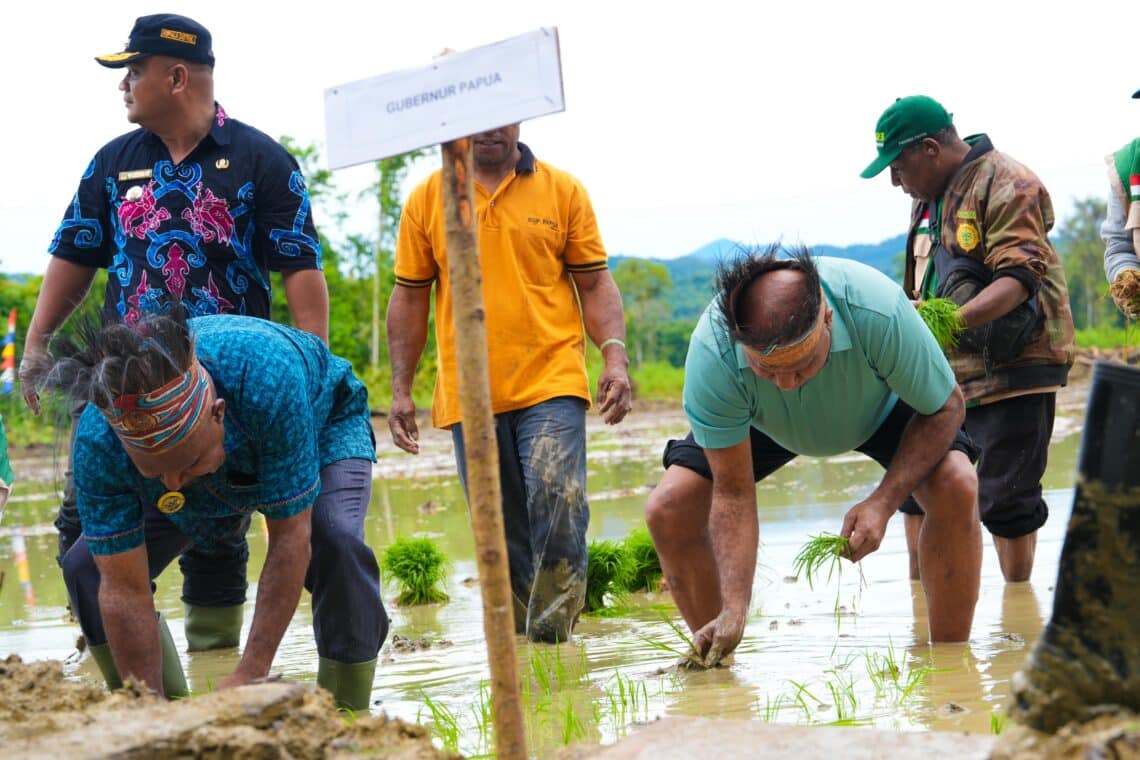
A farmer stood quietly at the edge of the paddy, holding a bundle of young rice seedlings. He watched as others stepped into the field, their feet sinking slightly into the mud. Among them was Mathius Fakhiri, moving without ceremony, bending down, and placing the first seedlings into the soil.
There were no loud instructions. No rush.
Just a steady, deliberate movement.
It was the first rice planting on a two hectare field in Swentab, a small start tied to a much larger plan.
The Feeling of a First Step
Moments like this rarely come with clear signals that they matter.
There is no visible marker that says this is where something changes.
But if you spoke to the people standing there, you could sense it.
“This is new for us,” one farmer said, adjusting his footing in the mud.
He did not sound uncertain, but he was not fully confident either.
It was something in between.
Curiosity, perhaps.
Or cautious hope.
Why Rice, and Why Here
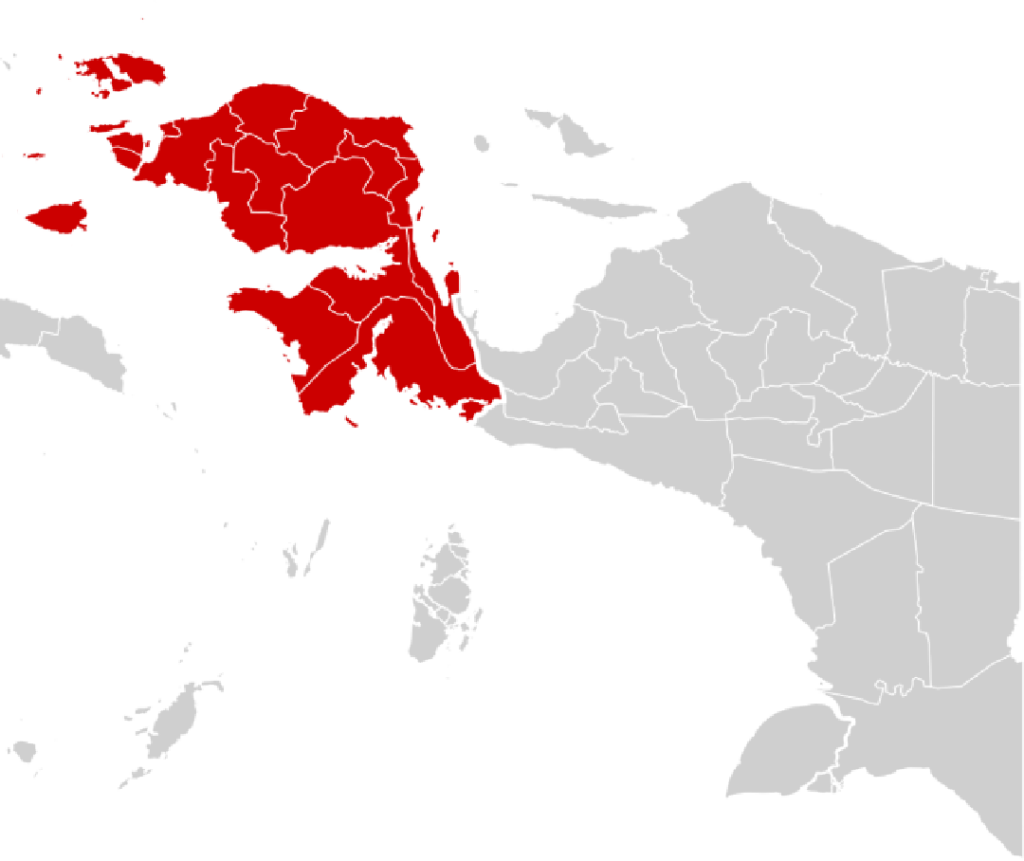
Papua is not traditionally a rice growing region.
For generations, many communities relied on sago, sweet potatoes, and other local crops. These foods are still important today, especially in rural areas.
But over time, diets have changed.
Rice has become more common, especially in urban centers. It is widely consumed, easily distributed, and increasingly seen as a staple.
The problem is that much of that rice comes from outside Papua.
Ships bring it in from other islands.
Trucks distribute it across cities and districts.
And when there are disruptions, whether due to weather or logistics, the impact can be felt quickly.
This is the reality behind the small field in Swentab.
It is not just about growing rice.
It is about reducing dependence.
Two Hectares That Carry a Larger Plan
The field in front of them measured only two hectares.
It could not feed a region.
It could not even supply a district in any significant way.
But it was not meant to.
According to the plan introduced during the visit, this plot is only the beginning.
The target is to expand rice fields in the area to 50 hectares over time.
When farmers heard that number, some nodded quietly.
Others looked out across the land, as if trying to imagine what that might look like.
Fifty hectares is not impossible.
But it is not easy either.
A Farmer’s Calculation
A farmer named Lukas stood with his hands on his hips, looking across the newly planted rows.
“If it becomes fifty hectares,” he said slowly, “that means more work.”
He paused.
“But also more harvest.”
He did not smile.
He was thinking through it.
Work and reward.
Effort and outcome.
It is a calculation every farmer understands.
The Role of Equipment
Later that day, as the planting wrapped up, another part of the program became visible.
Rows of agricultural equipment were lined up nearby.
Machines that, for many farmers, were unfamiliar.
The government distributed dozens of farming tools, including tractors and other equipment, to support the initiative.
For a farmer who has worked manually for years, this changes the rhythm of work.
“With this, we don’t have to do everything by hand,” Lukas said, pointing at one of the machines.
He sounded practical, not excited.
As if he was already thinking about how to use it.
What Independence Means
During the visit, Fakhiri spoke about independence.
Not in abstract terms.
But in the context of farming.
He said that farmers in Papua should not remain dependent on external supply chains.
That they should be able to produce, manage, and benefit from their own work.
It is a simple idea.
But not an easy one to achieve.
Because independence requires more than land.
It requires knowledge.
Tools.
Access to markets.
And consistent support.
Learning Something New
For many farmers in Swentab, rice is not a completely new crop.
Some have experimented with it before.
But irrigated rice farming, on this scale, is different.
It requires timing.
Water control.
Coordination between farmers.
“It’s not like planting cassava,” one farmer said with a quiet laugh.
He was right.
Rice demands precision.
And that precision takes time to learn.
Water, the Quiet Challenge
If you look closely at the field, you will notice something else.
The water.
It sits just above the soil, reflecting the sky.
Maintaining that water level is not simple.
It requires irrigation.
Channels must be built.
Flow must be controlled.
Too much water can damage crops.
Too little can dry them out.
In Papua, where terrain can vary, managing water becomes one of the most important factors in rice farming.
A Local Official’s View
A local agriculture officer stood nearby, watching the planting process.
“This is not just about planting once,” he said.
“It’s about building a system.”
He pointed toward the edge of the field.
“There will be irrigation improvements, training, and monitoring,” he added.
His tone was measured.
He knew the challenges ahead.
Between Hope and Reality
Programs like this often sit between two things.
Hope.
And reality.
Hope is what brings people to the field.
What makes them believe that something can change.
Reality is what determines whether it actually does.
The gap between the two is where most of the work happens.
A Community Observes
Not everyone stepped into the field that day.
Some stood back, watching.
Older residents.
Children.
People who were curious but not directly involved.
They watched quietly, observing how things unfolded.
“It looks good,” one older man said.
“But we will see.”
His words carried no doubt.
But no certainty either.
The Long Road to 50 Hectares
Expanding from two hectares to fifty will not happen quickly.
It will require:
Land preparation.
Farmer participation.
Continued government support.
Infrastructure development.
Each stage will bring new challenges.
Some expected.
Others not.
The Importance of Patience
Agriculture teaches patience.
Seeds do not grow overnight.
Fields do not expand instantly.
Results come in cycles.
Planting.
Waiting.
Harvesting.
Then starting again.
For Swentab, this is the beginning of that cycle.
A Changing Landscape
If the plan succeeds, the landscape here will change.
Fields will expand.
Water systems will improve.
Farming activity will increase.
But change in Papua often happens gradually.
Step by step.
Season by season.
A Quiet Ending to the Day
As the sun moved higher, the planting came to an end.
There was no closing speech.
No formal conclusion.
People simply stepped out of the field, washing mud from their hands and feet.
The seedlings remained.
Small.
Fragile.
Standing in rows.
Conclusion
From a distance, it is easy to overlook a field like this.
Two hectares of rice.
A small group of farmers.
A governor planting seedlings.
But in Papua, where agriculture is still evolving, small beginnings matter.
Because they are often the only way change begins.
The field in Swentab will not transform the region overnight.
It will not solve food dependency in a single harvest.
But it represents something important.
An attempt.
A direction.
A willingness to try something different.
And sometimes, that is where the real story starts.