When the fog lifts over the Baliem Valley in the early morning, Wamena slowly comes to life. Market vendors arrange sweet potatoes and leafy greens on woven mats. Motorcycles buzz along uneven streets. In the distance, mountains stand like quiet guardians over the town.
For decades, this highland capital in Papua has lived with a kind of isolation that shapes daily life in subtle but powerful ways. Almost everything that arrives in Wamena must come by air. A sack of rice, a bag of cement, and even bottled water often travel by plane before they reach the market shelves. And when planes cannot fly because of weather or other disruptions, prices rise and supply becomes uncertain.
That is why the TransPapua Jayapura–Wamena road has come to represent something much deeper than infrastructure. It is widely described as the economic lifeline of the Papua Pegunungan (Papua Highlands). For many families, it is a promise that daily life could become more affordable, more stable, and more connected to the rest of Indonesia.
A Long Dream Through Difficult Terrain
The idea of connecting Jayapura, Papua’s coastal capital, to Wamena by road is not new. Plans began decades ago, during the 1990s, when the government first envisioned a land corridor cutting across mountains, valleys, rivers, and dense forest.
On paper, the distance of roughly 575 kilometers does not seem extraordinary. But anyone who has seen the terrain understands the challenge. The road must pass through steep slopes, fragile soils, landslide zones, and regions where rain can transform stable ground into slippery clay within hours.
Engineers and construction workers have battled nature for years. Bridges have been washed away. Sections have collapsed after heavy rainfall. Equipment must often be transported piece by piece. Yet the effort continues.
For local residents, the struggle to build the road mirrors their own determination to overcome geographic barriers.
The Cost of Isolation
Before even a single kilometer of asphalt was laid, people in the highlands felt the economic consequences of isolation.
Because most goods must be flown into Wamena, transport costs are high. Officials have noted that air cargo fees can reach Rp10,000 to Rp13,000 per kilogram. That figure multiplies quickly when applied to food staples, construction materials, and daily necessities.
In markets, rice can cost more than Rp23,000 per kilogram. Cement can reach Rp400,000 or more per sack. Even simple bottled water may cost several times what it does in coastal cities.
For families who depend on small-scale farming or local trade, those prices weigh heavily. Parents must stretch limited income to cover food, school fees, and healthcare. Traders struggle to maintain profit margins. Small businesses operate with constant uncertainty.
When residents speak about the Jayapura–Wamena road, they often speak first about prices. They imagine trucks bringing rice, fuel, and vegetables at a lower cost than airplanes. They picture shelves stocked more consistently. They hope that daily life will feel less expensive and less fragile.
A Lifeline for the Highlands
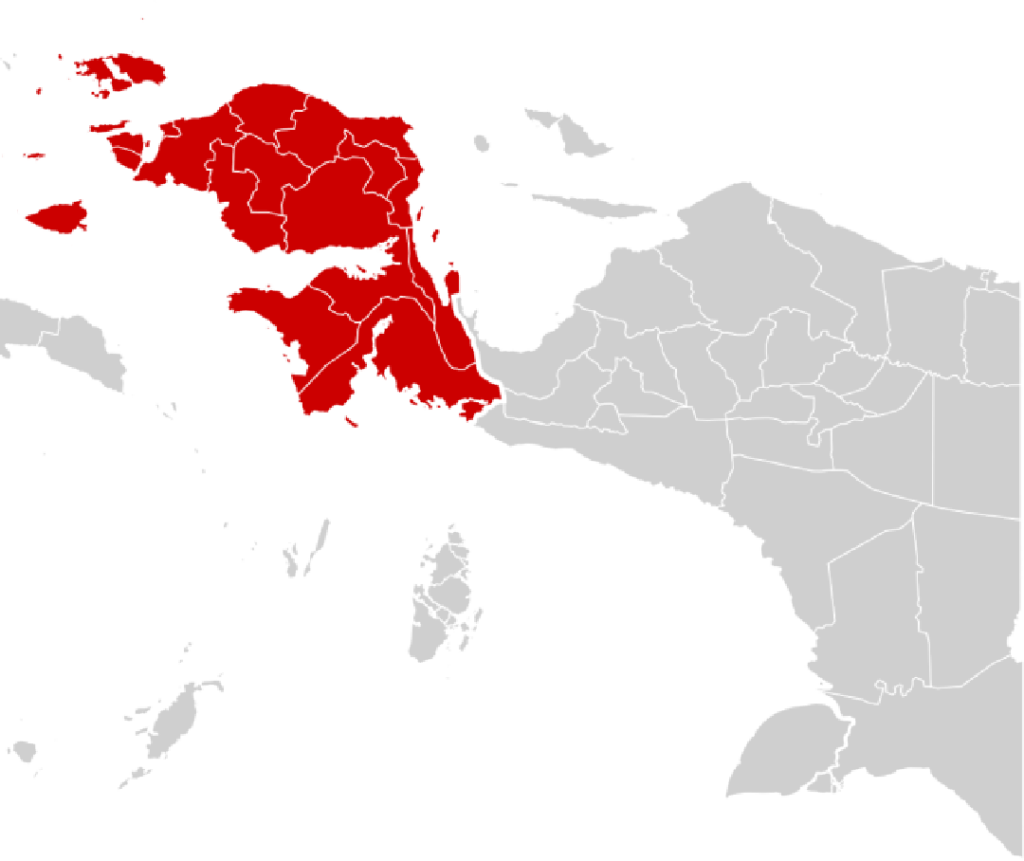
The Papua Pegunungan province has no coastline. Unlike other provinces that can rely on seaports, the highlands depend almost entirely on air access or difficult land routes.
That reality makes the Trans-Papua road especially significant. It is not simply another highway. It is the primary land artery linking inland communities to coastal trade routes and the national economy.
Government officials have referred to it as the economic artery of the highlands, and the phrase resonates because it feels accurate. Just as blood carries nutrients through the body, the road is expected to carry food, medicine, building materials, and opportunity.
During community discussions, local leaders often emphasize that the road is about fairness. They argue that highland communities deserve the same access to affordable goods and economic growth as other regions of Indonesia.
Investment and Commitment
The central government, through the Ministry of Public Works, has allocated trillions of rupiah to complete critical segments of the road. Significant funding has been directed toward paving sections, building bridges, and stabilizing slopes.
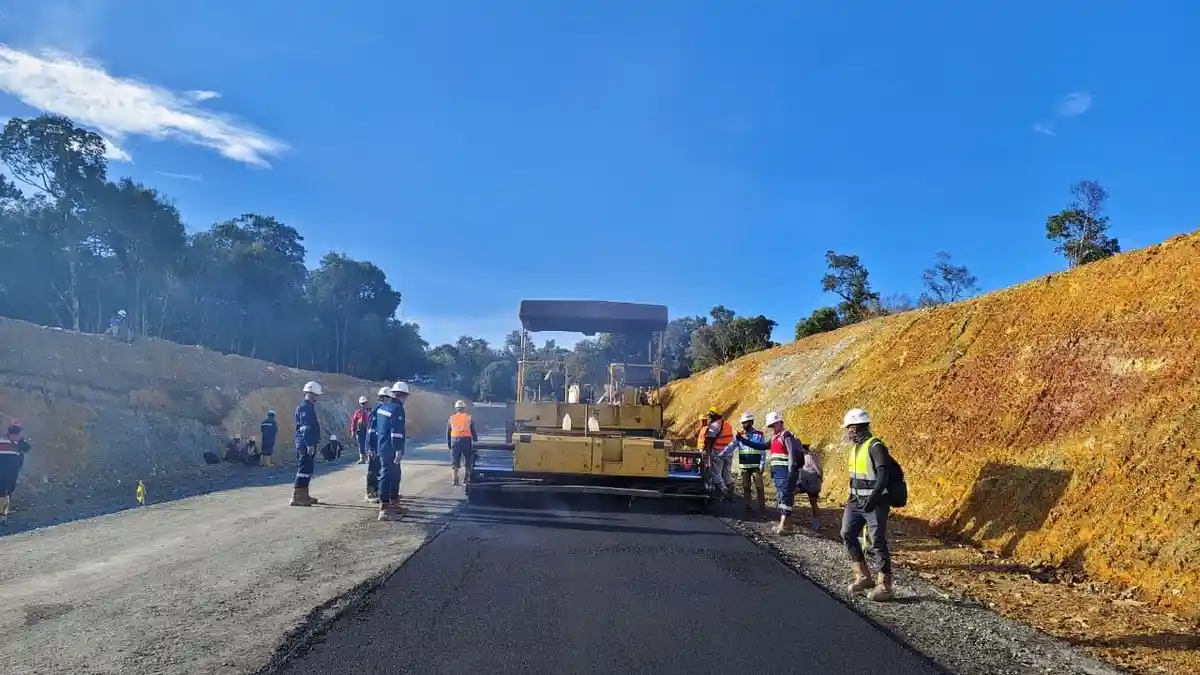
Construction teams have worked on stretches such as the Senggi to Airu segment and major bridge projects that connect previously isolated districts. Temporary Bailey bridges have been installed where landslides damaged permanent structures.
The financial commitment signals that the project is not symbolic. It is intended to be functional and lasting.
Yet beyond budget numbers and engineering milestones, the human element remains central.
Voices from the Road
A truck driver who regularly transports goods between segments of the route described the journey as both exhausting and meaningful. He spoke about navigating narrow mountain passes and muddy sections that test his patience and skill.
“It is not an easy road,” he said. “But when I see people waiting for supplies, I know why it matters.”
A shop owner in Wamena said that when partial land access improves, she notices immediate changes. Goods arrive more predictably. Customers feel more confident spending money when prices stabilize.
She recalled days when flights were canceled due to bad weather and her shelves emptied quickly. “Those were hard days,” she said. “If the road works well, maybe we will not worry like that anymore.”
Parents also think about the road differently. For them, it means the possibility of faster travel in emergencies. When a child falls ill at night, waiting for a flight can be frightening. A reliable road offers an alternative.
Economic Possibilities Beyond Lower Prices
Lower prices are only one part of the equation. The road also opens possibilities for local producers.
Farmers in the Baliem Valley grow sweet potatoes, vegetables, and other crops. If transport becomes easier and cheaper, they may be able to send surplus produce to coastal markets. That could increase income and encourage agricultural diversification.
Small entrepreneurs could expand their reach. Builders could access materials more affordably. New businesses might emerge along the corridor itself, creating jobs in roadside services, repair shops, and local trade hubs.
Young people, often compelled to migrate in search of opportunity, might find more options closer to home.
Balancing Development and Local Concerns
Infrastructure projects of this scale always raise questions. Land ownership in Papua is deeply connected to customary rights and ancestral ties. Ensuring that road construction respects those rights is essential.
Government representatives have acknowledged the importance of dialogue with tribal leaders and local communities. Sustainable development in Papua cannot ignore cultural realities.
Environmental concerns also require attention. The road passes through ecologically sensitive regions. Protecting forests and waterways while building infrastructure is a delicate balance.
Local elders sometimes speak about the road with mixed feelings. They recognize its economic importance but hope that development does not erode cultural identity or harm natural resources.
A Symbol of Inclusion
For many residents of the highlands, the road carries symbolic meaning. It represents inclusion in national progress.
There have been times when people in remote regions felt forgotten by decision-makers in distant capitals. A functioning highway linking Jayapura and Wamena suggests a different narrative, one in which infrastructure connects rather than divides.
A community leader in Jayawijaya once described the road as a bridge between mountains and opportunity. He said that when trucks move smoothly across highland valleys, it sends a message that geography should not determine destiny.
Looking Toward Completion
The target for completing key segments of the Jayapura–Wamena road has been set for later in 2026. While challenges remain, construction continues with determination.
Each newly paved kilometer brings visible change. Each completed bridge shortens travel time. Each repaired landslide zone strengthens resilience.
For people in Wamena and surrounding districts, the road’s completion cannot come soon enough. Yet they understand that building through mountains is not simple.
They wait with cautious optimism.
More Than Asphalt
It is easy to describe the Trans Papua Jayapura–Wamena road in technical terms: length, budget, and kilometers paved. But in the highlands, people speak about it differently.
They speak about mothers who hope to buy rice at lower cost.
They speak about farmers who want to sell vegetables beyond their village.
They speak about students who dream of easier travel to schools and universities.
They speak about emergency journeys that could save lives.
The road is concrete and steel, yes. But it is also memory, expectation, and aspiration.
When trucks finally travel consistently from Jayapura to Wamena without interruption, the impact will not be measured only in reduced transport costs. It will be measured in the quiet relief of families who no longer fear sudden shortages, in the growth of small businesses, and in the strengthened sense that Papua’s highlands are connected to the broader currents of national life.
In the morning light over the Baliem Valley, as mountains cast long shadows over new stretches of asphalt, the road stands as a reminder that development is not abstract. It touches real lives.
And for the people of Papua’s highlands, the Trans-Papua Jayapura–Wamena road is not just infrastructure. It is hope carried forward, one kilometer at a time.