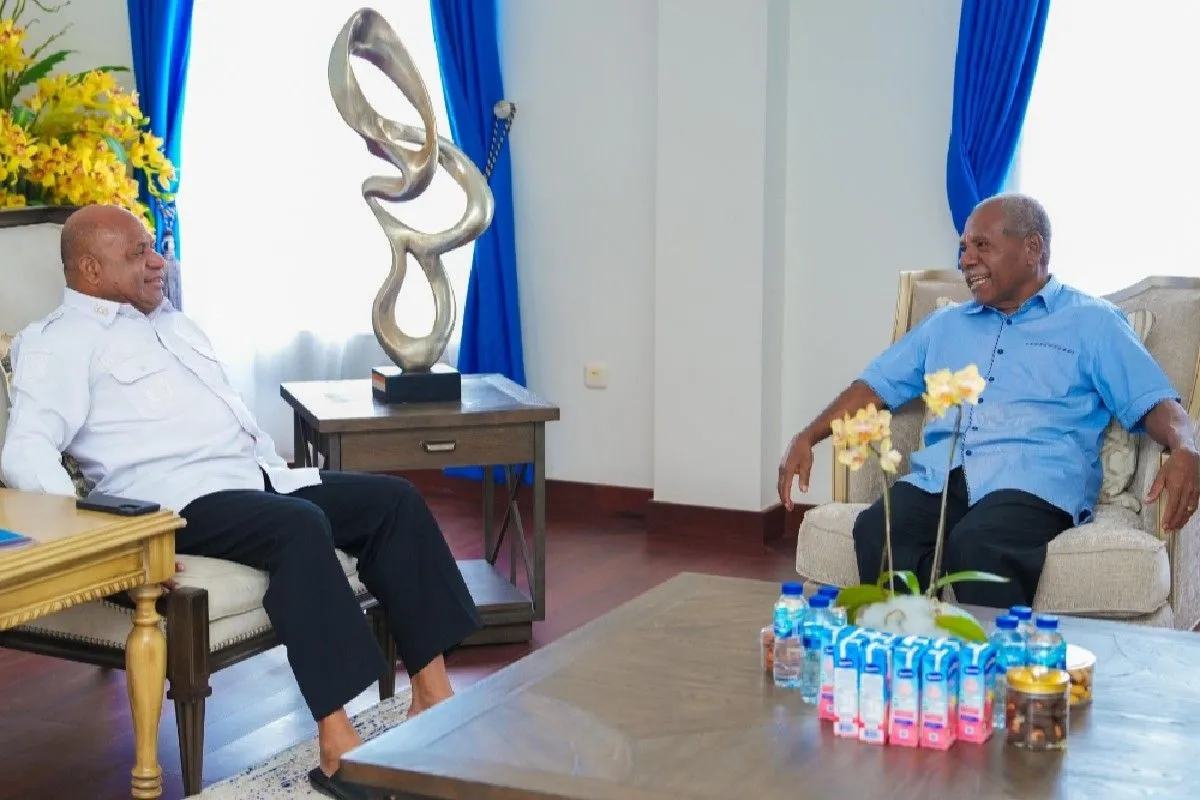
On March 25, 2026, the meeting was held at Papua’s governor’s office in Jayapura.
The meeting did not feel formal.
There were no rows of cameras, no long speeches prepared for the press. A small group of individuals sat across from each other in a government office in Jayapura, discussing land, people, and a concept that is often challenging to define.
Trust.
At the center of that conversation was Mathius Fakhiri; listening was Matius Awoitauw, an indigenous leader from Sentani who spoke about concerns that have been repeated many times over the years.
Not about rejecting development.
But what about being part of it.
It is a distinction that matters in Papua.
And one that continues to shape how the region moves forward, influencing both local governance and community engagement in development initiatives.
A Conversation That Happens Often, But Not Always Heard
If you spend time in Papua long enough, you will notice that these conversations are not new.
They happen in meeting rooms like this one.
They happen in villages.
They happen in informal gatherings, sometimes late into the night.
People discuss planned roads, potential land use, and the decision-making process.
The tone is rarely confrontational.
It is more reflective.
But beneath it is a question that keeps returning.
Who gets to decide what development looks like?
Land Is Never Just Land
In many places, land is measured in hectares and mapped in documents.
In Papua, it carries something more.
It is tied to identity.
To ancestry.
The project is also connected to stories that have been passed down through generations.
When a development project is proposed, it is not only about building something new.
It is about entering a space that already has meaning.
That is why, as Fakhiri emphasized during the meeting, indigenous communities are not just participants in development. They are custodians of the land itself.
Without their support, plans can exist on paper but struggle in practice.
What “Support” Really Means
Support, in this context, is not a signature on a document.
It is something more complex.
It involves understanding.
Agreement.
A sense that development is being done with the community, not simply around it.
A customary leader in Sentani explained it in a way that felt direct.
“We are not against progress,” he said.
“But we want to be respected in the process.”
He did not raise his voice.
He did not need to.
The Gap Between Plans and Reality
Papua has seen many development plans over the years.
Some have worked.
Some have struggled.
And often, the difference comes down to how well those plans connect with local realities.
A road can be built.
A building can be constructed.
But if the community does not feel involved, the impact may be limited.
This phenomenon is not unique to Papua.
But it is particularly visible here.
The Governor’s Approach
For Fakhiri, the approach seems to be shifting.
Less emphasis on imposing solutions.
More emphasis on dialogue.
During the meeting, he spoke about the importance of continuing conversations with Indigenous communities.
Not as a formality.
He viewed it as an integral part of the process.
He acknowledged that development cannot run effectively without their involvement.
It was not framed as a political statement.
It sounded more like a practical observation.
A Balance That Is Not Easy
Balancing development and cultural identity is not straightforward.
On one hand, there is a need for infrastructure.
Better roads.
Improved public services.
Economic opportunities.
On the other hand, there is a need to preserve identity.
To respect traditions.
To ensure that change does not erase what already exists.
These two priorities do not always align easily.
A Young Voice
At a university in Jayapura, a student studying social sciences reflected on this tension.
“We want development,” she said.
“But we also want to keep our identity.”
She paused, then added, “It’s not about choosing one or the other.”
Her words capture something that is often difficult to express in policy discussions.
The idea that development and tradition are not opposites.
They can coexist.
But only if handled carefully.
The Role of Dialogue
One of the recurring themes in Fakhiri’s approach is dialogue.
Creating space for conversation.
Allowing concerns to be voiced.
Taking time to listen.
This process may seem slow compared to top-down decision-making.
But in Papua, it may be necessary.
Because without it, decisions can feel disconnected.
A Community Perspective
In a village not far from Jayapura, a local resident described how decisions used to be made.
“Sometimes we only hear after everything is planned,” he said.
He was not criticizing.
Just explaining.
“If we are involved earlier, it is different,” he added.
Different, in this case, means more acceptance.
More understanding.
Less resistance.
Why Inclusion Matters
Inclusion is often discussed as a value.
In Papua, it is also a strategy.
When communities feel included, projects move more smoothly.
When they feel excluded, even well-intended efforts can face challenges, such as resistance from community members and a lack of cooperation, which can ultimately hinder project success.
This phenomenon is something that many local leaders understand.
The government is increasingly acknowledging this issue as well.
Stability and Development
Another dimension of indigenous support is stability.
Papua has experienced periods of tension.
Maintaining social harmony is essential for development to continue.
Customary leaders often play a role in mediating conflicts, which is crucial for maintaining social harmony and ensuring that development can continue in Papua.
In maintaining relationships between communities.
Their influence is not always visible.
But it is significant.
A Subtle Shift
What is happening now may not look like a major transformation.
There are no sweeping announcements.
No dramatic policy changes.
Instead, there is a gradual shift.
A greater emphasis on listening.
On involving.
On aligning development with local realities.
The Limits of Policy
Policies can set direction.
Budgets can provide resources.
But neither guarantees success.
Because development is not only technical.
It is social.
It involves relationships.
Trust.
Understanding.
A Farmer’s Reflection
In a rural area outside Jayapura, a farmer shared his thoughts on development.
“We want better roads,” he said.
“So we can bring our products to market.”
He paused, then added, “But we also want to be asked first.”
It is a simple request.
But it carries weight.
Looking Forward
The challenge for Papua is not whether development will happen.
It already is.
The question is how it will happen.
Will it be inclusive?
Will it respect local identities?
Will it create benefits that are widely felt?
These questions do not have easy answers.
But they are the necessary ones.
A Quiet Ending
Back in the governor’s office, the meeting ends without ceremony.
People stand up.
Shake hands.
Exchange a few final words.
Outside, the city continues its usual rhythm.
Cars move through the streets.
People go about their day.
Nothing appears different.
But conversations like this one have a way of shaping what comes next.
Conclusion
Development in Papua is not only about building things.
It is about building relationships.
Between government and communities.
Between plans and reality.
Between the future and the past.
As Governor Mathius Fakhiri continues to emphasize, indigenous support is not an additional factor.
It is the foundation.
And without that foundation, even the most ambitious plans may struggle to stand.
But with it, development has a chance to move forward.
Not just quickly.
But meaningfully.