It doesn’t happen very often that talks about Papua’s future happen quickly in Jayapura’s government conference rooms. Plans for growth in this area are very important because every policy choice affects communities that are separated by mountains, forests, rivers, and oceans. When leaders meet to talk about planning for the future, they don’t just talk about budgets and programs. They are changing people’s lives for years to come.
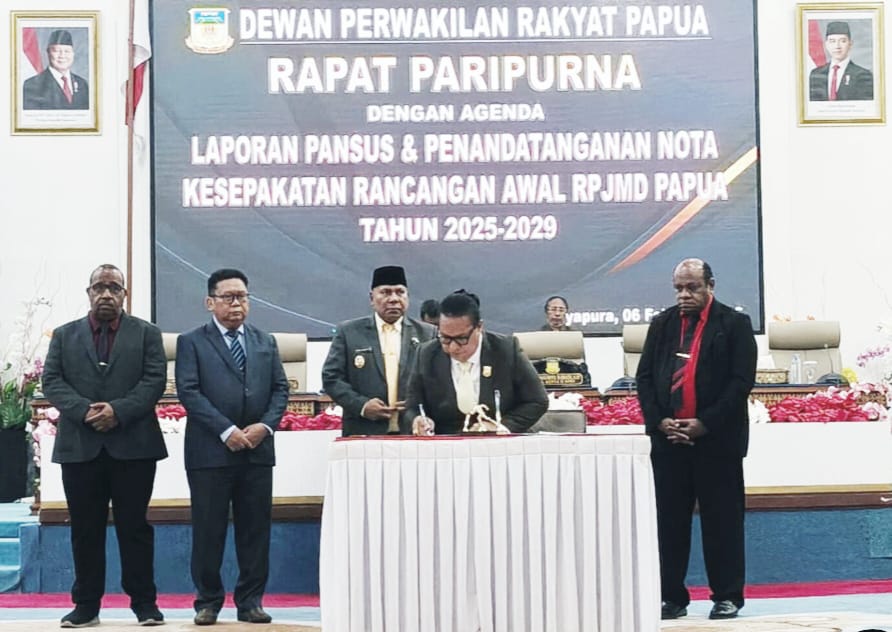
On February 6, 2026, the Papua Provincial Government and the Papua Provincial Parliament reached an important milestone when they agreed on the Regional Medium Term Development Plan (RPJMD) 2025–2029. This agreement set the official course for Papua’s development goals for the next five years.
For many people, this was more than just filling out forms. Papua is moving into a new phase of planned and participatory development, and this was a sign of that. The RPJMD is supposed to be the main way to make policies, investments, and public services better throughout the province.
What the RPJMD Means for Papua
The RPJMD is an official five-year plan for development that makes sure that provincial projects are in line with national development goals and meet the needs of the people in the area. It is the main source of information for development partners, local governments, and government agencies.
Officials say that the 2025–2029 RPJMD is meant to help bring about what they call “the change toward a better and richer Papua.” According to provincial officials, the plan’s main goals are to improve people’s lives, create more jobs, and build more infrastructure and economic opportunities.
Reports say that the provincial government wants the RPJMD to be more than just a piece of paper; it should be a useful tool. The plan will change how much money is spent, what policies are most important, and how well Papua’s government agencies do their jobs.
Agreement Between Government and Parliament
The Papua Provincial Government and the Papua Provincial House of Representatives had to work together closely to finish the approval process. After talking things over and making sure their policies were in line, both sides agreed on the first draft of the RPJMD 2025–2029.
Officials said that the deal was a very important step toward making sure that development activities can keep going without any problems. Lawmakers’ approval gives the development strategy legal status and political support, which guarantees that all institutions will accept it.
People who watch say that these kinds of deals are needed to keep things moving forward. Long-term planning can fail or be inconsistent without legal backing.
Participatory Development Planning
One of the most important parts of the new RPJMD is participation. Policymakers have made it clear that only government officials and lawmakers should plan for development. People in the community have been asked to give their thoughts.
Reports say that recent planning talks included talks with local governments, community groups, and people who are interested in development. This method shows that planning is becoming more open to everyone, with people who are directly affected by development having a say in how it is done.
Participatory planning is very important in Papua because it is so different. Different parts of the world have different needs. Coastal towns might put fisheries and marine infrastructure at the top of their list of things to do. People in the highlands might care more about getting to the roads and helping farmers. Cities may care more about education and having a wider range of jobs.
Planners want to make development projects that are realistic and work by taking these voices into account.
Changing Papua by Setting Strategic Goals
The RPJMD lists a number of important things that need to be done that will bring about change all over Papua.
It’s still very important to develop human resources. Plans are in place to start more programs that will improve health care and education. Officials have said that long-term growth won’t work without strong human capital.
Building up infrastructure is still a top priority. In many places, getting around is still a problem. People think that better roads, ports, and digital infrastructure will help the economy grow and make it easier for people to get to public services.
Another important part is the growth of the economy. The RPJMD wants to help local businesses, make farming and fishing stronger, and create jobs. This is part of the country’s bigger efforts to close the gaps in economic growth between regions.
Supporting a Brighter Papua Vision
The RPJMD is part of a bigger plan by the provincial government to make things better. This plan is often called “building a Bright Papua” future. This vision includes improving welfare indicators, lowering the number of people who are poor, and making it easier for more people to get the services they need.
Officials say that development needs to happen in both cities and rural areas. This idea is also important in Papua because geography can make it hard for some people to get to services.
The RPJMD is meant to help fill these gaps by building more infrastructure and providing more social services in areas that don’t have enough of them.
Economic Growth and Local Opportunity
Changing the economy will probably be a big part of the five-year plan. The RPJMD helps businesses in the area grow in areas like fishing, farming, small business development, and tourism.
Officials believe that boosting local economies can lower unemployment and raise the income levels of families. Papua can make its economy stronger by using its own strengths instead of relying on others.
The plan also encourages investment and stresses how important it is to have growth that lasts. It is hoped that economic growth would find a balance between using resources and protecting the environment.
Strengthening Governance and Institutional Performance
Another important goal of the RPJMD is to improve how the government works. To make sure that development projects get results that can be measured, strong institutions are needed to provide good public services.
The plan has ways to keep track of performance and judge it that are meant to make people more responsible. Government agencies need to make sure that their programs help them reach their measurable development goals.
This method fits with a trend in Indonesia toward more open and performance-based planning in government.
Things That Need to Be Fixed
There is a lot of hope, but it won’t be easy to put the RPJMD into action. Papua has problems with its structure, like being far away from other places, not having enough infrastructure, and having higher logistical costs than many other places.
The distribution of human resources is still not fair. There aren’t enough skilled people in rural areas because most of them live in cities.
Taking care of the environment is also very important. The ecosystems in Papua are important to the whole world. Planning for growth must find a way to protect the environment while also encouraging economic growth.
Officials know about these problems, but they stress that the RPJMD is a planned way to deal with them over time and in a systematic way.
The Human Impact of Long Term Planning
Regular people only care about development plans if they actually make things better. Families want better schools, reliable health care, cheap transportation, and jobs.
The RPJMD should help plan projects that will have a direct effect on how people live their lives. Farmers can get their crops to market faster if roads are built. More students can graduate if schools are better. Better healthcare can help mothers and babies live longer.
People can see and feel the effects of development planning in their daily lives when it works well.
Aligning Provincial and National Development Goals
The RPJMD also links the provinces’ priorities with the plans for national growth. Papua can get more money, technical help, and investment programs if it follows national planning frameworks.
This alignment makes sure that Papua’s growth is a part of Indonesia’s overall growth plan, but it is still unique to the area.
Looking Toward 2029
The RPJMD’s five-year time frame shows that it takes time for things to grow. Building infrastructure takes time. Changes in education don’t show results for years. Policies must be supported all the time for economic change to happen.
By 2029, the government wants to see real changes in the economy, welfare indicators, and how well infrastructure connects.
A Plan and a Roadmap Built on Hope
Agreeing on policies is only one part of accepting the RPJMD 2025–2029. It shows that both the government and parliament are dedicated to helping Papua grow and develop.
People won’t judge the plan’s success by speeches or papers; they’ll judge it by how much better their lives are and how many more chances they have.
Papua’s future will depend on the continued implementation of plans, the involvement of the community, and the political will to do so.
Conclusion
The RPJMD 2025–2029 is meant to be the plan for Papua’s growth over the next five years. The goal of the roadmap is to make the future more successful and open to everyone by focusing on people, infrastructure, economic growth, and planning that includes everyone.
Papua’s plans for development are never just about the numbers. It is about bridging the gap between people, making things more fair, and building trust between people and institutions.
A lot of Papuans think that the strategy will really work once it is put into action. The RPJMD will be a plan for the future and a promise of progress.