
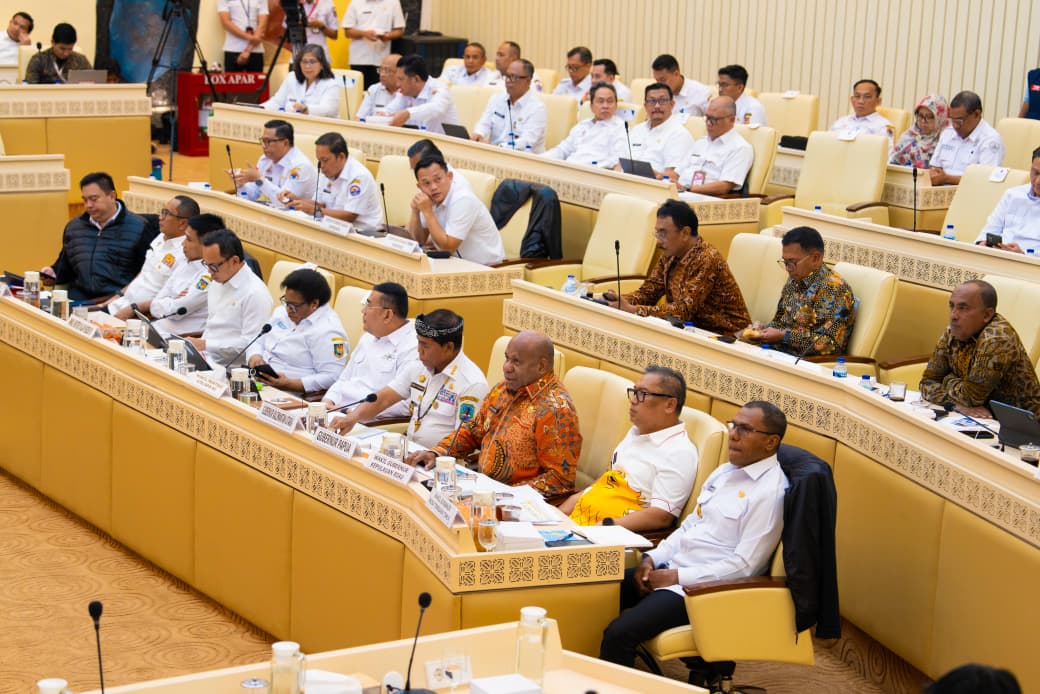
On 21 January 2026, in a working meeting with Commission II of the Indonesian House of Representatives in Jakarta, the Governor of Papua delivered a clear and assertive message. Papua’s border areas should no longer be treated as the far edge of the nation but repositioned as the front door of the Indonesian state. The proposal was presented as part of a broader discussion on governance, regional autonomy, and national border management, highlighting how Papua’s geographic position holds strategic importance for Indonesia’s sovereignty and future development.
The governor emphasized that border regions are not simply lines on a map. They are living spaces where citizens experience the presence of the state directly. When border areas lack infrastructure, services, and economic opportunities, the state feels distant. When borders are well managed, connected, and prosperous, they become symbols of national confidence and stability.
This perspective marked a shift from traditional approaches that focused primarily on security risks. Instead, the governor framed border development as a comprehensive agenda involving economic growth, social welfare, and diplomatic engagement with neighboring countries.
Reframing Papua’s Border Identity
For decades, Papua’s border regions with Papua New Guinea have been associated with isolation and limited access. Many villages remain difficult to reach, relying on basic transport routes and facing high costs for goods and services. These conditions have shaped public perceptions of the border as a vulnerable and neglected area.
During the meeting, the governor challenged this narrative. He argued that border areas should represent the state’s openness, strength, and commitment to its people. By calling them the front door of the country, he highlighted their symbolic role as the first impression of Indonesia for cross-border visitors and neighboring communities.
This reframing aligns with broader national efforts to strengthen border governance across Indonesia’s vast archipelago. The governor’s argument rested on the idea that dignity and prosperity in border communities reinforce national unity and reduce social and economic disparities.
Infrastructure as the Foundation of State Presence
Central to the governor’s proposal was the construction and strengthening of official border facilities. He proposed the development of additional state border crossing posts in land and maritime areas, particularly in Keerom Regency and Jayapura. These facilities would function as formal gateways for the movement of people and goods while also serving as centers for public services.
According to reports cited in national media, these border posts are expected to integrate immigration, customs, quarantine, and security services in one location. This integration aims to ensure that cross-border interactions occur through regulated channels, reducing informal crossings that often arise due to limited infrastructure.
Beyond border posts themselves, the governor stressed the importance of supporting infrastructure such as roads, ports, electricity, and telecommunications. Without these foundations, border facilities risk becoming symbolic structures without practical impact on daily life.
Economic Opportunities Along the Border
The governor stressed that boosting the economy along the border should go hand in hand with empowering the people who live there. These border regions have a lot to offer in terms of agriculture, fishing, trade, and small businesses. Better access and infrastructure could help local communities get more involved in the formal economy.
Cross-border trade with Papua New Guinea was singled out as a major opportunity. Communities on both sides of the border have always had strong social and economic connections. By making these interactions official and supporting them through legal trade, we could create jobs and also strengthen our relationship with Papua New Guinea.
The governor made it clear that any economic activity in these border areas needs to put local communities first. Development shouldn’t push out the people who already live there or hurt their traditional ways of making a living.
Instead, the focus should be on generating prospects that honor local customs while simultaneously incorporating communities into the wider national economic framework.
Six Strategic Issues Presented in Parliament
During the session with Commission II, the governor outlined six strategic concerns pertaining to border governance. These encompassed deficiencies in infrastructure, the need for improved coordination between central and regional governmental bodies, security management protocols, social welfare provisions, cross-border collaborative efforts, and the necessity for regulatory clarity.
A primary challenge highlighted was the issue of overlapping authority among various institutions. Border management necessitates the involvement of numerous ministries and agencies, frequently resulting in fragmented policy implementation. The governor advocated for the establishment of more explicit coordination mechanisms to ensure the alignment and efficacy of development initiatives.
Furthermore, the limited accessibility of public services in remote border regions was identified as a significant issue. Access to education and healthcare continues to be a challenge for a considerable portion of the population.
Filling these gaps is key to making sure border communities actually feel the state’s presence in a positive way.
Security through Development and Engagement
Security wasn’t just a standalone goal; it was seen as something that comes from development and engagement. The governor recognized the security problems in border areas, like illegal crossings and smuggling. But he also made the case that you can’t just rely on enforcement to fix these things.
When communities have jobs, education, and access to services, they’re less likely to get involved in illegal activities. Development, then, becomes a way to prevent security problems. This approach shows a bigger picture understanding: stability is built on trust and inclusion.
The governor also pointed to existing cooperation with Papua New Guinea, such as joint border patrols and dialogue forums.
Bolstering these systems can help clear up confusion and build stronger bonds of trust between the two nations.
Human Development at the Border
The governor prioritized human development, going beyond just infrastructure and security. He argued that border residents, like anyone else, are entitled to a good quality of life. He framed investments in education and healthcare as key elements of his vision for the border.
Schools in these areas frequently struggle with a lack of teachers and resources. Healthcare is also a challenge, with residents sometimes having to travel far for even basic medical attention. Tackling these problems demands consistent funding and incentives to draw professionals to these less accessible areas.
The governor made it clear: investing in people isn’t just the right thing to do; it’s smart strategy. Communities that are educated and healthy are simply better at driving economic growth and helping keep things stable in the region.
National Sovereignty and Symbolism
The border, seen as a nation’s front door, carries a lot of weight in terms of what it represents. It’s where a country shows its dedication to its own sovereignty and the integrity of its land. Borders that are well managed project a sense of confidence and order, both at home and abroad.
During the parliamentary debate, lawmakers recognized that ignoring the border areas could be seen as a sign of weakness. On the other hand, putting resources into border development sends a clear signal: the state values every inch of its territory.
This symbolism holds particular weight in Papua, where feelings of being left out have influenced political conversations. Bolstering border governance could help combat exclusionary narratives by showing a tangible state presence and concern.
Legislative Response and Support
Commission II members reacted favorably to the governor’s presentation. Several lawmakers concurred that border development should be a top priority and incorporated into national planning. They stressed the need for cooperation between central ministries and provincial governments.
The discussion highlighted the need to connect border development projects with Indonesia’s overall regional autonomy framework. Successful decentralization demands that provinces possess the resources and authority to tackle local issues while still supporting national goals.
Lawmakers stressed the importance of accountability and oversight to guarantee that the money earmarked for border development is spent wisely and openly.
Challenges Looming
Even with widespread backing, considerable hurdles persist. Border development initiatives demand considerable investment and a sustained effort. The unique geography of Papua drives up construction expenses and complicates logistics.
Better coordination between different agencies is crucial to prevent overlap and setbacks. Furthermore, involving the local community is vital to ensure development programs address their needs and build public confidence.
The governor recognized these difficulties, yet underscored that doing nothing would be even more expensive.
Neglecting border areas can easily lead to more inequality and unrest.
A Vision Built on Inclusion
The idea of making Papua’s borders Indonesia’s front door is fundamentally about inclusion. It’s about making sure people living on the fringes of the country feel like they’re part of the national story.
By putting money into infrastructure, services, and economic chances, the government can turn border regions into places people are proud of, not places of neglect. This will take time, money, and a steady commitment from leaders.
The governor’s message in Jakarta was straightforward: Papua’s borders are not a problem.
These initiatives present an avenue for illustrating the potential for concurrent advancement in development, sovereignty, and human dignity.
Looking Ahead
The realization of this vision hinges on the sustained commitment of both the provincial government and national legislators. Policies must be effectively implemented, and these actions must yield demonstrable benefits for the communities situated along the border.
Should it be executed successfully, Papua’s border development strategy could become a precedent for other remote areas within Indonesia. It has the potential to reshape the perception of borders, transforming them from mere divisions into zones of interaction.
Consequently, the concept of transforming the border into the nation’s front door transcends mere rhetoric. It embodies a declaration of Indonesia’s self-perception and its chosen approach to its citizens and its Pacific neighbors.

