
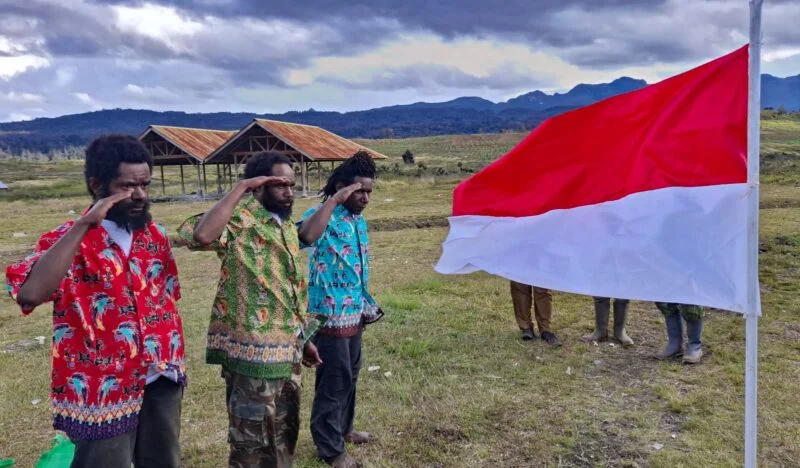
In the remote highlands of Puncak Regency, Papua, a modest ceremony recently carried a message far beyond its immediate surroundings. On 19 January 2026, Three former members of the Free Papua Organization, commonly known as Organisasi Papua Merdeka (OPM), publicly declared their loyalty to the Government of Indonesia and rejected separatist ideology. The event took place in front of community leaders, religious figures, local residents, and representatives of state institutions. While the gathering was simple in form, its implications resonate deeply within ongoing discussions about peace, stability, and development in Papua.
According to reports from multiple Indonesian media outlets, the three men had previously been affiliated with armed separatist groups, West Papua National Liberation Army (Tentara Pembebasan Nasional Papua Barat, or TPNPB) operating in the Sinak area of Puncak. Their decision to return to the framework of the Indonesian state was formalized through a pledge of loyalty to the Unitary State of the Republic of Indonesia and an explicit rejection of any form of separatist struggle. This moment marked a personal turning point for the individuals involved and offered a broader signal regarding the changing relevance of separatism in contemporary Papua.
The Puncak region has a long history of being a hotspot for armed separatist movements. The area’s challenging geography, coupled with its underdeveloped infrastructure and a legacy of historical grievances, has made it a prime location for groups seeking to break away from Indonesia. For decades, the presence of armed groups has upended everyday life, limiting movement and stalling progress in the region.
The three former OPM members who took the pledge were once part of this ongoing situation. Their involvement in separatist activities put them in direct conflict with the government, effectively cutting them off from the normalcy of civilian life. Living in the mountains, always on the run, and constantly under the strain of conflict, their existence was defined by insecurity and unpredictability. Media accounts suggest that these circumstances often place a significant strain not just on the fighters themselves, but also on their families and the communities they belong to.
Grasping this context is key to understanding why they acted as they did. Their return wasn’t just a political maneuver; it was a profoundly human decision, shaped by what they’d experienced, what they’d thought about, and the shifting realities they faced.
The Pledge Ceremony
The pledge ceremony itself was both formal and intimate. Each of the three former OPM members stood before witnesses and read a statement pledging their allegiance to Indonesia. They affirmed their dedication to Pancasila, the national ideology, and to the Indonesian Constitution. They also made it clear that they rejected separatism and were prepared to live peacefully as citizens of Indonesia.
Witnesses reported that the ceremony included prayers led by religious leaders, underscoring themes of reconciliation, forgiveness, and a shared future.
Local elders, as moral witnesses, underscored the event’s communal spirit. For many, witnessing familiar faces abandon armed conflict in favor of peace was a deeply felt and encouraging sight.
Security force representatives were there, not to impose but to observe. Their presence was described as supportive, mirroring an emphasis on persuasion and conversation over force. This setting fostered the impression that the commitment was freely given and genuine.
Personal Reflections and Motivations
The statements from former OPM members indicate that their choice was influenced by personal contemplation and a longing for a more secure existence. The constant threat of violence and the absence of essential services had taken their toll.
The men, it seems, longed to be with their families, to work, and to be part of their communities, free from the threat of violence.
This isn’t a surprising sentiment for those leaving armed groups. The initial allure of a separatist cause frequently gives way to the harsh truths of a drawn-out conflict: little progress and the suffering of ordinary people. For these three, the road to reconciliation presented a chance to start anew and make a positive impact.
Their words also reflected a concern for the future. By renouncing violence, they expressed a hope that younger Papuans wouldn’t have to endure the same struggles and instability.
The Role of a Human-Centered Approach
Media reports indicate this didn’t happen in a vacuum.
The outcome stemmed from a consistent effort by state institutions, all centered on people. Instead of just focusing on security measures, the authorities blended dialogue, community engagement, and guarantees of safety for those who chose to abandon armed groups.
This strategy acknowledges that the conflict in Papua can’t be solved with force alone. Building trust, honoring local traditions, and involving community leaders are all vital for paving the way toward reconciliation. The presence of elders and religious leaders at the ceremony highlighted the significance of local credibility in these peace initiatives.
Those involved in the process emphasized that reintegration isn’t the final step; it’s just the start. Supporting former fighters means ensuring their safety, helping them find work, and easing their acceptance back into the community. These actions are designed to stop a return to violence and foster lasting stability.
Community Response and Social Impact
The local community’s reaction was mostly favorable. Residents voiced their hope that the area’s cycle of violence could finally start to diminish. For those who’ve endured fear and upheaval, even modest progress toward peace can significantly affect their mental well-being.
Community leaders highlighted that reconciliation fosters social unity. When former combatants reintegrate peacefully, it eases strain and enables villages to concentrate on common objectives like education, healthcare, and economic development. The ceremony was viewed as a chance to mend relationships frayed by years of strife.
Yet, leaders also recognized that rebuilding trust is a gradual process.
The integration of former combatants necessitates transparent dialogue and sustained dedication from all involved. Consequently, the public announcement of the pledge was significant, as it signaled both accountability and openness.
Separatism’s waning influence is evident in the actions of the three former OPM members, a development that has been broadly interpreted as indicative of a decline in its appeal among certain Papuan populations. Although separatist viewpoints persist, especially within international advocacy circles, the practical realities are more nuanced.
A growing number of Papuans are prioritizing pragmatic issues, including access to education, healthcare, infrastructure, and economic prospects. For these communities, prolonged conflict presents minimal advantages and considerable disadvantages. The reintegration of former separatists into civilian life implies that the prospect of armed struggle no longer resonates with the ambitions of individuals desiring stability and advancement.
This does not imply that all grievances have been fully addressed. Governance, inequality, and historical injustices continue to be integral to Papua’s ongoing discussions. Nevertheless, the decision to pursue these issues through peaceful and constitutional channels signifies a departure from violence as a preferred method of resolution.
Implications for Peace and Development
From a wider viewpoint, this commitment holds significant implications for peace-building initiatives within Papua. Each individual who disengages from armed conflict diminishes the potential for violence and fosters an environment conducive to dialogue. Such occurrences can initiate a positive feedback loop, thereby prompting others to reconsider their participation in separatist endeavors.
Peace and development are inherently interconnected.
Without security, development projects often falter. But, on the flip side, genuine development can help tackle some of the underlying issues that fuel conflict. When former combatants are successfully reintegrated, it fosters a safer setting where schools can function, healthcare can improve, and businesses can thrive.
Both government officials and community leaders have emphasized that peace needs to be paired with inclusive development. Building infrastructure, providing social services, and implementing economic programs are all vital to making sure that reconciliation leads to real, positive changes in people’s everyday lives.
A Message Beyond Puncak
Though the ceremony was held in a specific place, its significance reaches far beyond Puncak Regency. It presents a different perspective, countering the idea that separatism reflects the unified desires of all Papuans.
Instead, it emphasizes the multiplicity of viewpoints and the capacity of individuals to prioritize peace over discord.
For domestic audiences, the occurrence underscores the efficacy of dialogue and human-centric policies. Conversely, for international observers, it serves as a case study of the evolution of conflict dynamics and the influence of local decisions on wider political landscapes.
Crucially, the former OPM members did not characterize their return as a capitulation; rather, they presented it as a deliberate choice for a more promising future. This particular framing is significant, as it upholds dignity and motivates others to pursue analogous paths, free from the apprehension of disgrace or retaliation.
Looking Ahead
The reintegration of three former OPM members into the Indonesian state does not, however, resolve the ongoing challenges confronting Papua. Nevertheless, it constitutes a significant stride toward diminishing violence and fostering social cohesion.
Each act of reconciliation fosters a climate conducive to peace, thereby challenging the perception that armed separatism represents the sole viable course of action.
The continuation of this advancement necessitates sustained dedication from all involved parties. Governmental bodies bear the responsibility of ensuring the fulfillment of commitments regarding support and inclusivity. Communities must remain receptive to reconciliation efforts while simultaneously addressing historical grievances. Furthermore, former combatants require assistance as they navigate their transition to civilian life.
Ultimately, the occurrence in Puncak underscores the principle that peace is constructed through individual decisions. When individuals prioritize dialogue over violence and embrace unity over division, they actively shape the trajectory of their communities. Consequently, the commitment of these three former OPM members serves as both a personal achievement and a wider emblem of optimism for a more peaceful Papua.

