As December settles in across Papua—from the swaying palms of coastal villages to the mist-shrouded peaks of the central highlands—a quiet but urgent mission unfolds. For families scattered across remote valleys, highland ridges, and vast jungle corridors, the looming Christmas and New Year celebrations carry more than festive promise. They stir unease: will there be rice on the table? Will prices soar as demand rises?
This year, thanks to a determined push by Perum Bulog (Bulog)—backed by the national security forces and local governments—many Papuans may find reassurance instead of anxiety. As of early December 2025, stockpiles are in place, trucks and boats are rolling, and planes are ready to descend on remote airstrips. It’s a campaign of hope, necessity, and commitment.
The High Stakes of Rice in Papua
In Papua, rice is more than a staple food: it is a symbol of stability. In much of Indonesia, markets bustle, roads link cities, and supply chains are predictable. In Papua, landscapes are challenging, distances vast, and access—often seasonal and weather-dependent. In remote highlands and island communities, transporting even modest amounts of food can feel like moving mountains.
Every year, as the holidays approach—known locally as “Nataru” (Natal and Tahun Baru, Christmas and New Year)—demand rises. Families plan feasts; traveling home becomes more common; budgets tighten. In such conditions, sudden shortages or price spikes can cause real hardship. For households living on modest incomes, the difference between a full meal and going hungry can depend on whether rice makes it to their village on time.
For this reason, ensuring steady supply and fair pricing is not just an economic concern—it is a matter of dignity and social stability. Recognizing this, Bulog launched a major operation in Papua to bridge supply, access, and affordability—with a scale and urgency rarely seen before.
Mobilizing Food Security: Bulog’s SPHP Mission
At the heart of the effort lies Bulog’s flagship intervention: the SPHP—the “Stabilisasi Pasokan dan Harga Pangan” (Food Supply and Price Stabilization) program. Through SPHP, subsidized rice is delivered across remote and underserved regions, aiming to stabilize both the supply and price of staple food ahead of high-demand periods.
In Papua, the urgency is clear. According to the head of Bulog’s regional office in Papua, Ahmad Mustari, as of early December 2025, the agency had secured 24,158 tons of rice in warehouses across the region, with an additional 5,135 tons still en route.
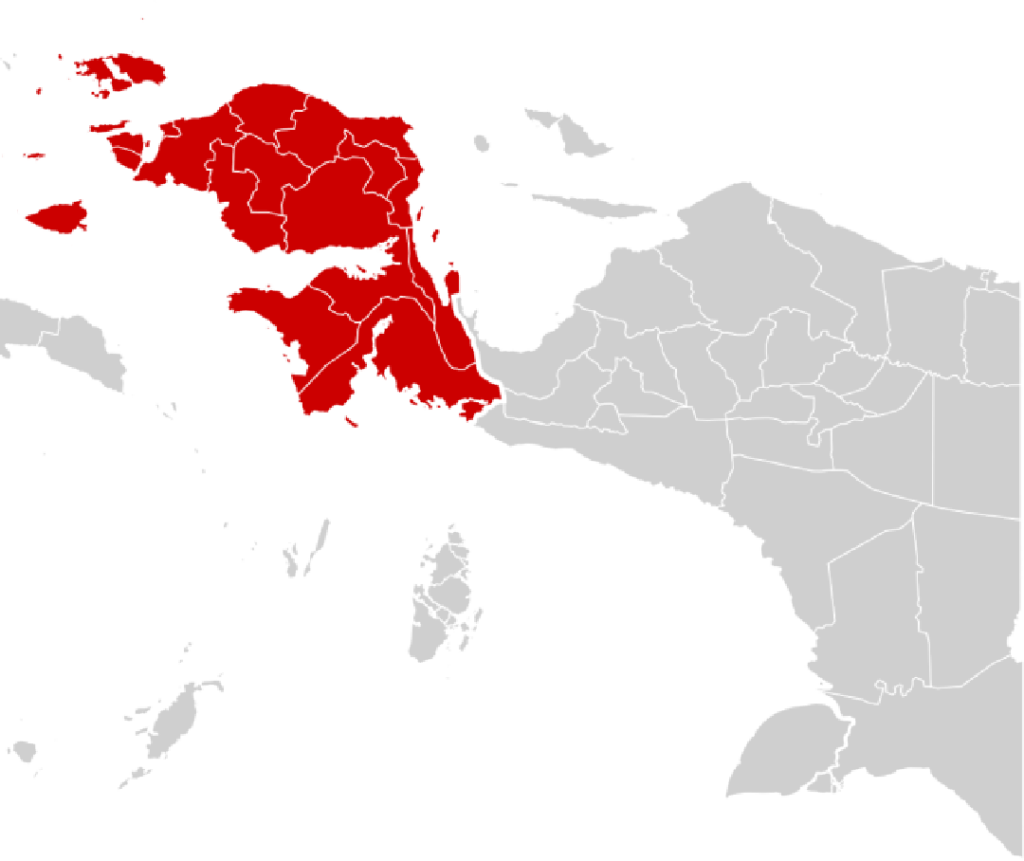
This stock covers the six provinces of “Tanah ”Papua”—encompassing over 40 regencies and cities. With that, Bulog says the supply is sufficient to meet needs through the Christmas–New Year period.
But this isn’t a case of warehouse-to-market complacency. Bulog is actively distributing—and quickly—especially to the most remote, hardest-to-reach areas. On 8 December 2025, the agency reported sending SPHP rice to four remote highland regencies: Pegunungan Bintang, Nduga, Yahukimo, and Intan Jaya, plus one in central Papua.
Remarkably, some of these areas had seldom—or never—received subsidized rice deliveries before. In Pegunungan Bintang, for example, SPHP rice had to traverse a mix of air, river, and land—sometimes taking weeks to arrive.
Overcoming Papua’s Rugged Geography: Air, River, Land—Whatever It Takes
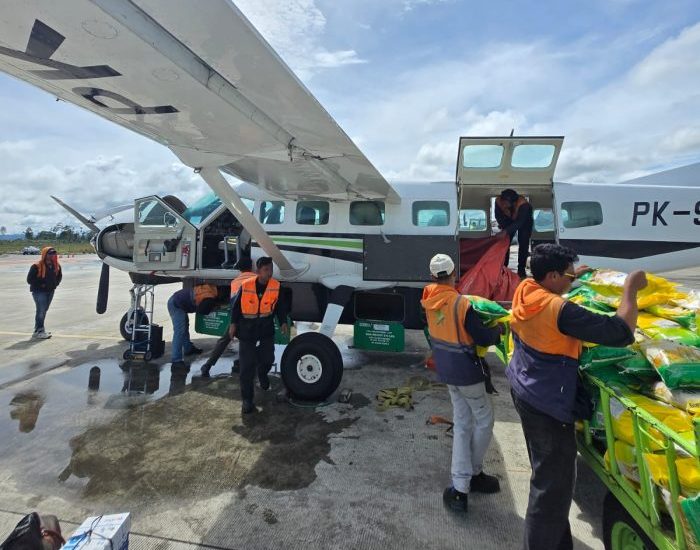
What makes this operation extraordinary is how it confronts Papua’s notorious logistical challenges head-on. Where roads don’t exist or are unreliable, Bulog is using air transport. Where rivers thread through dense jungle, river barges and boats become supply lines. Where land access remains possible, trucks roll—often escorted for safety and smooth passage.
In some highland districts, this might be the first time subsidized rice arrives before the holidays. In one documented shipment, villagers in Sugapa (Intan Jaya) received five tons of SPHP rice—a significant quantity for a small, remote regency. Another drop of 1.2 tons reached Ilaga in Kabupaten Puncak.
To manage these complicated routes and ensure safety, Bulog collaborates closely with Polda Papua (Papua Regional Police) and, when needed, local units of the national military (TNI). The rice is first stored at local police warehouses, then distributed to communities under controlled supervision—a step intended to prevent diversion, hoarding, or black-market resale.
Because transport to such remote places can be prohibitively expensive—sometimes costing more per kilogram than the rice itself—Bulog has committed to bearing all shipping costs. The aim: keep the final price to consumers uniform, fair, and predictable.
Thus, even in the most isolated regions of Papua, people can buy SPHP rice at the same price: Rp13,500–13,600 per kilogram (or about Rp67,500 for a 5 kg bag).
Early Distributions: From Symbolic Acts to Real Impact
Signs of progress appeared early. On 6 November 2025, Polda Papua and Bulog launched a symbolic distribution of 165 tons of SPHP rice, covering three provinces: Papua, South Papua, and Papua Highlands (Pegunungan).
Out of that, 95 tons went to Papua Province itself, with distribution handled via local police units, trucks, and regional logistic chains reaching district-level drop-offs.
That initial effort was not just a show of goodwill—it was a deliberate test case to ensure Bulog’s system could handle the diverse terrain, varied logistic requirements, and complex coordination among stakeholders. As Commissioner I Gde Era Adhinata of Polda Papua said at the time, this is “not only law enforcement, but also support for community welfare and economic stability.”
Since then, deliveries have scaled up rapidly. By early December, Bulog reported having over 24,000 tons in stock (with more on the way), enough to cover not just average demand but also a significant margin of safety.
Security, Oversight, and Equal Access: More Than Just Logistics
This is not simply a distribution campaign—it is a test of governance, coordination, and reliability. To that end, the involvement of police and military—not to impose force, but to ensure fairness, oversight, and accountability—is central.
Every bag of SPHP rice distributed is tracked. Shipments are stored in police-managed warehouses before delivery; final recipients buy at regulated prices. If rice is sold above the mandated ceiling, residents are encouraged to report the violation to their local police station or food-security task force.
For many remote communities, this is new: a transparent, state-backed route that not only ensures supply but also gives people the power to safeguard their own access.
By shouldering transport costs, Bulog removes a barrier that for years kept some regions chronically undersupplied. By using multiple modes of transport—air, river, and land—they acknowledge and adapt to the reality on the ground. And by partnering with security forces and local governments, they build a distribution network rooted in trust and accountability.
People Behind the Numbers: Faces, Hopes, and Relief
Picture a mother in a small highland village—perhaps in Pegunungan Bintang—gathering her children around the hearth as night falls. The cost of rice, in previous years, meant that sometimes the holiday meal was sparse, or delayed, or worse: skipped.
Now imagine a truck bumping along a rough dirt track, arriving at a small police warehouse hours before midnight; officers unload sacks of rice, carefully record them, and then distribute them to villagers. Each 5-kg bag is going to a family—not sold at inflated black-market rates, but at the same fixed price as in Jakarta or Surabaya.
For many of those families, this holiday season may bring more than decorations and songs—it may bring dignity, food on the table, and a fragile but real sense of stability and inclusion.
Local officials, too, can breathe easier. Because stock is secured, distribution planned, and price controlled, they can focus on other needs: preparing community celebrations, coordinating local transport, and ensuring that other essential items—cooking oil and sugar—are similarly stocked and distributed. As noted by authorities, rice isn’t the only priority: essential goods like cooking oil are also being planned for distribution to Papua ahead of Nataru.
Looking Ahead: Building a Long-Term Safety Net, Not Just a Christmas Stopgap
The current push is not framed as a one-off seasonal operation but as part of a growing commitment to food security and equitable access across Indonesia’s easternmost frontier. Bulog’s regional leaders emphasize that this supply program is part of a broader long-term plan: to build infrastructure, strengthen supply chains, and ensure fairness regardless of geography.
With warehouses now stocked, logistics chains underway, and security-backed delivery systems engaged, the foundation is being laid for more than just holiday-season adequacy. The hope—quietly shared by villagers, community leaders, and Bulog staff—is for lasting improvement: regular access to staple foods, stable prices, and reduced disparity between Papua and more developed parts of Indonesia.
If this succeeds, the 2025 Nataru season may well be remembered as the turning point—when remote villages, long overshadowed by isolation and logistic hurdles, finally felt the reach of the national food safety net.
Challenges Remain—But So Does Determination
Despite the encouraging developments, the mission is not without risks. Papua’s geography is unforgiving. Heavy rains, landslides, swollen rivers, unpredictable weather—any of these can derail a shipment, delay a convoy, or cut off a route entirely. Air transport helps, but it too depends on weather, airstrip condition, and aircraft availability.
There’s also the human factor: ensuring that distribution remains fair, that price controls are enforced, and that no diversion or leakage happens. The burden of oversight falls partly on local communities—not just on government agencies.
Moreover, demand during holidays can be volatile. If stock runs low or distribution lags, sudden price spikes may follow—especially in remote areas where black-market trade thrives. It will take vigilance, community trust, and disciplined coordination to prevent that.
Yet, what stands out in this story is not fear but resolve. The combination of institutional will, logistical planning, cross-agency cooperation, and community-level accountability marks this as more than a typical relief campaign.
Conclusion
As Christmas lights begin to flicker across towns and villages in Papua, and families prepare for festive meals, there is reason for cautious optimism. Through Bulog’s SPHP program, backed by the coordination of police, TNI, local governments, and community stakeholders, rice—the humble staple—may finally reach even the farthest corners of Tanah Papua.
For many Papuans, this year’s Nataru may not just be about celebration: it may be about relief. Relief from scarcity, relief from inflated prices, relief from uncertainty. For a mother in a highland village, or a father navigating jungle roads to buy food for his family, this can mean dignity restored, hunger avoided, and hope renewed.
If the distribution succeeds—if logistics hold, oversight works, and people trust the system—this may be more than a holiday success story. It may be a foundation for equitable food security, for social inclusion, for a future where geography does not decide who gets to eat.
In that, Bulog’s effort is humble but powerful. And in Papua—for a season at least—rice may once again mean stability, not struggle.