
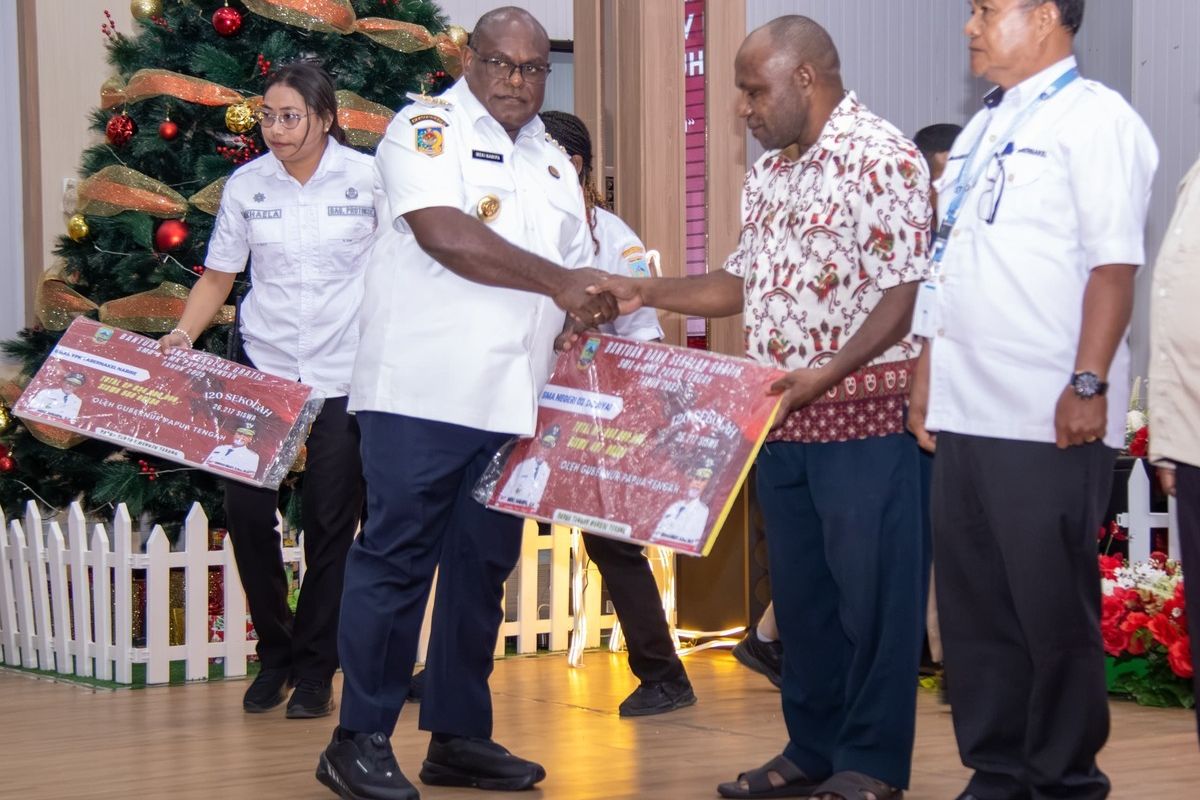
On December 3, 2025, as the rainy season deepened across the lush valleys and rugged highlands of Papua Tengah (Central Papua), a story of hope quietly began to take shape. It did not emerge from political conflict, a security operation, or a dramatic disaster response—events that often dominate news from the region. Instead, it grew from schoolyards, government meetings, and community gatherings where one message echoed with unusual clarity: education must be free, and every child deserves a fair chance.
This message carried the weight of a transformative policy. The Papua Tengah Provincial Government, under Governor Meki Nawipa, announced a funding initiative of Rp 90 billion to guarantee free education for more than 26,000 students. It was a bold decision, especially for a province still consolidating its administrative structures and facing multiple development challenges. But as details of the program became public, one thing was undeniable: this was not simply a budgetary announcement. It was an intentional choice to rewrite the province’s future.
The story of this policy is not just the story of money. It is the story of a government attempting to confront long-standing inequalities, of schools that have struggled in silence, of parents who have carried too much burden for too long, and of children who now see a path extending beyond the limits of their circumstances.
A Province at a Crossroads
Papua Tengah, like many regions in the broader island, has lived through complex histories—marked by geographical isolation, limited infrastructure, education gaps, and disparities that widen as one moves farther from urban centers like Nabire or Mimika. For decades, families in remote communities have made difficult decisions: whether to prioritize food or education, whether to send one child to school and keep another home, whether to give up schooling entirely when fees, uniforms, books, or transport costs became unbearable.
Teachers and church leaders have long spoken of classrooms where students arrived without notebooks or pencils. School heads have juggled inconsistent operational funds. Parents have improvised—cutting expenses, selling small goods, or relying on extended family support—to make sure their children stayed in class. Many couldn’t.
When the provincial government declared that no child would be left behind due to economic hardship, the announcement struck a deep emotional chord. It symbolized a turning point—an acknowledgment that the province’s greatest resource is not its land, nor its minerals, but its children.
The Moment the Policy Shift Became Real
Governor Meki Nawipa’s public announcement of the program did more than outline numbers. It expressed urgency. It reflected the recognition that the province must invest in its young generation if it hopes to build capable future administrators, teachers, health workers, and community leaders.
Local media from Kompas to Tribun Papua Tengah carried the news with a tone of optimism. Parents shared relief that their children’s schooling would no longer be threatened by unpredictable expenses. Teachers described the policy as a “lifeline” for schools that had repeatedly struggled with insufficient budgets. Government officials, meanwhile, expressed pride in what they framed as one of the most significant social investments ever undertaken by the newly established province.
The Rp 90 billion allocation was not merely symbolic. Funds were quickly transferred to schools. District governments received clear instructions. And most crucially, children who had been uncertain about returning to school in the new academic year suddenly found the doors wide open.
A Story of Children Who Can Now Dream Differently
In conversations across the province—whether in Timika’s coastal suburbs, the busy streets of Nabire, or the quiet highland villages around Deiyai and Dogiyai—parents repeatedly expressed the same sentiment: “We can breathe easier.”
For many families, school-related expenses have historically been unpredictable. Even small costs—such as activity fees, uniform replacements, or mandatory contributions—were enough to force children out of school, especially in households where income is unstable or heavily dependent on agriculture, seasonal work, or mining-related informal labor.
A mother in Paniai told a reporter that she had already prepared herself to withdraw one of her children from school due to rising living expenses. “Now,” she said, “maybe all my children can finish high school.” In her voice was not just relief, but something even more powerful—hope.
Teachers, too, speak of the shift. They describe students returning to class with renewed energy. They note that attendance has increased in several districts. School heads report that they can plan programs without wondering whether operational funds will arrive late, or whether small repairs must be postponed indefinitely.
This renewed sense of possibility is perhaps the greatest success of the free-education initiative so far. It is reshaping not just the logistics of schooling, but the emotional landscape of families and communities.
The Integrity Challenge and a Governor’s Firm Warning
Yet the government knows that even good policies can falter if weakly implemented. Governor Nawipa addressed this concern directly and firmly: school heads must manage funds with honesty.
In the past, some schools across Papua have struggled with issues of transparency—whether due to administrative weakness, lack of oversight, or intentional misuse of funds. The free-education initiative, involving tens of billions of rupiah, demands oversight at a scale not previously attempted.
For this reason, the provincial government announced the deployment of monitoring teams tasked with visiting schools across the province—checking documentation, verifying attendance data, reviewing spending, and gathering community feedback. Their mandate is simple: ensure that no public fund meant for children is diverted, delayed, or misused.
It is a message that resonates deeply in Papuan communities, where integrity from public institutions is not only expected but demanded. The government’s readiness to send auditors, enforce discipline, and hold school leaders accountable reflects a larger cultural shift in public governance.
A Policy That Becomes a Larger Vision
Beyond immediate relief and administrative oversight, the free-education program is part of a broader developmental vision. Papua Tengah is a new province—one still building its institutions, workforce, and leadership structures. This makes the question of human capital not just important but urgent. Without a generation prepared to navigate the complexities of modern governance, the province risks remaining perpetually dependent on external expertise.
The education initiative, therefore, is not an isolated program. It is a foundation.
Provincial planners envision a future where children who benefit from free education today will become the province’s future policymakers, engineers, economists, healthcare professionals, and teachers. They imagine a workforce built from within, capable of managing local industries, designing long-term development plans, and engaging confidently on national and regional platforms.
Education is not only a social policy—it is a political investment in the province’s autonomy and stability.
The Road Ahead: Challenges That Must Be Faced
Despite the enormous potential of the initiative, the road ahead is not free of obstacles. Some districts remain extremely difficult to access, especially during the rainy season. Monitoring teams will struggle to reach certain schools. Infrastructure gaps—particularly in remote highlands—continue to hinder the learning process. Internet access remains limited. Many schools still face shortages of teachers, classrooms, and basic facilities.
Financial sustainability is another major question. The province must secure reliable revenue streams to ensure that free education does not become vulnerable to budget cuts or political shifts. Without long-term funding stability, progress could stall.
Yet these challenges do not diminish the power of the moment. They simply highlight the need for continued commitment, careful planning, and community participation. If the province can sustain the effort, the long-term rewards will far outweigh the obstacles.
Conclusion
As December unfolds and schools prepare for the new academic year, the impact of the free-education initiative is already visible across the province. It appears in the voices of parents who speak with confidence about their children’s future. It appears in the smiles of students arriving at school without fear of being sent home for unpaid fees. It appears in the determination of teachers who feel supported by the government for the first time in years.
It appears, too, in the broader narrative of Papua Tengah—a province often underestimated, now shaping a story of empowerment through policy.
In the years to come, the success of this initiative will be measured not only by how many children complete school, but by how many find opportunities once beyond it; by how many grow into leaders who carry the memory of a government that believed in them early on.
The Rp 90 billion investment may not solve all of Papua Tengah’s development challenges. But it undeniably marks a profound shift: an investment in dignity, equality, and the long-term wellbeing of a generation.
For 26,000 children, this policy is more than a government program.
It is the beginning of a different future.

