
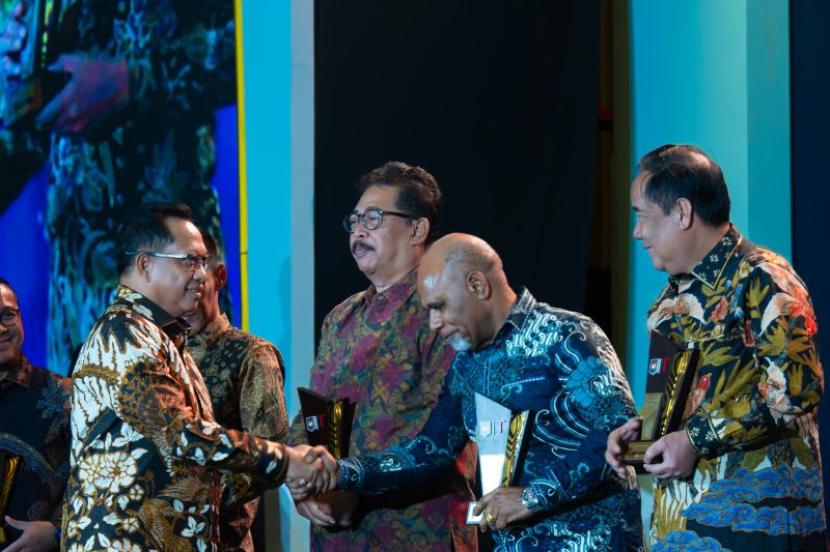
When Papua Tengah (Central Papua) Province was officially formed in late 2022, few imagined that within just three years it would stand on a national stage, receiving a prestigious award from Indonesia’s Ministry of Home Affairs for its success in reducing community inequality despite limited fiscal capacity. The recognition—part of the 2025 Regional Government Performance Awards—did more than honor a young administration. It signaled the beginning of a new narrative emerging from Indonesia’s easternmost lands: that a province once defined by geographical isolation and uneven development could reimagine its trajectory through disciplined management, inclusive policies, and a sustained focus on equity.
This is the story of how Papua Tengah, one of Indonesia’s youngest administrative regions, managed to rise quickly in the national landscape, proving that determined local governance can overcome structural disadvantages. It is also the story of the people who shaped this transformation—leaders, communities, and grassroots actors who believed that prosperity must not remain concentrated in urban pockets but must reach every valley, village, and indigenous community across the province.
A Province Born From Decades of Aspiration
Papua Tengah (Papua Tengah) is not merely a new administrative unit. It is the product of long-standing demands for more accessible services, more responsive government, and more balanced development across the mountainous interior of Papua. The province covers districts such as Puncak, Paniai, Dogiyai, Nabire, Deiyai, Intan Jaya, and Mimika—regions with diverse social landscapes, challenging geography, and decades of development gaps.
When the province was inaugurated in 2022, its government faced an uphill task. There were no fully established bureaucratic structures, limited fiscal resources, and high public expectations. Infrastructure was sparse. Many communities lived far from health clinics, markets, or administrative centers. Median incomes varied widely between districts. Indigenous communities remained vulnerable to social disparities.
Yet Governor Meki Fritz Nawipa and her administration set out with a simple but powerful commitment: Papua Tengah would be built with fairness at its core. No community would be left behind. No district would be overshadowed by another. And no citizen—especially indigenous Papuans—would be denied access to basic services.
This principle would later become the backbone of the province’s performance—and the foundation of its national recognition.
Building Institutions From the Ground Up
The first challenge after the province’s formation was institutional. Papua Tengah needed functioning governance: a provincial secretariat, regional agencies, planning systems, budget processes, service offices, civil servant structures, and oversight mechanisms. Establishing a new government while simultaneously delivering services required extraordinary coordination.
Yet by 2023, the province had formed its core administrative institutions. By 2024, these institutions were fully operational. The provincial government implemented:
- a new development planning framework aligned with the Ministry of Home Affairs’ performance indicators
- fiscal mechanisms emphasizing transparency and efficiency
- a data-driven approach to identifying inequality hotspots
- collaborative planning with districts to avoid overlapping programs
- inclusive policymaking involving indigenous councils, churches, women’s groups, and youth representatives
This institutional groundwork enabled the province not only to function but also to perform.
Choosing Equity as the First Battlefield
Many new provinces focus on large-scale symbolic projects in their early years. Papua Tengah intentionally did the opposite. Its leaders recognized that uneven development—seen in gaps in education, health access, infrastructure, and income—posed the greatest long-term threat to stability and well-being. The administration therefore prioritized:
- Equal distribution of basic services
Health outreach was extended to remote villages. Education support programs targeted areas with low school attendance. Routine monitoring ensured districts with higher vulnerability received a greater share of resources.
- Fair budget allocation
Despite having low fiscal capacity, the province implemented a formula ensuring that poorer districts received proportional support, preventing the concentration of funds in urban areas like Nabire or Mimika.
- Infrastructure that connects communities
Rather than focusing on grand projects, the province invested in strategic roads, early-stage connectivity, and community facilities that immediately improved access.
- Social stability and conflict mitigation
Local leaders, cultural figures, and churches partnered with the government to reduce social tensions, promote dialogue, and strengthen social safeguards for vulnerable groups.
By 2024, signs of change were evident: improved access to healthcare, more equitable distribution of development programs, and narrowing gaps in service availability between highland and lowland districts.
The Ministry’s Recognition: What It Means, and Why It Matters
In early 2025, the Ministry of Home Affairs released its evaluation of regional government performance. Papua Tengah emerged as a standout among Indonesia’s youngest provinces. It earned a top award specifically for
“Reducing social inequality in areas with low fiscal capacity.”
This category is critical because it highlights not only the province’s achievements but also the challenges it had to overcome. Provinces with low fiscal capacity often struggle to improve public services, let alone reduce inequality. Yet Papua Tengah exceeded expectations by:
- efficiently utilizing limited budgets
- aligning development priorities with inequality indicators
- implementing people-centered, measurable programs
- ensuring balanced resource distribution across districts
The ministry emphasized that Papua Tengah’s progress was exceptional for such a newly established province. Media reports—from Antara News, Tribun Papua Tengah, and Republika—echoed this sentiment, noting that the award underscored strong governance, disciplined execution, and genuine commitment to equity.
Voices From the Province: A Leadership Committed to Fairness
Vice Governor Deinas Geley, responding to the award, noted that the recognition was not simply a governmental victory. It was a testament to “the collective effort of all stakeholders and communities who believed in the province’s vision of fairness.” The award, he added, should strengthen the resolve to continue expanding access, reducing disparities, and ensuring that indigenous Papuans benefit fully from the region’s growth.
“For us,” he emphasized, “this award is a reminder that equitable development is not just a policy—it is a moral responsibility.”
Local communities also expressed pride. For many, this was the first time their province had been acknowledged nationally for progress rather than challenges. The award was seen as a validation of their resilience, their participation in development programs, and their trust in the new provincial administration.
On the Ground: How Policies Translated Into Real Impact
Awards only matter if the benefits are tangible. In Papua Tengah, residents are already beginning to feel the difference.
- Better Access to Health Services
Mobile health teams now reach districts where clinics were once days away. Basic supplies—from vaccines to maternal health support—are more consistently available.
- Education Programs Reaching Remote Children
Scholarships, school equipment distribution, and teacher deployment have expanded opportunities for children in mountainous regions.
- Economic Programs Supporting Grassroots Communities
Micro-business support, agricultural assistance, and market access initiatives have helped families improve income stability.
- Public Service Presence Strengthened in Remote Areas
Government representatives now regularly visit highland districts to engage with communities, collect data, and address grievances—an essential practice for inclusive governance.
These cumulative improvements contributed to measurable declines in inequality indicators, convincing national evaluators that Papua Tengah deserved recognition.
Challenges Still Ahead
Despite Papua Tengah’s recent achievements, the province still confronts significant challenges that will shape its long-term development journey. The region’s rugged and isolated terrain continues to complicate infrastructure projects, slowing efforts to connect remote communities and deliver essential services. Fiscal resources remain vulnerable to national budget fluctuations, creating uncertainty for multi-year programs and development planning. At the same time, the limited availability of skilled professionals—especially in fields such as health, education, engineering, and public administration—places pressure on provincial institutions that are still growing. Deep-rooted social disparities within indigenous communities also require sustained attention, demanding policies that are not only inclusive but also culturally responsive. Perhaps the most long-term challenge is the task of building a strong administrative culture and restoring full public trust in government institutions. Yet, despite these obstacles, Papua Tengah has demonstrated that meaningful progress is achievable when priorities are clearly defined and policies are executed with discipline and integrity.
A Province Setting the Standard for New Regions
Papua Tengah’s recognition matters not only to itself but to Indonesia more broadly. As other new provinces in Papua—such as South Papua and Southwest Papua—continue developing, Papua Tengah’s early success serves as a blueprint for effective governance in newly formed regions.
The message is simple:
With the right focus, even low-funded regions can reduce inequality and uplift communities.
Conclusion
Papua Tengah’s journey from a newly formed province in 2022 to an award-winning model of equitable development in 2025 is a narrative of determination, leadership, and community collaboration. It demonstrates that meaningful change does not always require large budgets—it requires intention, accountability, and a commitment to ensuring that every citizen, regardless of geography or background, has equal access to opportunity.
The Ministry’s award is not the culmination of Papua Tengah’s story but the beginning of a long, hopeful chapter—one where fairness guides policy, where indigenous voices shape development, and where a young province continues to rise as a beacon of balanced growth in Indonesia’s eastern frontier.

