
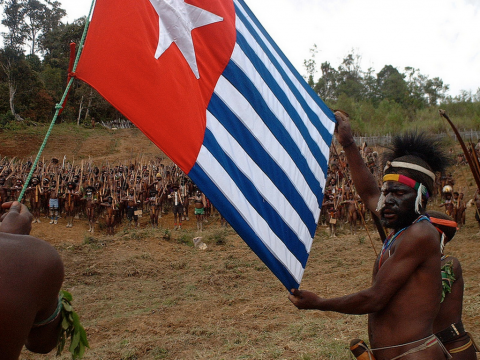
Every 1 December, whispers, rumors, and tension quietly resurface across Papua. For some, the date carries symbolic weight—a vestige of a colonial past, repurposed by those calling for independence. For others, it represents something deeply emotional and divisive, a date better left unmarked. In recent years, a growing number of Papuan voices have rejected 1 December as a “Papua Independence Day,” framing it instead as a historical misunderstanding—or worse, a provocation.
This shift matters. It speaks of identity, of belonging, and of a collective choice: whether to define Papua by separation or unity, division or peace.
The Historical Origins: Why 1 December Is Misunderstood
On 1 December 1961, under Dutch colonial administration over what was then called Netherlands New Guinea, a ceremony was held in which the colonial authorities permitted a local Papuan council (Nieuw Guinea Raad) to raise the “Morning Star” flag (Bintang Kejora) and recognize a local anthem. This event has been invoked by some as a “declaration of independence”—but historians and many Papuans argue the characterization is misleading.
As described in a recent article, that date was part of a broader Dutch-led decolonization plan, not a transition to sovereignty. The colonial government did not proclaim a Papuan state; neither was there a constitution, a recognized government, nor any international recognition. The flag and anthem were at best symbolic gestures by a colonial power trying to manage its retreat—not endorsements of a free and independent Papua.
In other words, 1 December 1961 is not legally or historically equivalent to a nation-state’s independence day. There is no formal proclamation, no internationally recognized sovereign status, and no treaty or document that could legitimize such a claim.
This fundamental gap between symbolic colonial-era occasions and established statehood underlies much of the current rejection of 1 December as an “independence day.”
Memory, Myth, and Manipulation: How Symbolism Became Political
Over time, the interpretation of December 1 changed—it moved from a colonial-era administrative maneuver to a rallying cry of separatist aspirations. Groups advocating for Papuan independence—including armed, political, and diaspora entities—began treating the date as a foundational moment: the birth of a Papuan nation.
Yet even among separatist circles, the narrative is contested. According to publicly available records of one such group, the Organisasi Papua Merdeka (Free Papua Organizations, OPM) and United Liberation Movement for West Papua (ULMWP), the group considers 1 December 1963 (not 1961) as its own founding date—highlighting a divergence even among pro-independence actors regarding what 1 December actually commemorates.
Still, the symbol of the Morning Star flag and the invocation of 1 December have been used to rally support, especially abroad—often framed as a fight against “Indonesian occupation,” rather than as a nuanced historical debate. As a result, 1 December has become more than history: it has become a tool of politics, identity, and contention.
Papuan Rejection: Voices Calling for Clarity and Peace
In recent years, media across Papua and Indonesia have echoed what many Papuans increasingly feel: 1 December should not be celebrated as independence day. A recent piece titled “Why 1 December is Not Papua’s Independence Day: Facts Often Misunderstood” argues directly that the date stems from colonial decolonization efforts—not from the legitimate birth of an independent nation.
Scholars from local institutions, such as one lecturer at the Universitas Cenderawasih, have reinforced the view that no credible document marks 1 December 1961 as a proclamation of statehood. The raising of the Morning Star flag was a colonial concession, not an acknowledgement of sovereignty.
For these voices, continuing to treat 1 December as a day of national independence for Papua skirts dangerously close to historical distortion, political agitation, and social provocation.
Many Papuans emphasize that their future lies not in symbolic gestures or separatist fantasies, but in cooperation, integration, and peace within the larger archipelago. They argue that what matters most is quality of life, development, mutual respect, and unity under the Republic of Indonesia.
The Stakes Are Real: Unity, Identity, and Stability
Rejecting 1 December as a Papuan national day is not just about correcting history—it is about safeguarding social harmony, ensuring security, and building collective identity.
In recent decades, separatist mobilization tied to symbolic dates has often triggered heightened security operations, crackdowns, and unrest. The rise in conflict and tragic episodes—such as the infamous PT. Istaka Karya’s 19 civilian workers massacre by OPM on December 1-2, 2018 in Nduga Regency and conflict among Indonesia’s government and OPM—casts a long shadow on any attempt to revive divisive symbolism.
For many Papuans, the emphasis is shifting from identity politics to concrete well-being: infrastructure, education, health, and opportunity. They see value in being recognized as full Indonesians—while preserving cultural distinctiveness—rather than being locked in perpetual conflict over contested status.
Moreover, embracing Indonesia’s territorial integrity does not necessarily mean erasing Papuan identity. Rather, it can be an affirmation that Papua belongs within a pluralistic nation-state—a place where Papuan cultures, languages, and traditions coexist with other Indonesian identities under one flag.
A Growing Consensus: Clarity Over Propaganda, Peace Over Provocation
The increasing use of historical-legal arguments against the celebration of 1 December suggests a growing consensus: many Papuans want clarity and closure. They ask for truth—not myth; recognition—not fragmentation; unity—not division.
This does not erase grievances, injustices, or the need for meaningful autonomy. But it reframes the path forward: not through symbolic defiance or polarizing anniversaries—but through dialogue, policy, development, and integration.
Rejecting the politicization of 1 December does not deny Papuan identity. On the contrary—it asserts Papuan identity as part of the broader Indonesian mosaic, with dignity, resilience, and hope.
In that sense, the refusal to celebrate 1 December as an “independence day” becomes a statement of maturity: a rejection of divisive provocations, a demand for honest history, and a commitment to a shared future.
Conclusion
As 1 December approaches each year, some will mark the date quietly—if at all. Others will ignore it altogether. And among Papuans today, more voices are likely to follow this path: not drawn by the pull of separatist nostalgia, but guided by a desire for unity, peace, and progress.
History, as taught by colonial record and scholarly consensus, indicates that 1 December 1961 was not a declaration of Papuan sovereignty. For many Papuans, that is reason enough to reject its celebration as an independence day. Beyond that—among those who remain in Papua, who raise children in its villages and towns, who look to the future—the greater aspiration is not for independence, but for dignity: dignity within a united Indonesia, respect for Papuan identity, and a future built in peace.
What 1 December truly represents, then, is not the start of a free Papua. It is a reminder of colonial legacy, contested memory, and the choices that lie ahead. And increasingly, Papuan voices are choosing to leave the shadows of the past behind in favor of a tomorrow defined by unity, belonging, and hope.

